 November 2024 in “Benha Journal of Applied Sciences”
 In this study, the researchers explored how the loss of structural integrity in hair follicles due to reduced α-SMA expression in the vertex area may contribute to androgenetic alopecia.
 December 2016 in “British Journal of Dermatology”
 The meeting highlighted the importance of genetic testing and multidisciplinary approaches in pediatric dermatology.
 May 2017 in “bioRxiv (Cold Spring Harbor Laboratory)”
 This study found that the peach gene CTG134, involved in auxin-ethylene interactions, plays a role in hormonal regulation during root hair formation in Arabidopsis and tobacco.
January 2006 in “Chinese Journal of Dermatology” This study observed that amelanotic melanocytes from human hair follicles appeared morphologically immature, suggesting they might not transfer melanosomes into keratinocytes.
January 2003 in “Linchuang pifuke zazhi” This study used atomic force microscopy to image surface structures of human epidermal melanocytes, hair follicle amelanotic melanocytes, and mouse melanoma cells, revealing differences in branch structure and granule distribution.
3 citations
,
December 1975 in “PubMed” This study found that acid and alkaline phosphatases serve different functions in Beagle dog skin, with ALP primarily involved in growth processes and ACP in phospholipid breakdown.
 6 citations
,
January 1985 in “ACTA HISTOCHEMICA ET CYTOCHEMICA”
6 citations
,
January 1985 in “ACTA HISTOCHEMICA ET CYTOCHEMICA” This study found that epithelial components of calcifying epithelioma of Malherbe showed lectin binding and keratin staining patterns similar to normal hair follicles, with prominent Con A staining in tumor giant cells.
 April 2016 in “Journal of Investigative Dermatology”
 In this study, ALP knockdown significantly impaired the hair follicle-inducing capacity of human dermal papilla spheres, highlighting a critical role for ALP in hair follicle neogenesis.
34 citations
,
January 1998 in “Archiv für Pathologische Anatomie und Physiologie und für Klinische Medicin” This report describes four trichoblastoma cases rich in Merkel cells, suggesting these tumors may mimic fetal skin development where Merkel cells are numerous.
27 citations
,
December 2005 in “Journal of Cutaneous Pathology” This study found that while malignant pilomatricomas maintain some keratin expression patterns seen in benign counterparts, they notably express additional epithelial keratins, potentially influencing tumor calcification.
9 citations
,
January 2011 in “American Journal of Dermatopathology” This study investigated pilomatrixoma, a benign skin tumor, and found that irregular expression of β-catenin and Lef-1 in transitional cells may contribute to amorphous debris and cyst formation.
 April 2019 in “Journal of Investigative Dermatology”
 This study reported that gain-of-function mutations in TRPV3 lead to hair loss in mice by disrupting inner root sheath keratinocyte differentiation, ultimately causing follicular keratinocyte stem cell exhaustion and permanent follicle disruption.
12 citations
,
January 1991 in “Acta Dermato Venereologica” The researchers reported that BCE-like changes overlying dermatofibroma show a differentiation pattern most similar to normal basal cells based on specific keratin markers.
49 citations
,
July 2006 in “British Journal of Dermatology” This study observed that calcifying epithelioma of Malherbe is composed of tumor cells that differentiate into both hair cortex and outer root sheath, supporting its hair follicle origin.
8 citations
,
August 1987 in “The Journal of Dermatology” This study reports that the monoclonal antibody BKN-1 specifically stained basal cell epithelioma cells and certain normal skin structures, indicating a similarity in keratin expression between the tumor and follicular epithelium below the isthmus portion.
January 2005 in “Australian viticulture” This study found that different bovine epithelial tissues express varying types of cytokeratins, with hair follicle and nasolabial gland expressing both acidic and basic types, while others express only one or the other.

In this study, researchers explored the heterogeneity of pigment cells in the human scalp anagen hair follicle bulb and discovered unexpected subpopulations of melanocytes, including immature SOX10-negative cells, highlighting potential non-melanogenic roles or transitional migratory functions that require further investigation.
86 citations
,
August 2000 in “Pigment cell research” This study observed that melanogenesis in human hair follicles is linked to anagen phases, with melanocyte activity and enzyme expression being region-specific to the nascent bulb.
1 citations
,
April 2012 in “Cancer Research” This study found that overexpression of antizyme in MEK-activated transgenic mice reduced skin tumor development and restored normal differentiation of keratinocyte progenitor cells, highlighting the role of polyamines in keratinocyte biology.
20 citations
,
December 2010 in “Journal of Morphology” In this study, researchers found that alpha-keratin homologs similar to those in mammalian hair are present in the claws of the lizard Anolis carolinensis, suggesting a structural role during claw formation.
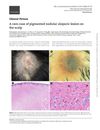
This study reported the case of a 30-year-old man with a bluish-grey scalp nodule that developed over a previously stable hairless plaque, revealing histopathological features consistent with epithelioid cell nests and spindle-shaped dermal melanocytes embedded in collagen.
2 citations
,
September 1978 in “Anatomia Histologia Embryologia” This study observed that alkaline phosphatase activity in dog hair follicles varied with hair cycle stages, displaying weak to negative reactions in the anagen stage, positive reactions in catagen, and strong positivity in telogen.
35 citations
,
September 2006 in “American Journal Of Pathology” In this study, researchers found that overexpression of the Hedgehog signaling effector Gli2 in mice led to odontogenic keratocysts development, implicating GLI transcription factors in human keratocyst pathogenesis.
47 citations
,
April 1978 in “Journal of Cutaneous Pathology” This study found that basal cell epithelioma resembles fetal primary epithelial germ based on specific cellular characteristics.
1 citations
,
January 1989 This study produced and characterized four new monoclonal antibodies that specifically recognize differentiation antigens in human hair follicle and epidermal structures.
38 citations
,
April 2016 in “The Journal of Pathology” This study found that mice lacking alkaline ceramidase 1 with elevated skin ceramide levels showed disrupted skin homeostasis, including altered hair follicle structures, increased water loss, and a hypermetabolism phenotype.
42 citations
,
August 2008 in “Stem Cells and Development” This study found that mesenchymal cells from adult mouse whisker follicles differentiated into odontoblast-like cells, demonstrating odontogenic potential in a specialized microenvironment both in vitro and in vivo.
December 2022 in “Laboratory Animal Research” This study described two cases of trichoblastomas in the tactile hair skin of aged house musk shrews, highlighting that their histological structure differs from that in humans and other animals.
This study found that onychomatricoma can fully mimic the nail unit and differentiate toward the nail bed and isthmus, distinguishing it from other pilar tumors.
39 citations
,
February 2011 in “American Journal of Dermatopathology” This study shows for the first time that onychomatricoma can recapitulate the entire nail unit with differentiation toward the nail bed and isthmus, identifying new histopathological and immunohistochemical features.