 326 citations
,
February 2009 in “The American journal of pathology”
326 citations
,
February 2009 in “The American journal of pathology” This review discusses the role of Lgr5 as a marker for identifying adult stem cells, particularly in the intestine and hair follicles, and reports no clinical results.
293 citations
,
September 2004 in “Development” This study found that WNT signaling is essential for the initiation of mammary gland morphogenesis in embryonic mice, promoting placode development and potentially playing a critical role in skin appendage formation.
 271 citations
,
March 1999 in “Developmental biology”
271 citations
,
March 1999 in “Developmental biology” This study reveals that overexpression of Wnt3 in transgenic mouse skin leads to a short-hair phenotype and cyclical balding due to structural defects in hair shafts, highlighting a role for WNT signaling in hair growth regulation.
 260 citations
,
December 2012 in “Cold Spring Harbor Perspectives in Biology”
260 citations
,
December 2012 in “Cold Spring Harbor Perspectives in Biology” This review discusses the significant role of Wnt signaling in skin development, homeostasis, and disease, highlighting recent advances in understanding its diverse functions, but reports no new experimental results.
245 citations
,
April 2009 in “Circulation Research” This study found that human fetal CD133+ progenitor cells and their conditioned medium accelerated wound healing and promoted angiogenesis in a mouse model of ischemic diabetic ulcers through paracrine mechanisms involving Wnt signaling.
 232 citations
,
June 2012 in “Cold Spring Harbor Perspectives in Biology”
232 citations
,
June 2012 in “Cold Spring Harbor Perspectives in Biology” This review summarizes the roles of Wnt signaling in wound healing but presents no new clinical findings, suggesting potential for Wnt-based therapies to enhance tissue regeneration.
176 citations
,
January 2013 in “Proceedings of the National Academy of Sciences” This study reveals an antagonistic competition between BMP and Wnt signaling within stem cells, influencing their fate towards hair germ characteristics based on the BMP/Wnt activity ratio.
159 citations
,
January 2006 in “BMC Cell Biology” This study found that manipulating Wnt signaling pathways in cutaneous wounds can induce skin structures resembling regeneration, suggesting a potential role for Wnt signals in restoring skin architecture during wound healing.
 144 citations
,
August 2019 in “Cells”
144 citations
,
August 2019 in “Cells” This review discusses the WNT signaling pathway's involvement in human diseases and highlights recent advances in WNT-related treatments, but it presents no new research findings.
 137 citations
,
September 2005 in “Proceedings of the National Academy of Sciences of the United States of America”
137 citations
,
September 2005 in “Proceedings of the National Academy of Sciences of the United States of America” In this study, researchers found that transgenic expression of the Hairless gene in keratinocytes can restore hair follicle regeneration in Hr-deficient mice by repressing Wise, a modulator of Wnt signaling.
 136 citations
,
May 2019 in “Cells”
136 citations
,
May 2019 in “Cells” This review discusses the advancements in intraoperative stem cell therapies and highlights their potential to improve hair regrowth, but it reports no new clinical results.
117 citations
,
April 2008 in “Developmental biology” This study identified that Eda-A1 unexpectedly induces placode inhibitors dkk4 and lrp4, indicating the importance of tightly regulated signaling for proper ectodermal organ development.
 113 citations
,
June 2015 in “Stem Cell Research & Therapy”
113 citations
,
June 2015 in “Stem Cell Research & Therapy” This study found that activation or inhibition of Wnt/β-catenin and Notch signaling pathways in rats can alter wound healing, possibly by affecting epidermal stem cell activity and keratinocyte behavior.
105 citations
,
October 2017 in “Stem cells” This review discusses Wnt signaling pathways in skin development and stem cell regulation, highlighting potential interactions with other pathways but reports no new findings.
96 citations
,
March 2007 in “Developmental biology” This study found that the Wnt inhibitor Dkk4 may play a role in regulating hair follicle development through a feedback loop with canonical Wnt signaling pathways.
 95 citations
,
January 2012 in “British Journal of Dermatology”
95 citations
,
January 2012 in “British Journal of Dermatology” This study found that androgens inhibit hair follicle stem cell differentiation by disrupting the Wnt signalling pathway in dermal papilla cells, but Wnt activation can restore differentiation.
91 citations
,
December 2019 in “The EMBO Journal” This study found that the E3 ligases NEDD4 and NEDD4L regulate intestinal stem cell priming by degrading the LGR5 receptor, and their loss leads to increased Wnt activation and crypt proliferation, which in turn accelerates intestinal tumor progression in mice.
 91 citations
,
December 2010 in “Stem Cells”
91 citations
,
December 2010 in “Stem Cells” This study found that Wnt signaling regulates the symmetric division of adult neural stem cells, increasing their numbers during subependymal regeneration, stroke response, and colony formation.
 84 citations
,
October 2014 in “PLoS Genetics”
84 citations
,
October 2014 in “PLoS Genetics” This study found that epidermal Wnt production is crucial for forming the skin's spinous layer through a BMP-FGF signaling cascade, although Wnt from basal cells is not needed for their differentiation.
74 citations
,
January 2014 in “Journal of Investigative Dermatology” High kallistatin levels in diabetics worsen wound healing by blocking important cell signals.
 74 citations
,
January 2013 in “Journal of Investigative Dermatology”
74 citations
,
January 2013 in “Journal of Investigative Dermatology” Four genetic risk spots found for hair loss, with WNT signaling involved and a link to curly hair.
 74 citations
,
September 2006 in “Cell Cycle”
74 citations
,
September 2006 in “Cell Cycle” This review examines the role of Hairless, a nuclear receptor corepressor, in regulating Wnt signaling during hair cycling and reports no new clinical results.
 72 citations
,
April 2008 in “Organogenesis”
72 citations
,
April 2008 in “Organogenesis” This review discusses the roles of Wnt signaling in skin organogenesis and related processes but reports no new experimental results, highlighting areas for future research.
 70 citations
,
January 2009 in “The Journal of clinical endocrinology and metabolism/Journal of clinical endocrinology & metabolism”
70 citations
,
January 2009 in “The Journal of clinical endocrinology and metabolism/Journal of clinical endocrinology & metabolism” This study explored the interaction between androgen and Wnt signaling in dermal papilla cells, targeting the effects of androgen on hair growth reduction.
 66 citations
,
July 2015 in “Organogenesis”
66 citations
,
July 2015 in “Organogenesis” This review summarizes recent findings on how Wnt signaling proteins play crucial roles in the cutaneous wound healing process but reports no new clinical results.
 61 citations
,
October 2013 in “PLoS ONE”
61 citations
,
October 2013 in “PLoS ONE” This study found that amplifying Wnt signaling, either genetically or through topical application of liposomal Wnt3a, improved skin wound healing in a mouse model.
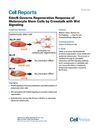 59 citations
,
April 2016 in “Cell Reports”
59 citations
,
April 2016 in “Cell Reports” This study demonstrated that EdnrB signaling promotes melanocyte stem cell proliferation and differentiation, enhancing hair and epidermal melanocyte regeneration, especially under conditions of active Wnt signaling.
 59 citations
,
November 2010 in “Circulation Research”
59 citations
,
November 2010 in “Circulation Research” This review discusses the potential role of Wnt signaling in aging-related heart diseases and reports no clinical results.
 56 citations
,
February 2010 in “PLOS ONE”
56 citations
,
February 2010 in “PLOS ONE” This study demonstrates that canonical Wnt signaling is crucial for maintaining thymic epithelial microenvironments in postnatal thymus, possibly by affecting TEC progenitor cells.
 54 citations
,
April 2019 in “Journal of cellular physiology”
54 citations
,
April 2019 in “Journal of cellular physiology” In this study, miR-218-5p was found to enhance hair shaft growth and positively regulate the Wnt signaling pathway by targeting SFRP2 during skin and hair follicle development.