 April 2023 in “International journal of dermatology and venereology”
 This study observed distinct dermoscopic features in pityriasis versicolor that could aid in its differentiation from similar skin disorders.
February 2026 in “Revista Saber Digital” In this case report, researchers described a German Spitz dog with alopecia X, emphasizing successful hair regrowth with deslorelin treatment, highlighting its efficacy as a therapeutic option and the necessity for accurate diagnosis in veterinary dermatology.

This study reviews existing literature on regenerative therapy for androgenetic alopecia, highlighting that integrating growth factors, biotin, D-pantenol, and other active ingredients using the Vittahair protocol may enhance hair follicle regeneration, increase hair density, and improve hair quality, providing a precise and evidence-based treatment alternative.
 April 2017 in “Australasian Journal of Dermatology”
 Different skin conditions show distinct types of vessel inflammation, a new quality of life index for vulval disease is reliable, a certain intrauterine system might be linked to chronic vaginal yeast infections, and oral minoxidil reduces hair loss in women.
 4 citations
,
September 2024 in “BMC Cancer”
4 citations
,
September 2024 in “BMC Cancer” In this prospective phase II clinical trial, researchers are investigating whether adding dutasteride to combined androgen blockade can improve the response rate and clinical outcomes for patients with androgen receptor-positive recurrent or metastatic salivary duct carcinoma.
 November 2023 in “The Bovine practitioner”
 In this study, a 5-year-old Angus bull experienced systemic granulomatous disease and vasculitis potentially associated with grazing on hairy vetch, but other bulls in the same pasture showed no symptoms, suggesting variability in disease manifestation from similar exposures.
January 2022 in “Galicia Clínica” This report documents a rare case of alopecia universalis in an HIV-positive patient in Portugal, highlighting the changing comorbidity spectrum in this population due to increased life expectancy from antiretroviral therapy.
5 citations
,
July 1996 in “Journal of Cutaneous Medicine and Surgery” This study explains that while trichothiodystrophy and xeroderma pigmentosum share genetic defects, TTD patients primarily exhibit issues in transcription initiation, not the increased skin cancer risk seen in XP.
November 2024 in “Journal of Investigative Dermatology” This study identified PTEN as a key regulator in non-healing venous leg ulcers, suppressing immune responses and lymphangiogenesis, suggesting its potential as a therapeutic target for promoting VLU healing.
 March 2023 in “Photodiagnosis and Photodynamic Therapy”
 This study found that vitamin D levels were lower in alopecia areata patients, with trichoscopic features like broken hairs and black dots more prevalent in cases with vitamin D deficiency.
 2 citations
,
January 2019 in “Springer eBooks”
2 citations
,
January 2019 in “Springer eBooks” This review discusses segmental vitiligo as part of the vitiligo clinical spectrum and highlights its role as a model for studying repigmentation, but reports no new clinical results.
1 citations
,
November 2006 in “Medicina de Familia SEMERGEN”  April 2026 in “International Journal of Engineering Research and Science & Technology”
 This study introduced the Vitamin Deficiency Detection System, which helps users identify potential vitamin deficiencies by analyzing symptoms they select on a user-friendly interface.
 May 2024 in “Rossijskaâ oftalʹmologiâ onlajn”
 In this case report, a 17-year-old Korean female with Vogt–Koyanagi–Harada syndrome showed positive improvement in her symptoms following systemic glucocorticosteroid pulse therapy, highlighting the rarity and importance of early disease detection.
September 2025 in “JUKEJ Jurnal Kesehatan Jompa” This study found that 20% mung bean seed coat extract effectively stimulates hair growth in New Zealand White rabbits, demonstrating results close to minoxidil 2% in terms of hair length, weight, and growth area, suggesting its potential as a natural alternative for hair loss therapy.
 March 2014 in “Journal of The American Academy of Dermatology”
 Reflectance confocal microscopy can noninvasively diagnose onychomatricoma by showing unique features different from healthy nails or nail fungus.
 510 citations
,
August 2006 in “Endocrinology”
510 citations
,
August 2006 in “Endocrinology” This minireview discusses a proposed model of the vitamin D receptor that explains how 1alpha,25(OH)2D3 can mediate both genomic and rapid responses through different ligand shapes and cellular locations, without presenting new research findings.
 April 2023 in “Neurology”
 This study examined treatments for emesis in young Alexander disease patients, finding that 95% responded positively to valproic acid, which was more effective than anti-reflux medications or cyproheptadine, though some adverse effects require monitoring.
April 2017 in “Journal of Investigative Dermatology” This study found that lymphatic vessels promote hair follicle growth in mice, suggesting new therapeutic strategies for hair loss treatments.
February 2025 in “Journal of the European Academy of Dermatology and Venereology” This study found that ultraviolet-induced fluorescence dermoscopy enhanced the identification of follicular openings in alopecia areata, potentially aiding in the assessment of disease severity and treatment strategies.
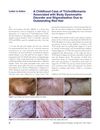 1 citations
,
January 2013 in “International Journal of Trichology”
1 citations
,
January 2013 in “International Journal of Trichology” A girl with red hair developed hair-pulling and body image disorders after being bullied for her hair color.
11 citations
,
November 2021 in “JBMR plus” This review discusses the role of the unliganded vitamin D receptor in hair follicle cycling and tumor formation in mice and reports no new experimental findings.
62 citations
,
January 2009 in “Biochemistry” This study found that both the natural ligand 1alpha,25(OH)(2)D(3) and the synthetic agonist LG190178 bind similarly to the vitamin D receptor's coregulator motifs, suggesting similar biological functions.
 March 2026 in “Biomedicines”
 This study found that the Antera 3D® system provided an objective and sensitive method for assessing pediatric pathological scars, capturing significant changes in pigmentation, vascularity, and volume, compared to the traditional Vancouver Scar Scale and dermoscopy, which showed varied sensitivities across different scar parameters.
10 citations
,
January 2012 in “Case reports in medicine” This report describes two cases where patients developed vitiligo as a side effect of diphencyprone treatment for alopecia areata, highlighting the need to inform patients about this potential adverse effect.

This study found significant cephalometric changes in patients with skeletal Class III malocclusion treated with rapid maxillary expansion and reverse traction, demonstrating maxilla advancement and improved facial convexity.
 June 2015 in “Reactions Weekly”
 A man developed alopecia areata after starting cancer treatment with vandetanib.
January 2020 in “JAAD case reports” This article reviews current understanding of frontal fibrosing alopecia and lichen planopilaris, highlighting increasing incidence and unclear pathogenesis, and emphasizes the role of inflammatory destruction of hair follicular stem cells; it reports no new clinical findings.
6 citations
,
January 2020 in “Open Journal of Psychiatry” This study concludes that the Greek version of the Dysmorphic Concern Questionnaire is a reliable and valid tool for assessing body dysmorphic disorder-related concerns in both research and clinical settings.
August 2020 in “European Journal of Dermatology” This study identified three EDAR gene variants potentially linked to hypohidrotic ectodermal dysplasia in three Pakistani families, which could aid in genetic counseling for similar cases.