 23 citations
,
November 2014 in “Anais Brasileiros de Dermatologia”
23 citations
,
November 2014 in “Anais Brasileiros de Dermatologia” This study suggests that trichoscopy may assist in diagnosing pemphigus, particularly for scalp-specific lesions, by identifying certain characteristic features.
 26 citations
,
December 1981 in “British journal of dermatology/British journal of dermatology, Supplement”
26 citations
,
December 1981 in “British journal of dermatology/British journal of dermatology, Supplement” This study observed that most hirsute patients on combined cyproterone acetate and 'Diane' therapy experienced a reduction in hair growth, with hair becoming softer, thinner, and lighter in color over 12 months.
21 citations
,
January 2000 in “Fetal Diagnosis and Therapy” This study found that trichothiodystrophy can be diagnosed prenatally in the second trimester using an endoscopically-guided fetal eyebrow biopsy, with sulfur content analysis being the most reliable test.
December 2025 in “International Journal of Cosmetic Science” A new tool helps better assess and treat hair loss in Chinese men.
 May 2026 in “Journal of Cutaneous and Aesthetic Surgery”
 This study observed that following hair transplantation, patients exhibited prominent perifollicular erythema and scaling one month after surgery, whereas by six months, accentuated follicular ostia and varying hair shaft abnormalities were consistently noted.
7 citations
,
March 2004 in “Journal of the American Academy of Dermatology” Tiger tail banding and hair abnormalities are reliable indicators for diagnosing trichothiodystrophy.
4 citations
,
January 2018 in “Indian dermatology online journal” This case report found that dermoscopy, showing characteristic "comma" and "corkscrew" hairs, effectively identified tinea capitis in a 7-year-old girl, allowing for early treatment before confirmation with fungal culture.
 5 citations
,
January 2022 in “Journal of Clinical Medicine”
5 citations
,
January 2022 in “Journal of Clinical Medicine” This study observed that videodermoscopic assessments of dermatomyositis patients revealed specific vascular and pigmentary features, suggesting it may be useful for preliminary diagnosis.
This pilot study found that Optical Coherence Tomography can non-invasively resolve hair follicle density and hair shaft and follicle diameters in patients at varying stages of hair loss.
9 citations
,
March 2005 in “International Journal of Cosmetic Science” This study found that torsional measurements can effectively distinguish the effects of hair care products on the cuticle versus the cortex of hair fibers, unlike tensile measurements.
 1 citations
,
June 2020 in “IP Indian journal of clinical and experimental dermatology”
1 citations
,
June 2020 in “IP Indian journal of clinical and experimental dermatology” This study found that yellow dots were the most common trichoscopic finding in adult patients with alopecia areata, observed in 88.5% of cases.
 89 citations
,
March 2018 in “The Journal of Dermatology”
89 citations
,
March 2018 in “The Journal of Dermatology” This review presents various trichoscopic findings for diagnosing alopecia areata but reports no new clinical results, emphasizing that no single marker is pathognomonic and multiple features should be considered together.
 1 citations
,
June 2022 in “Journal of The American Academy of Dermatology”
1 citations
,
June 2022 in “Journal of The American Academy of Dermatology” Combining scalp photos with hair density and caliber measurements gives a more accurate assessment of hair loss.
23 citations
,
January 2008 in “Skin Pharmacology and Physiology” This study demonstrated that optical coherence tomography effectively detects significant changes in hair structure caused by steroid treatment, suggesting its potential use in doping control and clinical therapy monitoring.
2 citations
,
January 2023 in “Skin Appendage Disorders” In this study, chemotherapy-induced alopecia in cancer patients showed specific trichoscopic patterns and abnormal hair shaft morphology, suggesting intermittent follicle damage from chemotherapy, but larger studies are needed for confirmation.
 March 2025 in “Forum Dermatologicum”
 This case report highlights the importance of trichoscopy in diagnosing fibrosing alopecia in pattern distribution, distinguishing it from female pattern hair loss, and guiding effective treatment.
 41 citations
,
December 2008 in “International Journal of Dermatology”
41 citations
,
December 2008 in “International Journal of Dermatology” This study observed that hair density and thickness were significantly reduced across multiple scalp sites in South Korean women with hair loss, highlighting potential patterns that could aid in differentiating hair disorders.
 September 2022 in “bioRxiv (Cold Spring Harbor Laboratory)”
 This study applied a new RGB trichrome stain to human skin samples, revealing distinct structural staining in normal tissues and potential proteoglycan-rich zones in hair follicles.
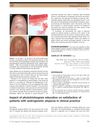 July 2014 in “Journal of Dermatology”
 This article discusses phototrichogram education and patient satisfaction in androgenetic alopecia but reports no new clinical findings.
2 citations
,
June 2001 in “Medical Electron Microscopy” This study observed that the keratinization pattern of trichilemmal cysts in two Japanese women may originate from the proliferation of the outer root sheath in the follicular isthmus of anagen hairs.
 1 citations
,
January 2021 in “Dermatologic Therapy”
1 citations
,
January 2021 in “Dermatologic Therapy” In this study, the TRICHOBIOLIGHT protocol showed effectiveness in treating androgenetic alopecia and telogen effluvium, with 82.5% of 103 patients experiencing excellent to good outcomes after mesotherapy and LED photobiostimulation on the scalp.
This case report highlights the clinical and trichoscopic diagnosis of congenital triangular alopecia in a 9-month-old boy and notes the condition's typical unresponsiveness to traditional treatments.
 April 2016 in “Journal of The American Academy of Dermatology”
 The study found that Temporal Triangular Alopecia often starts in early childhood, mainly affects the left side of the scalp, and has no effective treatment except surgery.
 September 1998 in “Journal of The European Academy of Dermatology and Venereology”
 Phototrichogram helps assess hair loss severity.
 4 citations
,
June 2021 in “Scientific Reports”
4 citations
,
June 2021 in “Scientific Reports” This study found that examining hair morphology provides deeper insights than classification, suggesting a potential population stratification artefact between hair curvature and cross-sectional shapes in the examined admixed African-European sample.
6 citations
,
January 2010 in “PubMed” This study found that psoriasis patients with scalp involvement had a significantly lower anagen ratio and higher telogen ratio compared to healthy individuals, indicating an association with an increased telogen/anagen ratio.
4 citations
,
September 1993 in “Steroids” This paper details a method for measuring testosterone metabolism into seven androgens using digital autoradiography, which offers high sensitivity and reduces the need for radioactive materials.
 33 citations
,
March 2006 in “Seminars in cutaneous medicine and surgery”
33 citations
,
March 2006 in “Seminars in cutaneous medicine and surgery” This article illustrates various hair shaft defects and suggests that dermatologists can diagnose most of them using light microscopy and polarization without needing advanced imaging techniques.
 July 2018 in “Journal of The American Academy of Dermatology”
 This article discusses current visualization methods for assessing hair restoration therapy responses, noting imprecision in triangulated measurements and patient dissatisfaction with visible tattoos.
 November 2008 in “Medical & surgical dermatology”
 This study reports that a prototype device may accurately measure changes in hair quantity, diameter, and density in patients with balding by assessing the cross-sectional area of hair bundles.