 August 2023 in “Asian journal of pharmaceutical and clinical research”
 This descriptive longitudinal study conducted in a Kolkata hospital found that intense pulsed light treatment significantly improved hirsutism in patients, as evaluated by trichoscopy and visual analog scores, demonstrating its effectiveness and safety for hair removal, independent of medical treatment.
 July 2023 in “Portuguese journal of dermatology and venereology”
 This study describes a rare case of a 9-year-old boy with simultaneous alopecia areata and trichotillomania, diagnosed through clinical history and trichoscopy, highlighting the complexity of pediatric hair loss caused by psychological and immune factors.
 July 2023 in “Journal of the European Academy of Dermatology and Venereology”
 This review in JEADV highlights the systemic causes of hair loss, emphasizing the psychosocial impact of androgenetic alopecia and exploring post-COVID-19 telogen effluvium, while also addressing the treatment safety and challenges in alopecia areata management.
July 2023 in “International Journal of Rheumatic Diseases” This case report described a woman in her 40s with ulcerative scalp sarcoidosis presenting in atypical skin locations, diagnosed with systemic sarcoidosis following comprehensive examination and histological analysis, and experiencing improvement with prednisone and hydroxychloroquine treatment.
 July 2023 in “Al-Azhar Assiut Medical Journal”
 In this study, tinea capitis was identified as the most common cause of noncicatricial alopecia in children, followed by alopecia areata and marginal traction alopecia. Diagnosis using trichoscopy enhanced understanding by revealing specific hair and scalp disorder characteristics.

This review discusses recent advances in noninvasive hair imaging technologies, such as global photography, trichoscopy, reflectance confocal microscopy, and optical coherence tomography, highlighting their potential to improve hair diagnostics and treatment monitoring, while also outlining their clinical applications and limitations.

This review discusses various non-invasive methods for diagnosing alopecia areata, highlighting that trichoscopy signs like short vellus hairs and yellow dots are sensitive indicators of the condition, while advanced imaging techniques provide valuable information on hair follicle status and scalp inflammation.
 June 2023 in “Italian journal of dermatology and venereology”
 In this retrospective study, researchers from the University of Bologna observed that trichoscopy can aid in diagnosing allergic scalp contact dermatitis, with key findings including common trichoscopic patterns of erythema, white scales, arborizing vessels, and simple red loops in 12 patients diagnosed with the condition.
 June 2023 in “British journal of dermatology/British journal of dermatology, Supplement”
 In this report, a 46-year-old woman's sudden diffuse hair loss was diagnosed as granulomatous alopecia areata, with spontaneous hair regrowth observed after two months. This case highlights that granulomatous inflammation should not exclude the diagnosis of alopecia areata, emphasizing the importance of clinicopathological correlation.
 June 2023 in “Journal of Drugs in Dermatology”
 This study highlights the challenges in diagnosing alopecia in Black patients, emphasizing the importance of a comprehensive approach involving clinical examination, trichoscopy, and biopsy to improve diagnostic accuracy.
 June 2023 in “Italian journal of dermatology and venereology”
 In this study, researchers evaluated an oral supplement containing arginine, l-cystine, zinc, and vitamin B6, finding it effective as an adjuvant treatment for telogen effluvium, as indicated by improved hair quantity and diameter after three months in 18 patients.
This study found that DR SKS Hair Growth Booster Serum significantly reduced hair fall and improved hair density in patients with androgenic alopecia over six months, with high patient satisfaction and no major adverse events reported.
 May 2023 in “Journal of Clinical Medicine”
 This review article reports recent advancements in understanding, diagnosing, and treating various hair loss conditions, like androgenetic alopecia and alopecia areata, including their genetic factors and new therapeutic options, while also examining the impact of COVID-19 on hair loss.
 April 2023 in “World Journal Of Advanced Research and Reviews”
 This study in Morocco found that all women with frontal fibrosing alopecia presented frontotemporal hairline recession, with trichoscopic features such as perifollicular erythema and follicular hyperkeratosis being indicative of the condition, and suggested a potential link between cosmetic products or emotional factors and the disease.
April 2023 in “Al-Azhar International Medical Journal /Al-Azhar International Medical Journal” This study found that both trichoscopy and folliscopy are highly accurate for diagnosing telogen effluvium, but trichoscopy is easier and quicker to perform.
 March 2023 in “Journal of Cosmetic Dermatology”
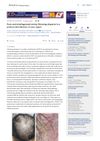
 This case report illustrates that fibrosing alopecia in a pattern distribution may be misdiagnosed as androgenetic alopecia due to similar hair loss patterns, but distinctive trichoscopic and histopathologic features help differentiate it.
 March 2023 in “International Journal of Biomedicine”
 This review discusses telogen effluvium, including its causes, symptoms, diagnostic methods, and treatment strategies, without presenting new clinical findings.
 January 2023 in “Research Square (Research Square)”
 This study found that patients with COVID-19 infection lasting longer than two weeks experienced more severe post-infection hair loss, with women and older individuals particularly affected.
 January 2023 in “Asian Journal of Pediatric Research”
 This study identified black dots as the most common trichoscopic sign in children with alopecia areata, which is crucial for diagnosis and understanding disease severity and prognosis.
 January 2023 in “Skin appendage disorders”
 This case report describes a patient who experienced proton-induced alopecia after proton therapy for a frontal meningioma, which was effectively treated with topical minoxidil, resulting in full hair regrowth after 4 months.
 January 2023 in “Springer eBooks”
 Most older adults experience pattern hair loss due to shrinking hair follicles, with men and women showing different balding patterns.
January 2023 in “Odisha Journal of Psychiatry” This case study describes a patient initially misdiagnosed with pediculosis capitis, later identified as having trichotillomania, highlighting the importance of thorough behavioral inquiries by physicians in such cases.
This study found that both trichoscopy and folliscopy are highly accurate for diagnosing telogen effluvium, though trichoscopy is simpler and faster to perform.
 January 2023 in “Skin appendage disorders”
 In this review, the authors detailed the clinical, trichoscopic, and histopathological features of hair disorders linked to autoimmune diseases, highlighting the role of dermatologists in identifying possible underlying autoimmune conditions in patients presenting with hair loss.
 January 2023 in “Skin appendage disorders”
 This article describes two cases of plica neuropathica, a rare hair condition involving severe matting, and discusses possible contributing factors and diagnosis methods while reporting no new scientific results.
 January 2023 in “Przegla̧d dermatologiczny”
 There are two main types of alopecia areata with different severity, and diagnosis is made through clinical examination and trichoscopy, influencing treatment choices.
January 2023 in “JDDG Journal der Deutschen Dermatologischen Gesellschaft” This review discusses pediatric androgenetic alopecia and reports no clinical results; the authors highlight a need for diagnostic and treatment options, suggesting further research.
 December 2022 in “Rossijskij žurnal kožnyh i veneričeskih boleznej”
 This source highlights that the incidence of alopecia areata is increasing among children, and while corticosteroids and Janus kinase inhibitors show potential effectiveness and safety, they remain unapproved by the FDA for pediatric use.
October 2022 in “Hair Transplantation” This review explores the use of hair restoration surgery for nonandrogenetic alopecias, including the risks associated with treating certain types of cicatricial alopecia, and reports no new clinical findings.
This article reviews current diagnostic methods and treatments for hair loss, including FDA-approved drugs and surgical options, but reports no new research findings.