7 citations
,
March 2023 in “European Journal of Dermatology” Using Selenium Disulfide shampoo weekly helps prevent scalp dermatitis flare-ups.
 7 citations
,
December 2019 in “American Journal of Clinical Dermatology”
7 citations
,
December 2019 in “American Journal of Clinical Dermatology” This review discusses the potential efficacy of topical antiandrogen therapies for treating androgenetic alopecia and acne vulgaris, finding promising results but highlighting the need for more comprehensive studies.
7 citations
,
February 2019 in “Veterinary medicine and science” This study reports the first identification of the deleterious NIPAL 4 variant, associated with autosomal recessive congenital ichthyosis, in an American Bully and describes its clinical management and follow-up.
This case report discusses a patient with female androgenetic alopecia and chronic telogen effluvium, emphasizing the importance of follicular unclogging to enhance treatment effectiveness, combining deep cleaning, caffeine application, physical stimulation, and lifestyle changes as an individualized, effective alternative to oral medications.
 July 2024 in “Forum Dermatologicum”
 This review evaluates various topical treatments for androgenetic alopecia but does not provide new clinical findings, emphasizing the need for selecting therapies with limited systemic side effects.
July 2022 in “Journal of Investigative Dermatology” This study suggests that using a non-medicated, hypo-allergenic scalp clarifying shampoo may improve hair volume and reduce shedding in women with lichen planopilaris and female pattern hair loss.
93 citations
,
January 2007 in “Skin Pharmacology and Physiology” In this study, caffeine applied in a shampoo penetrated hair follicles faster and more effectively than through the skin surface within the first 20 minutes.
 January 2022 in “International Journal of Health Science”
 The authors of this study aim to evaluate the strategies for using topical products in treating androgenetic alopecia, highlighting topical applications as potentially more effective and convenient compared to oral medications, which often suffer from poor patient adherence.
 8 citations
,
January 2011 in “Collection of Czechoslovak Chemical Communications”
8 citations
,
January 2011 in “Collection of Czechoslovak Chemical Communications” This study developed and validated a sensitive method using adsorptive cathodic stripping voltammetry to directly determine minoxidil in topical solutions, shampoos, and creams, achieving high recovery rates and precision.
 5 citations
,
January 2019 in “Clinical Drug Investigation”
5 citations
,
January 2019 in “Clinical Drug Investigation” This study found that certain off-label topical therapies, including prostaglandin analogs and polyphenols, improved hair restoration in men with androgenetic alopecia over placebo in the short term, though long-term effects are unknown.
 March 2004 in “Journal of The American Academy of Dermatology”
 This study found that the TrichoScan effectively measures hair growth changes, showing significant increases in hair counts and thickness in men with androgenetic alopecia after 6 months of using 5% minoxidil solution.
August 2021 in “Asian Journal of Pharmaceutical and Clinical Research” In this randomized trial, a solid shampoo formulated with plant extracts was more effective than placebo in improving androgenetic alopecia and reducing hair cortisol and DHT concentrations in men.
5 citations
,
July 2022 in “PubMed” This study identified the most common allergens in hair products linked to scalp allergic contact dermatitis, with hair dyes, shampoos, and conditioners primarily associated with the condition.
 61 citations
,
October 2005 in “The journal of investigative dermatology. Symposium proceedings/The Journal of investigative dermatology symposium proceedings”
61 citations
,
October 2005 in “The journal of investigative dermatology. Symposium proceedings/The Journal of investigative dermatology symposium proceedings” This review discusses scalp skin disorders, their overlapping symptoms, diagnostic techniques, and treatment strategies, emphasizing the importance of accurate differential diagnosis, but reports no new clinical results.
January 2016 in “Portuguese National Funding Agency for Science, Research and Technology (RCAAP Project by FCT)” This study aims to develop three topical formulations of finasteride to reduce its side effects for treating androgenic alopecia.
 51 citations
,
January 2014 in “Pediatric Clinics of North America”
51 citations
,
January 2014 in “Pediatric Clinics of North America” This article examines various types of childhood alopecia and highlights the importance of identifying chronic conditions or those linked to underlying medical issues, but reports no new results.
 June 2025 in “ARSHI Veterinary Letters”
 In this case study, a 5-month-old cat with dermatophytosis caused by Microsporum canis showed resolution of skin symptoms and hair regrowth after receiving topical antifungal shampoo and systemic itraconazole treatment for two weeks.
 February 2024 in “Medical mycology case reports”
 This study reported the presence of dermatophyte macroconidia directly in clinical samples from a 3-year-old boy with tinea capitis, marking the first time this has been documented. The infection, caused by Microsporum ferrugineum, was successfully treated with systemic itraconazole and topical ketoconazole shampoo.
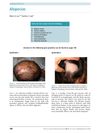 February 2013 in “Archives of Disease in Childhood: Education & Practice”
 Different types of alopecia in children require specific diagnoses and treatments.
 57 citations
,
August 2003 in “British Journal of Dermatology”
57 citations
,
August 2003 in “British Journal of Dermatology” This study found that daily use of 1% pyrithione zinc shampoo modestly improved hair growth over 26 weeks, although these effects were less than those of 5% minoxidil.
 1 citations
,
March 2020 in “Australasian Journal of Dermatology”
1 citations
,
March 2020 in “Australasian Journal of Dermatology” This report describes five cases of bitemporal alopecia areata with frontal hairline involvement, detailing their management strategies and highlighting potential differential diagnoses, but does not present new clinical results.
125 citations
,
May 2010 in “Pediatric dermatology” This review presents European guidelines for treating tinea capitis, noting systemic antifungals are essential, with griseofulvin preferred for Microsporum infections and newer antifungals viable for Trichophyton but often costlier.
 65 citations
,
November 2016 in “Journal of The American Academy of Dermatology”
65 citations
,
November 2016 in “Journal of The American Academy of Dermatology” This article reviews various types of primary cicatricial alopecias and emphasizes the importance of accurate diagnosis to improve management strategies, particularly detailing remaining lymphocytic forms and expanding on neutrophilic and mixed types.
 59 citations
,
December 2016 in “Clinical, Cosmetic and Investigational Dermatology”
59 citations
,
December 2016 in “Clinical, Cosmetic and Investigational Dermatology” This review discusses the clinical features and treatment challenges of acne keloidalis nuchae, a form of chronic scarring folliculitis, and reports no new results.
 37 citations
,
May 2016 in “Deutsches Arzteblatt International”
37 citations
,
May 2016 in “Deutsches Arzteblatt International” This review outlines various causes and manifestations of hair loss, highlighting that each type has distinct underlying mechanisms and requires specific treatment approaches, without reporting new clinical results.
22 citations
,
January 2020 in “Veterinary dermatology” This review discusses the unique characteristics and taxonomy of Malassezia yeasts and examines current diagnostic and therapeutic approaches in veterinary medicine; it reports no new clinical findings.
 12 citations
,
June 2005 in “Journal of the European Academy of Dermatology and Venereology”
12 citations
,
June 2005 in “Journal of the European Academy of Dermatology and Venereology” This case report describes an instance of alopecia and severe seborrhoeic dermatitis potentially linked to the immune response from starting combination antiretroviral therapy for acute retroviral syndrome.
11 citations
,
May 2009 in “Clinical and Experimental Dermatology” This case report describes a 12-year-old girl's persistent and worsening scalp condition, ultimately diagnosed as pityriasis amiantacea secondary to localized Darier's disease, after numerous ineffective treatments.
 3 citations
,
March 2017 in “Case Reports in Dermatology”
3 citations
,
March 2017 in “Case Reports in Dermatology” This case report describes a 26-year-old with systemic lupus erythematosus presenting with psoriatic alopecia, revealing a novel scalp dermoscopic pattern of “patchy dotted vessels.
 2 citations
,
November 2022 in “Frontiers in Pharmacology”
2 citations
,
November 2022 in “Frontiers in Pharmacology” This study systematically documented the ethnobotanical and ethnomedicinal knowledge from traditional healers in Addis Ababa, identifying 81 medicinal plants, including the endangered Echinops kebericho, used primarily for treating skin and general diseases.