Hair Botox makes hair look healthier and fuller.
 February 2019 in “IP Indian journal of clinical and experimental dermatology”
 In this study, continuous use of chemical hair relaxers and curlers was associated with adverse effects such as hair fall, thinning, and scalp irritation in patients with telogen effluvium.
This study found that a hair treatment cream using keratin protein from chicken feathers effectively improved damaged hair, particularly by repairing the surface layer.
January 2016 in “International archives of medicine” In this study, a significant relationship was observed between hair coloring and both hair damage and scalp problems among students at the University of Sumatera Utara.
Trichorrhexis nodosa causes hair to break easily, often affecting young to middle-aged black women.
1 citations
,
May 2021 in “Research journal of topical and cosmetic sciences” This study observed that taking 500mg/day of Microcore’s Muttaijow ComplexTM for 12 weeks significantly improved the appearance of skin, hair, and nails in healthy middle-aged adults.
 1 citations
,
June 2019 in “International Journal of Applied Pharmaceutics”
1 citations
,
June 2019 in “International Journal of Applied Pharmaceutics” In this study, nanostructured lipid carriers for hair split-end repair showed similar efficacy regardless of charge, with negatively charged carriers exhibiting better stability over six months compared to positively charged ones.
 August 2025 in “Deleted Journal”
 This article provides an overview of herbal oils or extracts, particularly focusing on the benefits of Arwa oil, which combines various natural oils to nourish hair follicles and treat scalp inflammation, potentially addressing hair problems like hair loss and split ends.
47 citations
,
November 2007 in “The journal of investigative dermatology. Symposium proceedings/The Journal of investigative dermatology symposium proceedings” This review discusses how various factors, including cosmetic procedures and scalp conditions, can damage hair, but highlights the availability of products to improve hair health; it reports no new empirical results.
29 citations
,
February 2019 in “Pediatric dermatology” This abstract suggests that specific trichoscopic features like black dots, coiled hair, and trichoptilosis may help differentiate trichotillomania from patchy alopecia areata.

This abstract highlights that maintaining healthy, voluminous thin hair involves using gentle care products, such as shampoos, conditioners, and masks containing specific ingredients like hydrolyzed keratin, collagen, and panthenol, to improve manageability, strength, and moisture retention.
 April 2026 in “Zenodo (CERN European Organization for Nuclear Research)”
 This study focused on formulating and assessing flaxseed herbal oil for its potential to moisturize and nourish hair, highlighting flaxseed's rich content of beneficial compounds such as omega-3 fatty acids and antioxidants which support scalp health and promote hair growth.
 April 2026 in “Zenodo (CERN European Organization for Nuclear Research)”
 This article discusses the potential benefits of flaxseed oil for moisturizing and nourishing hair, highlighting its rich content of beneficial compounds, but it reports no clinical results.
December 2023 in “International Journal of Health and Pharmaceutical” This study investigated the effects of a derma pen treatment using green betel leaf extract cream on hair development in female Wistar rats, highlighting the antioxidant and anti-inflammatory properties of betel leaves that may aid in hair growth and condition.
 5 citations
,
October 2021 in “Indian Journal of Plastic Surgery”
5 citations
,
October 2021 in “Indian Journal of Plastic Surgery” This paper suggests that using semiconical blades and coronal slits in hair transplantation may reduce vascular damage compared to other techniques, potentially offering optimal slit creation.
March 2007 in “Journal of Cell Science” This study found that keratin K1014chim expression in mice did not reduce epidermal cell proliferation but increased susceptibility to benign tumors, challenging previous beliefs about K10's role in inhibiting tumor development.
 30 citations
,
October 2005 in “Journal of Investigative Dermatology Symposium Proceedings”
30 citations
,
October 2005 in “Journal of Investigative Dermatology Symposium Proceedings” This article reviews modern hair transplantation techniques, noting that while many innovations have improved natural-looking results and expanded candidate eligibility, some may have hidden drawbacks, and it reports no new results.
 10 citations
,
November 2016 in “International Journal of Cosmetic Science”
10 citations
,
November 2016 in “International Journal of Cosmetic Science” This study proposed the existence of a membrane-like structure between the cuticle and cortex in human hair, which may provide strong protection against external stimuli.
 2 citations
,
August 1994 in “The Journal of Dermatologic Surgery and Oncology”
2 citations
,
August 1994 in “The Journal of Dermatologic Surgery and Oncology” This article discusses the hair transplantation process and product, but reports no new experimental results; the author is Leonard M. Dzubow.
 10 citations
,
May 2010 in “Journal of The American Academy of Dermatology”
10 citations
,
May 2010 in “Journal of The American Academy of Dermatology” This report presents a rare case of short anagen syndrome in a 38-year-old African American woman, expanding the documented demographic beyond previously reported Caucasian individuals with fine blond hair.
 10 citations
,
June 2000 in “Primary Care”
10 citations
,
June 2000 in “Primary Care” This article reviews common hair disorders and their normal anatomy and life cycle, but reports no new research findings.
 8 citations
,
March 2018 in “Cosmetics”
8 citations
,
March 2018 in “Cosmetics” In this study, researchers found that UV radiation causes hydroxy radicals to form cuticle holes specifically between the cuticle layers in wet hair, unlike random holes caused by Fenton's reaction.
 1 citations
,
August 2021 in “International journal of scientific research in science and technology”
1 citations
,
August 2021 in “International journal of scientific research in science and technology” This study evaluated a polyherbal hair oil, containing natural ingredients like Hibiscus and Aloe Vera in a coconut oil base, for its phytochemical properties, antimicrobial activity, and potential to reduce dandruff and hair loss while promoting hair growth.
 March 2026 in “International Journal of Pharmaceutical Research and Development”
 This study describes the development of a herbal oil formulated to promote hair growth, incorporating various herbs such as Murraya koenigii and Panax ginseng, and assesses its properties including viscosity and pH levels.
 September 2025 in “International Journal for Research in Applied Science and Engineering Technology”
 In this study, researchers developed an herbal hair tonic using ingredients like coconut oil, aloe vera, and neem, and evaluated its antibacterial, antifungal, and hair strength-enhancing properties, though specific results are not reported.
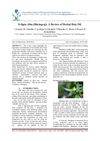
This review article underscores the benefits of herbal hair oil formulations, which include ingredients like Bhringraj leaves and coconut oil, in promoting hair health with fewer side effects compared to chemical products, offering nutrients for sebaceous gland function.
 December 2024 in “Australian Journal of General Practice”
 In this case report, a 20-year-old woman exhibited progressive asymptomatic hair loss with a pattern inconsistent with alopecia areata or female pattern hair loss, showing areas of both extending and improving hair loss.
 May 2024 in “International Journal of Advanced Research in Science Communication and Technology”
 In this study, the preparation of herbal hair oil from ingredients like Amla, Hibiscus, and Bhringraj was reported to show anti-hairfall properties, along with beneficial effects such as anti-dandruff activity and improved scalp blood circulation, while meeting standard evaluation criteria for stability and organoleptic properties.
 January 2024 in “Open access journal of pharmaceutical research”
 This study aimed to develop a herbal hair oil formulation using ingredients like hibiscus, amla, and coconut oil to address hair loss and related issues without causing the adverse effects associated with synthetic medications.
 September 2023 in “International journal of drug delivery technology”
 This study developed and tested an herbal shampoo containing tea, ashwagandha, sandalwood, and nagarmotha, finding it exhibited good cleansing properties and effectively controlled Candida and Malassezia fungi.