24 citations
,
December 2018 in “Inflammation and Regeneration” This review discusses the roles of various PLA2 enzymes in skin health and disease, highlighting potential pathways for future diagnosis and therapy, but it reports no new clinical results.
 August 2018 in “Journal of The American Academy of Dermatology”
 A 5-year-old girl with a rare skin disorder was effectively treated with skin creams instead of oral medication.
 June 2023 in “Research Square (Research Square)”
 This study found that among male Han Chinese, a higher polygenic risk score was linked to increased risk and poorer treatment outcomes for benign prostatic hyperplasia.
January 2025 in “Dermatology Research and Practice” In this research, RNA expression analysis of scalp biopsies from lichen planopilaris patients revealed changes in specific genes after treatments with hydroxychloroquine, narrow band UVB, or low level laser light therapy, suggesting potential biomarkers and implicating M2 macrophages in the disease's immunopathogenesis.
 September 2011 in “Urology”
 This study aimed to estimate the value of urine prostate specific antigen (uPSA) as a marker for benign prostatic hyperplasia (BPH) but reported no new clinical findings.
1 citations
,
December 2025 in “Baylor University Medical Center Proceedings” Leuprolide may better manage cholesterol and blood pressure in PCOS than spironolactone.
November 2020 in “Acta Medica Bulgarica/Acta medica Bulgarica” This case report details two patients with Graham-Little-Piccardi-Lassueur syndrome who showed marked skin lesion improvement with corticosteroid treatment, though cicatricial scalp alopecia remained unresponsive.
 April 2012 in “The Journal of Urology”
 This study modeled how differences in trial settings and protocols, such as biopsy compliance and control arm screening, can explain the varying prostate cancer mortality reductions observed in the ERSPC and PLCO trials.
 6 citations
,
July 2016 in “Gynecological Endocrinology”
6 citations
,
July 2016 in “Gynecological Endocrinology” This study found that women with PCOS have higher total PSA levels than controls, and the total PSA level correlates positively with testosterone and free androgen index.
 April 2023 in “Journal of Investigative Dermatology”
 This study found that MPZL3 plays a crucial role in controlling sebaceous gland size and sebocyte proliferation in mice and humans, implicating its potential involvement in skin disorders like acne and psoriasis.
 July 2022 in “The journal of investigative dermatology/Journal of investigative dermatology”
 This case study reports that a 26-year-old woman with epidermolysis bullosa prurogompsa also presented with unique findings of co-existing muscular dystrophy and immune-based myasthenia gravis, with significant improvement following steroid treatment.
This study developed a nanocarrier-based gel to enhance the delivery and effectiveness of resveratrol in treating psoriasis. In a mouse model, the gel improved skin penetration and retention, showed notable anti-psoriatic effects, and was deemed safe and biocompatible.
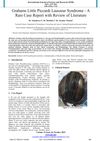 October 2023 in “International Journal of Science and Research (IJSR)”
 This paper describes Grahams Little Piccardi Lassueur Syndrome, a rare type of Lichen Planopilaris that causes different types of alopecia and distinctive skin papules, primarily affecting females aged 40 to 70, and notes the current challenges in treatment options, particularly once scarring occurs.
 January 2018 in “Springer eBooks”
 PDE inhibitors, especially PDE4 inhibitors like apremilast, are effective for certain inflammatory skin conditions but have side effects and can be costly.
 April 2023 in “Journal of Investigative Dermatology”
 This report details the development of a PSR™ Terminalia extract with antioxidant and anti-aging potential, highlighting its rich composition in phenolic acids, polysaccharides, and organic acids, without new clinical results.
 1 citations
,
June 2023 in “ScienceRise Pharmaceutical Science”
1 citations
,
June 2023 in “ScienceRise Pharmaceutical Science” This study explored a computer simulation method for selecting emulsion compositions in dermatology, finding that the PS biocomplex can be effectively used as an emulsifier or co-emulsifier, which streamlines the development process and reduces experimental demands.
 1 citations
,
October 2014
1 citations
,
October 2014 The document concludes that diagnosing and managing plaque psoriasis, particularly in sensitive areas, is challenging and requires careful differentiation from similar skin conditions.
 May 2017 in “Journal of The American Academy of Dermatology”
 PLAU and SerpinB2 affect cell death differently in various forms of leprosy and could be targets for new treatments.
158 citations
,
June 2014 in “Journal of Lipid Research” This review summarizes recent discoveries of GPCRs for lysophosphatidylserine and lysophosphatidylinositol, detailing their roles as lipid mediators, but reports no new experimental results.
 April 2023 in “Journal of Investigative Dermatology”
 This study found that PX-12 inhibited the NLRP3 inflammasome and reduced psoriasis-like symptoms in a mouse model, suggesting its potential as a treatment for psoriasis.
January 1962 in “Archives of Dermatology” This case report describes a 5-year-old girl with lipoid proteinosis, characterized by a raspy voice, thinning scalp hair, and recurrent crusted lesions leading to pock-like scars.
 1 citations
,
July 1973 in “British Journal of Dermatology”
1 citations
,
July 1973 in “British Journal of Dermatology” The document concludes that secondary syphilis cases are increasing and often misdiagnosed, pityriasis rubra pilaris can be distinguished from psoriasis by skin cell features, and different skin layers produce specific components during skin repair.
 1 citations
,
January 2017 in “Journal of Pakistan Association of Dermatology”
1 citations
,
January 2017 in “Journal of Pakistan Association of Dermatology” This study found that cutaneous manifestations in children with systemic lupus erythematosus differ from adults, with no female preponderance and less frequent photosensitivity and vascular lesions.
November 2025 in “Informatica” This study introduces a novel image enhancement method that significantly improves the visual quality of low-light sports images by utilizing improved bilateral filtering and the CLAHE algorithm, achieving a 65.24% improvement in color and edge detail preservation compared to state-of-the-art methods on the LOL dataset.
19 citations
,
September 2010 in “Journal of the European Academy of Dermatology and Venereology” This study found that while the CLASI is generally useful for assessing disease activity and damage in cutaneous lupus erythematosus, it may not accurately reflect all subtypes, indicating a need for revision.
July 2025 in “Journal of Investigative Dermatology” Scarring alopecia involves increased immune cells and specific gene changes near damaged hair follicles.
 16 citations
,
September 2018 in “Journal of Molecular Liquids”
16 citations
,
September 2018 in “Journal of Molecular Liquids” This study investigated a nanostructured system using PS-b-PAA diblock copolymer for incorporating the hydrophobic photosensitizer ClAlPc, finding it effective in causing cellular damage in Caco-2 cells under light while demonstrating no cytotoxicity without light, suggesting its potential use in photodynamic therapy.
 January 2020 in “Benha Journal of Applied Sciences”
 This study found that serum apelin-13 levels were significantly higher in patients with moderate to severe psoriasis vulgaris compared to healthy controls.
18 citations
,
January 2018 in “BMC dermatology” This paper describes a case of epidermolysis bullosa simplex with muscular dystrophy associated with a novel PLEC mutation and diffuse alopecia, highlighting a potential genetic link that remains uncertain.
September 2009 in “MedEdPORTAL” This resource outlines a structured oral examination approach for internal medicine students using a case study of systemic lupus erythematosus, highlighting its convenience and effectiveness based on student feedback.