13 citations
,
September 1997 in “Archives of Dermatology” This case report describes a 5-year-old boy with a solitary patch of hair loss, potentially linked to a fungal infection after antibiotic treatment showed minimal effectiveness.
 January 2016 in “Journal of The American Academy of Dermatology”
 This case report describes a 59-year-old woman diagnosed with frontal fibrosing alopecia, presenting with scarring alopecia and perifollicular erythematous papules.
 April 2018 in “Journal of Investigative Dermatology”
 This study investigated novel genetic tools to manipulate hair follicle compartments in mice and found that altering dermal papilla genes can significantly impact hair pigmentation.
October 2023 in “Clinical and Experimental Dermatology” In this report, the authors highlight the diagnostic challenge of distinguishing syphilitic alopecia from alopecia areata, noting that the characteristic exclamation mark hairs of alopecia areata can also appear in syphilitic alopecia, underscoring the need for a comprehensive diagnostic approach.
September 2012 in “British Small Animal Veterinary Association eBooks” This article discusses pigmentation disorders in veterinary dermatology, focusing on the role of melanogenic pigmentation, and reports no new research results.
 March 2004 in “Journal of The American Academy of Dermatology”
 This report describes a unique case of dyschromatosis universalis in a 10-year-old Haitian male, notable for the presence of a silvery sheen to his scalp hairs and eyelashes, which may represent a variation of the condition.
July 1979 in “Archives of Dermatology” This case report describes a 68-year-old woman with benign mucous membrane pemphigoid and unusual keratotic plaques on her extremities, associated with longstanding mouth and eye symptoms and phalangeal swelling.
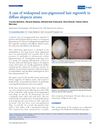 March 2019 in “Our Dermatology Online”
 A woman with severe hair loss regrew mostly white hair after treatment.
12 citations
,
January 2014 in “Dermatology online journal” In this case review, researchers hypothesize that hair regrowth following alopecia areata may be linked with poliosis, suggesting that this association might be more common than previously documented.
127 citations
,
November 2010 in “Pigment cell & melanoma research” This article discusses the challenges in hair follicle pigmentation research compared to epidermal melanocytes and highlights the limitations of relying on mouse models, but reports no new experimental findings.
 41 citations
,
January 2014 in “Annals of Dermatology”
41 citations
,
January 2014 in “Annals of Dermatology” This study found that dermoscopy showed distinctive patterns for different types of alopecia, supporting its clinical usefulness for diagnosing diseases with small round or oval hairless patches on the scalp.
303 citations
,
August 1971 in “The American Journal of Medicine” This report suggests that in vitiligo, melanocytes may be destroyed by the same factors necessary for melanin production, contributing to the skin's depigmentation.
19 citations
,
October 1996 in “International Journal of Dermatology” This study concluded that pseudopelade is an autosomal dominant condition, distinct from other forms of alopecia, characterized by atrophic hair follicle loss and notable familial association.
16 citations
,
February 2008 in “PubMed” Vitamin B12 deficiency can cause skin darkening and white hair, but it's reversible.
1 citations
,
May 2024 in “Dermatology Online Journal” In this case study, two middle-aged patients with pruritic scalp erosions were diagnosed with localized pemphigus vulgaris, which resolved without relapse after treatment with low-dose oral prednisone and intralesional triamcinolone acetonide.
June 2026 in “Indian Dermatology Online Journal” In this case report, a 20-year-old man with a birthmark was identified as having a supernumerary nipple, a developmental anomaly, using dermoscopy to distinguish it from other pigmented skin lesions such as melanocytic nevus or basal cell carcinoma.
December 2025 in “EXPERIMENTAL & CLINICAL MEDICINE GEORGIA” This study describes Pseudopelade of Brocq as a rare and enigmatic scarring alopecia characterized by irregular hair loss patterns on the scalp, requiring exclusion of other conditions like lichen planopilaris and discoid lupus erythematosus for a specific diagnosis.
 December 2023 in “Clinical, cosmetic and investigational dermatology”
 This study found that specific dermoscopic signs, such as diameter diversity of leukotrichia and Pohl-Pinkus constrictions, were associated with progressive vitiligo, and early-stage melanin synthesis was impaired in vitiligo-associated leukotrichia.
 April 2019 in “Journal of Investigative Dermatology”
 This study reported that gain-of-function mutations in TRPV3 lead to hair loss in mice by disrupting inner root sheath keratinocyte differentiation, ultimately causing follicular keratinocyte stem cell exhaustion and permanent follicle disruption.
11 citations
,
August 1986 in “Archives of Dermatology” This case report describes a patient with skin and nail hyperpigmentation and premature gray hair due to vitamin B12 deficiency, which were reversed after treatment with cyanocobalamin.
2 citations
,
June 2009 in “Journal of the American Academy of Dermatology” This case report describes a healthy 27-year-old woman with progressive alopecia and hyperpigmentation on her forehead and frontal scalp, with limited response to triamcinolone acetonide treatment.
2 citations
,
August 2025 in “Reports — Medical Cases Images and Videos” In this case report, a rare melanotrichoblastoma tumor was identified in a 51-year-old female following the histological and immunohistochemical analysis of a lesion on the pubo-inguinal area, presenting with strong epithelial marker positivity and a low proliferative index.
1 citations
,
January 2008 in “SKINmed Dermatology for the Clinician” This case report describes a patient with mucous membrane pemphigoid who experienced recurrent blisters and cicatricial alopecia, showing improvement with prednisolone and dapsone treatment.
1 citations
,
April 2004 in “Cancer” This study describes that 65% of patients receiving imatinib mesylate in a patient assistance program experienced skin hypopigmentation, primarily in ethnically Chinese individuals, suggesting variability across populations.
 14 citations
,
January 2005 in “Pediatric Dermatology”
14 citations
,
January 2005 in “Pediatric Dermatology” This case report describes a child with hypopigmented mycosis fungoides successfully treated with UVA1 light therapy.
7 citations
,
March 1990 in “Pigment Cell Research” This animal study observed that while topical MBEH and intraperitoneal phenol induced hair graying in eumelanic mice, they had little effect on pheomelanic mice, and amcinonide reduced certain epidermal melanocytes in both.
 April 2012 in “Informa Healthcare eBooks”
 Syphilitic alopecia is a rare hair loss condition in secondary syphilis that looks similar to another condition but can be diagnosed with specific tests and responds to antibiotics.
February 2013 in “Journal of the American Academy of Dermatology” Follicular red dots can appear where alopecia areata and vitiligo overlap.
July 1974 in “Archives of Dermatology” This case report details the lack of confluent repigmentation in an 8-year-old girl with vitiligo after three years of trioxsalen and ultraviolet light treatment.
 2 citations
,
November 1995 in “American Journal of Obstetrics and Gynecology”
2 citations
,
November 1995 in “American Journal of Obstetrics and Gynecology” This article reviews the need for multicenter clinical trials to establish reference data for ultrasound screening protocols for Down syndrome and reports no new findings.