24 citations
,
July 2018 in “British Journal of Dermatology” Contact allergies might contribute to frontal fibrosing alopecia.
 September 2013 in “Hair transplant forum international”
 This abstract describes frontal fibrosing alopecia, a type of cicatricial alopecia identified in post-menopausal women, and reports no new clinical findings.
 1 citations
,
December 2017 in “Anais Brasileiros de Dermatologia”
1 citations
,
December 2017 in “Anais Brasileiros de Dermatologia” This article discusses the DOAJ, a comprehensive index of international open access journals, and emphasizes its role in providing free quality content online without presenting new research findings.
 May 2024 in “International Seven Journal of Multidisciplinary”
 This review discusses fibrosing frontal alopecia, including its causes, mechanisms, and treatments, and emphasizes the need for further research to improve understanding and treatments; it reports no new clinical results.
1 citations
,
August 2024 in “Anais Brasileiros de Dermatologia” This review discusses the non-follicular skin manifestations of frontal fibrosing alopecia and how they affect diagnosis and treatment, but reports no new clinical results.
September 2023 in “Journal of the American Academy of Dermatology” This meta-analysis found a significant positive association between frontal fibrosing alopecia and both sunscreen and moisturizer use, with the moisturizer association significant only in males.
 166 citations
,
April 2012 in “Journal of The American Academy of Dermatology”
166 citations
,
April 2012 in “Journal of The American Academy of Dermatology” This study reviewed clinical data from 60 patients with frontal fibrosing alopecia and found increasing prevalence and generally poor response to treatment, with the cause remaining unclear.
 August 2021 in “Annals of Agricultural and Environmental Medicine”
 This review provides a detailed analysis of frontal fibrosing alopecia, focusing on its prevalence in postmenopausal Caucasian women, associated comorbidities, and potential autoimmune, genetic, hormonal, and environmental factors; it emphasizes the need for improved understanding to enhance diagnosis and treatment.
 July 2018 in “Elsevier eBooks”
 This review discusses the evolving understanding of frontal fibrosing alopecia as a generalized skin condition with diverse manifestations, and reports no new clinical results.
7 citations
,
July 2021 in “The Journal of Dermatology” This study in Asian females found that higher use of moisturizers and sunscreen among FFA patients may reflect appearance concerns rather than indicating a direct link to the disease mechanism.
 January 2015 in “Hair transplant forum international”
 This snippet mentions an increase in women seeking surgical hair restoration and subsequently encountering more cases of frontal fibrosing alopecia, but the abstract doesn't contain results or conclusions.
 July 2022 in “Research Square (Research Square)”
 This study found that Egyptian women with frontal fibrosing alopecia had lower serum PPARγ levels and a higher occurrence of PPARG gene polymorphism compared to healthy controls, suggesting a potential role for PPARγ in the condition's development.
1 citations
,
August 2018 in “Journal of the American Academy of Dermatology” A young woman developed facial bumps before hair loss, which is unusual for her condition.
May 2026 in “International Journal of Dermatology” This study investigated a unique frontal fibrosing alopecia-like presentation of alopecia areata, finding that patients experienced an insidious, chronic course with limited scalp hair regrowth, and showed a lower response to systemic corticosteroids compared to patchy alopecia areata.
 September 2021 in “CRC Press eBooks”
 This review discusses fibrosing alopecia in a pattern distribution and highlights diagnostic features, but reports no new clinical results; the authors emphasize the value of trichoscopy and histology in diagnosis.
 January 2022 in “Дерматологія та венерологія”
 This paper presents two cases of frontal fibrosing alopecia in postmenopausal women, noting challenges in monitoring due to the invasive nature of the diagnostic process.
1 citations
,
March 2012 in “Actas dermo-sifiliográficas/Actas dermo-sifiliográficas” Dermoscopy helps diagnose frontal fibrosing alopecia by identifying specific scalp features.
 August 2015 in “Dermatología Argentina”
 This study reviewed 18 postmenopausal women with frontal fibrosing alopecia, noting frontotemporal hairline recession and eyebrow loss, often treated with steroids, triamcinolone, and other medications.
 68 citations
,
May 2016 in “Experimental dermatology”
68 citations
,
May 2016 in “Experimental dermatology” This review discusses what is known about the pathobiology of frontal fibrosing alopecia and reports no new clinical findings, highlighting potential environmental and genetic factors in disease pathogenesis.
 8 citations
,
November 2018 in “Australasian Journal of Dermatology”
8 citations
,
November 2018 in “Australasian Journal of Dermatology” This study adds evidence suggesting a genetic component to frontal fibrosing alopecia, with daughters experiencing an earlier onset than their mothers, although the clinical pattern remains similar to non-familial cases.
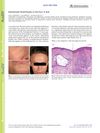 1 citations
,
January 2019 in “Acta dermato-venereologica”
1 citations
,
January 2019 in “Acta dermato-venereologica” The woman's skin and hair symptoms were confirmed as frontal fibrosing alopecia, and while facial papules are common in such cases, there's no effective local treatment, but systemic treatments can help.
August 2019 in “Journal of the American Academy of Dermatology” Frontal fibrosing alopecia may be caused by an autoimmune reaction and hormonal imbalance.
 April 2023 in “World Journal Of Advanced Research and Reviews”
 This study in Morocco found that all women with frontal fibrosing alopecia presented frontotemporal hairline recession, with trichoscopic features such as perifollicular erythema and follicular hyperkeratosis being indicative of the condition, and suggested a potential link between cosmetic products or emotional factors and the disease.
November 2024 in “Dermatology and Therapy” In this review, cosmetic practices such as non-ablative lasers, autologous fat injections, and oral isotretinoin may help alleviate certain symptoms of frontal fibrosing alopecia, while treatments like deep chemical peels and ablative laser therapies are contraindicated due to potential scarring risks.
 March 2026 in “Dermatology Reports”
 This study found that frontal fibrosing alopecia had higher long-term remission rates compared to lichen planopilaris, highlighting differences in their clinical presentations and outcomes.
April 2019 in “Journal of Investigative Dermatology” This study found that frontal fibrosing alopecia involves distinct molecular changes, such as downregulation of steroid and cholesterol pathways and upregulation of fibrotic and immune response genes, which may help guide treatment strategies.
 October 2020 in “International Journal of Research in Dermatology”
 This review discusses the possible immune-mediated and environmental factors contributing to frontal fibrosing alopecia but reports no new clinical findings, emphasizing the need for standardized treatment evaluations.
 8 citations
,
September 2011 in “European Journal of Dermatology”
8 citations
,
September 2011 in “European Journal of Dermatology” This study reports that most cases of frontal fibrosing alopecia did not show significant improvement with available treatments, and effective management remains unproven.
 55 citations
,
June 2007 in “Journal of Statistical Planning and Inference”
55 citations
,
June 2007 in “Journal of Statistical Planning and Inference” This study introduces an extended approach to the Bonferroni procedure that accounts for correlations among endpoints, aiming to improve test power while maintaining strong control of the family-wise type I error rate in clinical trials.
2 citations
,
June 2021 in “Sultan Qaboos University medical journal” This case report presents three sisters with familial frontal fibrosing alopecia, making it the 25th documented familial case, with treatment results observed in one sister.