 8 citations
,
September 2015 in “Hair transplant forum international”
8 citations
,
September 2015 in “Hair transplant forum international” This article highlights the significant hair transplant results achieved with the potentially obsolete FUT technique and includes varied expert opinions on its efficacy, but it reports no new clinical findings.
March 2026 in “Anais Brasileiros de Dermatologia” Lichen planopilaris and frontal fibrosing alopecia are likely distinct diseases with different tissue involvement.
February 2026 in “Bioscientia Medicina Journal of Biomedicine and Translational Research” This case report highlights the importance of considering eosinophilic pustular folliculitis in adolescent patients with persistent papulopustular eruptions to avoid misdiagnosis and ensure effective anti-inflammatory treatment.
 June 2024 in “British Journal of Dermatology”
 This case report highlights the diagnosis of folliculotropic mycosis fungoides in a 15-year-old boy with atypical skin and hair follicle changes, a rare occurrence in pediatric patients.
April 2019 in “Journal of Investigative Dermatology” Targeting immune pathways like JAK/STAT may help treat frontal fibrosing alopecia.
1 citations
,
January 2024 in “Pharmaceuticals” The researchers reported that dPGS-PCL as a carrier improved the penetration of tofacitinib in an ex-vivo human skin model compared to free tofacitinib, but did not show significant differences in inhibiting IL-6 and IL-8 during short incubation.
 9 citations
,
July 2020 in “Journal of Dermatology”
9 citations
,
July 2020 in “Journal of Dermatology” This study found that diffuse and pseudo-fringe sign patterns are common in Asian patients with frontal fibrosing alopecia, and that treatments combining antiandrogens or antimalarials with topical therapy are effective.
3 citations
,
August 2017 in “Clinical case reports” A rare skin condition causes red and dark patches on the face and limbs.
 12 citations
,
November 1987 in “Pediatric dermatology”
12 citations
,
November 1987 in “Pediatric dermatology” This report identified longitudinal grooves in the hair shafts of four children, diagnosing them with uncombable-hair syndrome.
March 2019 in “eCommons (Cornell University)” This report covers the diagnosis and treatment of equine pemphigus foliaceus presented by a case study of a Hackney pony mare, showing improvement with prednisolone treatment.
 1 citations
,
January 2018 in “Acta dermato-venereologica”
1 citations
,
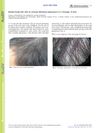
January 2018 in “Acta dermato-venereologica” A teenager's hair with alternating white and dark bands, known as Pili annulati, is a genetic condition that is usually harmless and often considered attractive.
 17 citations
,
October 2017 in “Journal of Cutaneous Medicine and Surgery”
17 citations
,
October 2017 in “Journal of Cutaneous Medicine and Surgery” This review discusses the various treatment options for frontal fibrosing alopecia but reports no definitive results, as no treatment has proven effective in halting hairline recession or promoting hair growth.
 April 2017 in “Journal of Investigative Dermatology”
 This study observed that using a 1064 nm Nd: YAG laser may stabilize hair loss and promote new growth in some females with frontal fibrosing alopecia, though individual results varied.
 23 citations
,
April 2021 in “Journal of Clinical Medicine”
23 citations
,
April 2021 in “Journal of Clinical Medicine” This review compiles existing data on frontal fibrosing alopecia and highlights the promise of 5-alpha reductase inhibitors as a treatment option, while noting the need for clarity on its cause and progression.
 13 citations
,
September 2017 in “Skin appendage disorders”
13 citations
,
September 2017 in “Skin appendage disorders” Some women with Frontal Fibrosing Alopecia also have Lichen Planopilaris, which can lead to more symptoms and affect hair outside the scalp.
 32 citations
,
September 2017 in “Journal of the American Academy of Dermatology”
32 citations
,
September 2017 in “Journal of the American Academy of Dermatology” In this study, researchers reported that oral isotretinoin effectively treated facial papules in frontal fibrosing alopecia, with histopathologic findings suggesting the involvement of elastic fibers and sebaceous glands in papule formation beyond perifollicular inflammation.
 March 2022 in “Research Square (Research Square)”
 This study reported that pelage hair follicle mesenchymal stem cells isolated from mice using Ficoll Density Gradient Sedimentation can be obtained in large numbers and may promote hair growth via exosome secretion.
16 citations
,
April 2020 in “JAMA dermatology” More inflammation leads to faster and worse hair loss in women with frontal fibrosing alopecia.
1 citations
,
May 2024 in “Skin Appendage Disorders” In this study, researchers analyzed trichoscopy findings in black patients with FFA to aid in precise diagnosis and treatment, highlighting the importance of understanding disease characteristics to improve hair care in this group.
17 citations
,
June 2022 in “Frontiers in Nutrition” This study found that fermented Flammulina velutipes polysaccharides showed higher antioxidant and anti-inflammatory capacities than non-fermented ones, suggesting potential use in functional foods and health products.
This study found that selective deletion of PIKFyve kinase using a PF4 promoter in mice led to defective platelet lysosome biogenesis and a prothrombotic effect, with unexpected macrophage infiltration in multiple organs.
 23 citations
,
October 2018 in “Australasian Journal of Dermatology”
23 citations
,
October 2018 in “Australasian Journal of Dermatology” This review highlights that frontal fibrosing alopecia’s increasing incidence may involve immune, genetic, hormonal, and environmental factors, yet its pathogenesis remains complex and not fully understood.
 26 citations
,
October 2018 in “British Journal of Dermatology”
26 citations
,
October 2018 in “British Journal of Dermatology” This study found that high frequency use of sunscreen is associated with frontal fibrosing alopecia among women attending a specialist hair clinic in Australia.
 339 citations
,
February 2014 in “Journal of The American Academy of Dermatology”
339 citations
,
February 2014 in “Journal of The American Academy of Dermatology” This study found that eyelash loss, facial papules, and body hair involvement were linked to severe frontal fibrosing alopecia, and antiandrogens were the most effective treatment.
 November 2023 in “The journal of investigative dermatology/Journal of investigative dermatology”
 In this case series, researchers reported on the clinical characteristics and treatment approaches for Frontal Fibrosing Alopecia in four cases, emphasizing the importance of early identification and intervention to manage this scarring hair loss disorder that primarily affects the frontal hairline and eyebrows.
3 citations
,
May 2024 in “International Journal of Women’s Dermatology” This article discusses the connection between product use, contact dermatitis, and frontal fibrosing alopecia and reports no new findings; the authors emphasize the need for more research to improve patient outcomes.
 23 citations
,
November 2018 in “Journal of the European Academy of Dermatology and Venereology”
23 citations
,
November 2018 in “Journal of the European Academy of Dermatology and Venereology” This study observed that frontal fibrosing alopecia is increasingly diagnosed in Italian Caucasian females, often showing premenopausal onset and eyebrow alopecia as an early sign.
January 2024 in “International Journal of Trichology” This case report detailed two instances of plica polonica, an acquired hair matte condition, attributing it to factors like drug effects and hair care neglect, but emphasized not labeling affected patients as unable to self-care.
 September 2017 in “Journal of Investigative Dermatology”
 This study found that infrared thermography might be a useful non-invasive tool to help diagnose frontal fibrosing alopecia by identifying active phases of the disease.
 8 citations
,
October 2016 in “Actas Dermo-Sifiliográficas”
8 citations
,
October 2016 in “Actas Dermo-Sifiliográficas” This study found that men with frontal fibrosing alopecia exhibited more frequent facial papules, androgenetic alopecia, and body hair loss compared to women with the condition, and were generally older.