7 citations
,
November 1997 in “Reproduction Fertility and Development” In this study, subcutaneous injections of murine epidermal growth factor in marsupial pouch young inhibited the formation of hair follicles and associated structures, altering normal follicle development.
96 citations
,
December 1995 in “Journal of Investigative Dermatology” 1 citations
,
January 1987 in “PubMed” This study reported that in a histopathologic analysis of five parenteral heroin users with candida folliculitis, candida and pseudohyphae were frequently found in association with hair follicles.
21 citations
,
December 2015 in “European journal of cell biology” In this study, researchers demonstrated that follicular tight junctions in porcine skin form a barrier to nanoparticle penetration, particularly in upper regions, which supports its use as a model for human skin.
 September 2016 in “Journal of Dermatological Science”
 This study investigated the mechanism responsible for pili torti formation in Björnstad syndrome using a transmission electron microscope, but did not establish a definitive explanation.
33 citations
,
March 1996 in “Veterinary Quarterly” This report describes effective treatment of demodicosis in ferrets using amitraz, marking the first known cases in this species.
83 citations
,
July 1993 in “Journal of the American Veterinary Medical Association” This study found that surgical removal of adrenal glands resolved clinical signs of adrenocortical tumors and hyperplasias in ferrets, but cortisol levels were not excessively high.
January 2008 in “Medical Entomology and Zoology” 10 citations
,
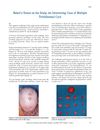
January 2018 in “International journal of trichology” This case report highlights the importance of histopathological examination in accurately diagnosing eruptive vellus hair cyst due to its rarity and resemblance to other conditions.
 5 citations
,
January 2014 in “Journal of Cutaneous and Aesthetic Surgery”
5 citations
,
January 2014 in “Journal of Cutaneous and Aesthetic Surgery” A woman had 13 non-cancerous cysts on her scalp successfully removed in one surgery.
9 citations
,
June 2020 in “JAAD Case Reports” This article discusses dissecting cellulitis of the scalp, an uncommon hair condition, and reports no new clinical results; recent terminology adjustments are noted for potential overlaps with other follicular diseases.
32 citations
,
September 1996 in “Archives of Dermatological Research” 6 citations
,
September 1996 in “Archives of Dermatological Research” 5 citations
,
March 1943 in “Archives of Dermatology and Syphilology” This report describes a rare case of a woman with keratosis follicularis presenting with extensive alopecia and nail abnormalities, adding to the medical literature due to its unusual presentation.
February 1999 in “The anatomical record” This study observed defects in hair cuticle cross-linking in some, but not all, mouse mutants with sparse or structurally unsound hair.
 21 citations
,
April 1982 in “Genetics Research”
21 citations
,
April 1982 in “Genetics Research” In this study, researchers observed that mice with the naked gene showed frequent absence of hair cuticle and cortical cells during follicle growth, with abnormal keratin deposition also noted.
31 citations
,
October 1992 in “Archives of Dermatology” This article presents a case study of a 25-year-old man with persistent scalp nodules and abscesses with patchy alopecia, unaffected by a course of oral tetracycline.
43 citations
,
November 1988 in “The Journal of Comparative Neurology” This study examined the sensory innervation of hair follicles in the furry skin of rat hindlimbs, finding significant differences among hair types in their innervation patterns and densities.
 4 citations
,
August 2017 in “Journal of cutaneous pathology”
4 citations
,
August 2017 in “Journal of cutaneous pathology” This case report documents only the second known instance of congenital lymphadenoma, expanding the diagnostic possibilities for cutaneous lymphoepithelial tumors in children.
December 2009 in “Journal of Veterinary Clinics” The authors diagnosed a 5-year-old Pekinese dog with keratoacanthoma with granulomatous inflammation, and the mass did not recur 5 months after surgical removal.
2 citations
,
June 2022 in “Life” This case report reviews panfolliculoma, a rare benign follicular tumor, highlighting its occurrence and characteristics, and emphasizes the importance of accurate histopathological differentiation to avoid misdiagnosis.
5 citations
,
June 2016 in “University of Zagreb University Computing Centre (SRCE)” This study observed that canine follicular tumors are an uncommon type of skin neoplasia in Croatian dogs, often benign but with a small percentage presenting malignancy, and vary based on the breed's hair growth type.
January 2015 in “프로그램북(구 초록집)” This case report describes an unusual instance of eruptive syringomas in a 25-year-old man, persisting for about 10 years, which is atypical given the patient's sex and the condition's usual presentation.
6 citations
,
July 2017 in “Clinical and Experimental Dermatology” This report presents four new cases of follicular porokeratosis, which exhibit distinct histological features where the cornoid lamella are confined to the follicular ostia.
39 citations
,
May 2013 in “Optometry and vision science” This monograph outlines a new method for identifying Demodex mites in eyelashes without epilation by rotating the eyelash within its follicle.
5 citations
,
March 2015 in “Indian Journal of Dermatology” This report describes a rare case of multiple trichofolliculomas on the face, which clinically resembled multiple trichoepitheliomas.
December 2024 in “Veterinary Dermatology” This case report identified cutaneous epitheliotropic T-cell lymphoma in a 3-year-old male sugar glider after skin biopsies, highlighting the need for thorough diagnostic evaluations in exotic pets.
6 citations
,
March 1976 in “Journal of Investigative Dermatology” February 2019 in “American International Journal of Humanities Arts and Social Sciences” This histological study of Millivora Capenesis skin describes the composition of the dermis, featuring distinct papillary and reticular layers with associated structures like hair follicles, glands, and corpuscles.
January 1997 in “Han-guk hyeonmigyeong hakoeji/Applied microscopy” This study observed that the mechanical connection between hair follicles and connective tissue in human fetal scalp skin is weaker than in the corresponding skin components, reflecting dynamic processes in hair growth.