 1 citations
,
September 2018 in “Australasian Journal of Dermatology”
1 citations
,
September 2018 in “Australasian Journal of Dermatology” In this report, a 2-year-old male with GAPO syndrome exhibited androgenetic-like alopecia with normal testosterone levels and telogen hair loss, which are novel findings for this condition.
 April 2023 in “Veterinary world/Veterinary World”
 This study identified six species of ectoparasitic insects infesting domestic goats in Bulgaria, with Linognathus stenopsis being the most prevalent across the surveyed farms.
47 citations
,
July 2005 in “European Journal of Cell Biology” Terrestrial vertebrates have balanced keratin gene clusters, unlike teleost fish.
 57 citations
,
May 2014 in “Molecular Phylogenetics and Evolution”
57 citations
,
May 2014 in “Molecular Phylogenetics and Evolution” This study utilized a sequence-structure alignment approach to improve the characterization of Class A Rhodopsin GPCR superfamily, including orphan and unclassified receptors, through evolutionary analysis.
This study reported a new method enabling the observation of the full leg regeneration process in the crustacean *Parhyale hawaiensis* over 10 days, capturing cellular resolution while minimizing photodamage, through innovative imaging techniques and computer-assisted cell tracking.
 10 citations
,
June 2021 in “Primates”
10 citations
,
June 2021 in “Primates” This study found that wild geladas in Ethiopian crop areas experienced higher levels of human disturbance and health issues, such as increased parasitic infections, compared to those in pasture areas.
 131 citations
,
March 2004 in “The American journal of pathology”
131 citations
,
March 2004 in “The American journal of pathology” This study found that modulating BMP activity in transgenic mice affects the development and characteristics of several ectodermal organs, such as skin, hair, and claws, highlighting a stage-dependent influence on organogenesis.
6 citations
,
February 2020 in “Journal of Cutaneous Pathology” This case report describes the histopathological features of nevus psiloliparus in an 11-year-old girl, noting "shadow" follicular units with loosely arranged collagen and reduced elastic fibers.
December 2018 in “Bioscience Journal” This study reports the first known occurrence of Leporacarus gibbus infestation alongside Cheyletiella parasitovorax and Psoropotes cuniculi in a domestic rabbit in Espírito Santo, Brazil.
 December 2021 in “International journal of research - granthaalayah”
 This report discusses a case of pilomatrixoma, an uncommon benign skin tumor, and emphasizes the importance of histopathological analysis for accurate diagnosis to avoid misdiagnosis as malignancy.
April 2017 in “Journal of dermatological science” This study found that while epidermal PLCγ1 is not necessary for keratinocyte differentiation in interfollicular epidermis, it is crucial for normal hair and sebaceous gland formation in mice.
13 citations
,
July 2004 in “Pediatric dermatology” This case study describes a 9-year-old boy with monilethrix and associated abnormalities, suggesting a new, severe autosomal recessive variant termed "monilethrix syndrome.
 9 citations
,
September 2016 in “Dermatologic Surgery”
9 citations
,
September 2016 in “Dermatologic Surgery” This study identified a new subtype of lichen planopilaris that mimics androgenetic alopecia, selectively affecting vellus hair follicles and presenting unique histopathological features.
 October 2022 in “JAAD case reports”
 This case report identifies necrolytic migratory erythema associated with a glucagonoma in a 40-year-old man, presenting with distinct skin lesions, weight loss, and diarrhea.
 14 citations
,
January 2015 in “Skin appendage disorders”
14 citations
,
January 2015 in “Skin appendage disorders” This study reports that subtle presentations of lichen planopilaris may be mistaken for seborrheic dermatitis in patients with androgenetic alopecia, highlighting the importance of dermatoscopy-guided biopsy for accurate diagnosis.
3 citations
,
March 2025 in “Science Advances” This study found that the unique crest feather formation in Polish chickens is driven by a 195-bp duplication in the HoxC10 gene region, which alters gene expression by modifying the genomic structure, suggesting a mechanism for diverse integumentary appendages in birds.
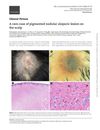
This study reported the case of a 30-year-old man with a bluish-grey scalp nodule that developed over a previously stable hairless plaque, revealing histopathological features consistent with epithelioid cell nests and spindle-shaped dermal melanocytes embedded in collagen.
7 citations
,
January 2013 in “Indian dermatology online journal” This report describes a rare case of a three-day-old male with ichthyosis hystrix type of epidermal nevus, featuring specific skin and hair symptoms but no nail or skeletal abnormalities.
January 2026 in “PLoS Biology” This study used developing mouse hair follicles to explore early epithelial bud formation, finding that the Rho GTPase regulator ARHGEF3 plays a crucial role in regulating cell fate and cadherin patterning, with knockouts showing disrupted morphology and increased straight hair follicle growth.
44 citations
,
May 2008 in “Acta Zoologica” This study explains how the development of keratin-associated proteins in embryonic epidermis is crucial for forming protective barriers in vertebrates, enabling them to adapt to terrestrial environments.
 January 2016 in “Elsevier eBooks”
 This review discusses three aspects of cell fate specification across Metazoa and reports no new experimental results, highlighting the formation of nematode equivalence groups, evolution of echinoderm skeletogenic mesoderm, and adult cell fate regulation.
January 2025 in “Arquivo Brasileiro de Medicina Veterinária e Zootecnia” In this study, researchers observed that telogen hair was more prevalent than anagen hair in both male and female agoutis over a one-year period in Teresina-PI, regardless of dry or rainy seasons, with no significant differences in dermal follicular volume between the sexes.
 50 citations
,
October 1918 in “The journal of experimental zoology”
50 citations
,
October 1918 in “The journal of experimental zoology” Artificially inducing hair regrowth in mice can change the normal pattern and timing of hair growth, with minimal color differences between old and new fur.
39 citations
,
November 2007 in “Journal of Histochemistry & Cytochemistry” This study found that in neonatal mice, the absence of the NG2 proteoglycan leads to reduced epidermal thickness and delayed subcutis thickening due to impaired proliferation and adipocyte deficiencies.
January 1981 in “Purdue e-Pubs (Purdue University)” This study observed that the pig integument is similar to human skin in both light and electron microscopy, with minimal postnatal developmental differences noted.
 1 citations
,
January 2023 in “Journal of Drugs in Dermatology”
1 citations
,
January 2023 in “Journal of Drugs in Dermatology” This review discusses Graham-Little Piccardi-Lasseur syndrome, a rare dermatosis with limited treatment options, emphasizing the importance of early diagnosis through physical exam and dermoscopy, but reports no new results.
 September 2020 in “bioRxiv (Cold Spring Harbor Laboratory)”
 This study found that zebrafish and stickleback fish use similar genetic programs for tooth regeneration, despite differences in their dental structures.
 47 citations
,
June 2016 in “JAMA Dermatology”
47 citations
,
June 2016 in “JAMA Dermatology” This study suggests men with early androgenetic alopecia might have hormonal profiles similar to women with polycystic ovarian syndrome, potentially indicating risk for related health complications.
January 2014 in “The Journal of Dermatology” This study reports that Korean adolescents with androgenetic alopecia tend to have milder symptoms than adults and a higher prevalence of family history of alopecia.
 56 citations
,
December 2011 in “The Plant Journal”
56 citations
,
December 2011 in “The Plant Journal” AGD1 is important for root hair development in Arabidopsis, working with phosphoinositide signaling and the actin cytoskeleton.