6 citations
,
August 2011 in “Anais Brasileiros de Dermatologia” This case report describes a 32-year-old man with therapy-resistant acneiform eruptions later diagnosed as vellus hair cysts, emphasizing the condition as a potential diagnostic consideration in similar cases.
This study reported that prompt diagnosis and treatment with 5-alpha-reductase inhibitors and topical immunomodulators are key to mitigating the effects of frontal fibrosing alopecia and preventing permanent hair loss.
 8 citations
,
December 2017 in “Journal of The American Academy of Dermatology”
8 citations
,
December 2017 in “Journal of The American Academy of Dermatology” This correspondence discusses the diagnostic criteria for frontal fibrosing alopecia but reports no new research findings, agreeing with many previously suggested criteria.
May 2025 in “Lasers in Surgery and Medicine” This study reported that nonablative monopolar radiofrequency therapy provided sustained reductions in both inflammatory and noninflammatory acne lesion counts and sebum production in participants with moderate-to-severe acne vulgaris, with high patient satisfaction and no significant adverse effects observed up to 12 months posttreatment.
1 citations
,
August 2024 in “Anais Brasileiros de Dermatologia” This review discusses the non-follicular skin manifestations of frontal fibrosing alopecia and how they affect diagnosis and treatment, but reports no new clinical results.
August 2026 in “Dermatology and Therapy” In this review, researchers outline the characteristics of scalp rosacea, an underrecognized inflammatory dermatosis, describing its multifactorial pathogenesis, diagnostic features, and management strategies, noting its clinical similarities with facial rosacea and the absence of standardized diagnostic criteria or therapeutic guidelines.
 February 2026 in “Cosmetics”
 This review examines the clinicopathologic features of perifollicular elastolysis and indicates that, while its presentation is consistent, there is a lack of high-certainty evidence for effective treatments.
 1 citations
,
April 2017 in “Journal of Investigative Dermatology”
1 citations
,
April 2017 in “Journal of Investigative Dermatology” In this study, D-OCT imaging revealed distinct structural and vascular changes in patients with frontal fibrosing alopecia, highlighting the technique's potential for diagnosing and monitoring the condition's activity.
 20 citations
,
February 2004 in “Clinical and Experimental Ophthalmology”
20 citations
,
February 2004 in “Clinical and Experimental Ophthalmology” This paper presents two cases of rare intraorbital ophthalmic artery aneurysms associated with arteriovenous malformations and discusses their clinical presentation, pathogenesis, and management, but reports no new clinical outcomes.
 13 citations
,
February 2004 in “Clinical and Experimental Ophthalmology”
13 citations
,
February 2004 in “Clinical and Experimental Ophthalmology” This report describes the clinical and histopathological features of lipoid proteinosis in a brother and sister with lid lesions, highlighting the importance of recognizing such lesions for diagnosis.
 5 citations
,
February 2004 in “Clinical and Experimental Ophthalmology”
5 citations
,
February 2004 in “Clinical and Experimental Ophthalmology” This study presents two cases correlating the clinical appearance of adult-onset foveomacular vitelliform dystrophy with optical coherence tomography findings, describing the location of the yellow vitelliform material.
 April 2019 in “Journal of Medical Science And clinical Research”
 This study observed that grey patch is the most common variant of tinea capitis in northeastern India, with T. violaceum being the predominant fungal isolate.
 August 2015 in “Dermatología Argentina”
 This study reviewed 18 postmenopausal women with frontal fibrosing alopecia, noting frontotemporal hairline recession and eyebrow loss, often treated with steroids, triamcinolone, and other medications.
 9 citations
,
February 2004 in “Clinical and Experimental Ophthalmology”
9 citations
,
February 2004 in “Clinical and Experimental Ophthalmology” This report documents the second known case of Castleman's disease in the lacrimal gland, diagnosed in an 84-year-old woman through histological examination after excising a left upper lid mass.
 11 citations
,
May 2010 in “Annals of the Academy of Medicine Singapore”
11 citations
,
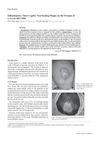
May 2010 in “Annals of the Academy of Medicine Singapore” This case report describes a 4-year-old girl in Singapore with inflammatory tinea capitis, which improved with oral griseofulvin and selenium sulfide shampoo.
 59 citations
,
June 2022 in “Frontiers in medicine”
59 citations
,
June 2022 in “Frontiers in medicine” This review discusses the complex causes and treatment challenges of chronic inflammatory skin diseases, emphasizing the need for biomarkers to predict treatment responses; it reports no new clinical results.
 44 citations
,
October 2017 in “British Journal of Dermatology”
44 citations
,
October 2017 in “British Journal of Dermatology” This review discusses the broadening scope of botulinum toxin applications beyond traditional uses, highlighting its effects on non-neuronal cells and potential in treating various dermatological conditions, without reporting new clinical findings.
 8 citations
,
August 1997 in “Australasian Journal of Dermatology”
8 citations
,
August 1997 in “Australasian Journal of Dermatology” This review discusses the distinctive non-infective skin presentations of HIV infection from a dermatological perspective and reports no new clinical findings.
 60 citations
,
September 2013 in “Alimentary Pharmacology & Therapeutics”
60 citations
,
September 2013 in “Alimentary Pharmacology & Therapeutics” This review discusses the dermatological adverse events from immunosuppressive and anti-TNF therapy in IBD, finding increased risks of non-melanoma skin cancer and other skin conditions, and recommends regular cancer screening.
 20 citations
,
January 2015 in “Polish Journal of Pathology”
20 citations
,
January 2015 in “Polish Journal of Pathology” Reflectance confocal microscopy is a useful, non-invasive tool for diagnosing some skin diseases, with potential for future improvements.
 April 2026 in “Frontiers in Medicine”
 This case study reports a 26-year-old male with secondary syphilitic alopecia misdiagnosed as alopecia areata, likely contracted through non-penetrative sexual contact. Effective treatment with intramuscular benzathine penicillin G led to complete hair regrowth within three months.

research Acne
2 citations
,
May 2011 in “Harper's Textbook of Pediatric Dermatology” Acne is a common skin condition linked to diet, hormones, and genetics, and early treatment can prevent scarring.
 November 2023 in “Berkala Ilmu Kesehatan Kulit dan Kelamin/Berkala ilmu kesehatan kulit dan kelamin (Periodical of dermatology and venerology)”
 This study suggests that using a dermoscope, a handheld microscope, can effectively help distinguish between Pityrosporum folliculitis and Acne vulgaris by revealing unique lesion characteristics that are not visible to the naked eye, offering a practical diagnostic alternative when KOH examinations are unavailable.
 18 citations
,
March 2004 in “Clinics in Dermatology”
18 citations
,
March 2004 in “Clinics in Dermatology” This review discusses recent advances in understanding the cellular, molecular, and genetic factors contributing to lupus erythematosus and reports no new experimental findings.
 7 citations
,
July 1999 in “In Practice”
7 citations
,
July 1999 in “In Practice” This article discusses the diagnostic approach to symmetrical alopecia in dogs, particularly focusing on conditions affecting the endocrine glands and hair follicles, without presenting new research results.
 1 citations
,
January 2014 in “Springer eBooks”
1 citations
,
January 2014 in “Springer eBooks” Adult acne is more common in women, often linked to hormones, and can be harder to treat.
 August 2017 in “Companion animal”
 This article discusses the diagnostic approach to focal alopecia in dogs, focusing on distinguishing between pruritic skin disease and inflammatory or non-inflammatory causes; it presents no new experimental results.
 January 2019 in “Medicine Science | International Medical Journal”
 This study found that specific skin lesions are common indicators of pediatric rheumatologic diseases, potentially aiding dermatologists and rheumatologists in diagnosis when biopsies are challenging.
 April 2021 in “International Journal of Research in Dermatology”
 This case report describes a 7-year-old child with linear lupus panniculitis of the scalp, treated successfully with a combination of hydroxychloroquine, topical and intralesional steroids, and a topical calcineurin inhibitor.
 14 citations
,
October 2019 in “International Journal of Women's Health”
14 citations
,
October 2019 in “International Journal of Women's Health” This article discusses the clinical presentation and management challenges of menopausal acne, noting its multifactorial etiology and recommending tailored treatment approaches based on acne severity and associated features, without reporting new clinical results.