 8 citations
,
December 2013 in “Journal of Investigative Dermatology Symposium Proceedings”
8 citations
,
December 2013 in “Journal of Investigative Dermatology Symposium Proceedings” This case report detailed alopecia universalis developing shortly after hepatitis C treatment with peg-interferon, ribavirin, and telaprevir, suggesting potential immune-related links between interferon treatment and alopecia areata.
 7 citations
,
February 2010 in “British Journal of Dermatology”
7 citations
,
February 2010 in “British Journal of Dermatology” A woman with a rare autoimmune disorder had a blister on her eye and unique immune reaction, which was effectively treated with medication.
7 citations
,
March 2001 in “Journal of the European Academy of Dermatology and Venereology” This case report highlights the complexity of lupus erythematosus/lichen planus overlap syndrome, noting a high potential for progression to systemic lupus erythematosus.
7 citations
,
January 1986 in “Prenatal Diagnosis” This study demonstrated that biochemical analysis of proteins from fetal skin biopsies is feasible, potentially enhancing prenatal diagnostic capabilities for protein-related disorders.
6 citations
,
January 2024 in “International Journal of Dermatology” This study examined FAERS data and found an increasing trend in alopecia areata cases, with monoclonal antibodies most frequently linked to the condition.
 6 citations
,
April 2020 in “Cureus”
6 citations
,
April 2020 in “Cureus” This case report presents a rare instance of coexistent tumid lupus erythematosus and systemic lupus erythematosus in a patient, with symptom improvement noted after hydroxychloroquine treatment.
6 citations
,
August 2008 in “Journal of Paediatrics and Child Health” This case report describes a 5-year-old girl whose undiagnosed Coeliac disease presented with symptoms of alopecia, iron deficiency anemia, and trichobezoar, indicating a link between malabsorption, anemia, and resulting pica.
5 citations
,
September 2021 in “Journal of cosmetic dermatology” This study found that alopecia areata patients had significantly abnormal T3, T4, TPOAbs, ANA, and lower vitamin D levels compared to healthy controls.
 5 citations
,
June 2021 in “Pharmacological Reports”
5 citations
,
June 2021 in “Pharmacological Reports” This study suggests that vitamin D treatment may be less effective in reducing thyroid autoimmunity for euthyroid men with early-onset androgenic alopecia compared to other men with autoimmune thyroiditis.
4 citations
,
January 2018 in “Health” This report describes the development of a low-cost method to mass-produce ostrich antibodies, which were shown to alleviate allergic reactions and demonstrate therapeutic effects in conditions such as atopic dermatitis, acne, and pollen allergies, potentially providing an alternative to steroids or antibiotics.
3 citations
,
May 2023 in “Journal of the American Academy of Dermatology” This study found that drug-induced alopecia areata was most commonly associated with TNF-alpha inhibitors and dupilumab, with most cases improving after discontinuing the medication.
3 citations
,
November 2022 in “The Egyptian Rheumatologist” This case report describes a rare instance where a young woman initially presented with macrophage activation syndrome as the first sign of systemic lupus erythematosus, and ultimately experienced multiorgan failure and death.
3 citations
,
January 2022 in “Modern Rheumatology Case Reports” This case report details a rare instance of simultaneous onset of systemic lupus erythematosus and IgG4-related disease in a 73-year-old woman, where treatment improved symptoms by using high-dose glucocorticoids, hydroxychloroquine, and belimumab.
 3 citations
,
November 2020 in “Cleveland Clinic Journal of Medicine”
3 citations
,
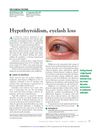
November 2020 in “Cleveland Clinic Journal of Medicine” Eyelash loss can be a sign of thyroid problems.
 3 citations
,
January 2019 in “Česká a slovenská farmacie”
3 citations
,
January 2019 in “Česká a slovenská farmacie” This review discusses various types of microneedles and their potential to expand the range of drugs delivered via the skin, but reports no new clinical results.
2 citations
,
June 2024 in “JAAD reviews.” In this review, researchers summarize drugs associated with scarring or permanent hair loss, notably after chemotherapy and tyrosine kinase inhibitor treatments, emphasizing the need for stronger evidence and long-term follow-up studies, as current findings are mostly from case reports.
 2 citations
,
January 2023 in “International journal of biological sciences”
2 citations
,
January 2023 in “International journal of biological sciences” This review discusses the mechanisms of hair repigmentation and reports no clinical results; the authors suggest further research into topical treatments for reversing gray hair.
2 citations
,
February 2021 in “Journal of comparative pathology” In this study, hyperplastic layers of scabietic sheep skin showed expansive keratin labeling, indicating altered keratin expression compared to healthy skin.
2 citations
,
September 2019 in “Neurology Neuroimmunology & Neuroinflammation” This case report describes a patient with autoimmune autonomic neuropathy associated with high-titer gAChR antibodies who developed selective pigmented hair loss during IV immunoglobulin treatment.
 2 citations
,
January 2004 in “Elsevier eBooks”
2 citations
,
January 2004 in “Elsevier eBooks” This article reviews historical uses of the term "lupus" for various skin disorders but provides no new clinical findings.
1 citations
,
January 2026 in “Science Advances” This study developed a 3D bioprinted skin model to mimic pemphigus vulgaris, providing a tool to study disease mechanisms and test targeted therapies by reproducing the architecture and pathogenic disruptions of native skin.
 1 citations
,
January 2025 in “OBM Geriatrics”
1 citations
,
January 2025 in “OBM Geriatrics” This study highlights the role of platelets in immune interactions and severe adenovirus infection, noting that activated platelets have a shorter lifespan. Results suggest potential for developing therapies targeting platelet senescence and immunologic mechanisms.
1 citations
,
April 2024 in “JDDG Journal der Deutschen Dermatologischen Gesellschaft” In this case report, the authors concluded that cutaneous lupus erythematosus was induced by the PD-1 inhibitor tislelizumab during treatment for metastatic lung adenocarcinoma, despite initial remission and treatment adjustments.
 1 citations
,
March 2024 in “Signal transduction and targeted therapy”
1 citations
,
March 2024 in “Signal transduction and targeted therapy” In this review, researchers explored the multifaceted role of NF-κB signaling in various biological processes and diseases, including its interactions with other pathways, and discussed possible therapeutic approaches targeting this pathway for treating conditions like cancer, autoimmune disorders, and COVID-19.
 1 citations
,
October 2022 in “Дерматовенерология Косметология”
1 citations
,
October 2022 in “Дерматовенерология Косметология” This article reviews skin toxicity classifications and management in patients undergoing molecularly targeted therapy, noting significant dermatotropic side effects associated with Epidermal Growth Factor Receptor Inhibitors.
 1 citations
,
October 2022 in “Rheumatology”
1 citations
,
October 2022 in “Rheumatology” This report describes a case of juvenile Rhupus syndrome in an 11-year-old girl, emphasizing the condition's rarity and the diagnostic challenges due to overlapping symptoms of juvenile idiopathic arthritis and systemic lupus erythematosus.
 1 citations
,
September 2022
1 citations
,
September 2022 This case report describes a patient who developed drug-induced lupus erythematosus after treatment with a monoclonal antibody combination against the SARS-CoV-2 surface protein, highlighting the need for careful follow-up.
 1 citations
,
November 2021 in “Advances in Dermatology and Allergology”
1 citations
,
November 2021 in “Advances in Dermatology and Allergology” This study described the clinical and pathologic characteristics of patients with cutaneous lupus erythematosus, noting that chronic cutaneous lupus was most common, with photosensitivity as a prevalent symptom.
1 citations
,
October 2021 in “Endokrynologia Polska” This study observed that levothyroxine therapy in men with autoimmune hypothyroidism was less effective at reducing thyroid antibodies and hormone disruptions in those with early-onset androgenetic alopecia compared to those without hair loss.
1 citations
,
January 2021 in “Journal of the American Academy of Dermatology” This study found that bullous lupus erythematosus lesions in cutaneous lupus erythematosus showed distinctive histopathology with neutrophilic predominance and were associated with severe disease and higher extracutaneous involvement.