July 2024 in “Clinical Case Reports” This study suggests that young females may experience a rare coexistence of Frontal Fibrosing Alopecia and ophiasis pattern Alopecia Areata, possibly sharing a common underlying pathophysiology.
 March 2021 in “bioRxiv (Cold Spring Harbor Laboratory)”
 This study found that the absence of Hif-p4h-2 in specific mouse skin cells disrupted hair follicle development, leading to hair loss due to irregular keratin formation and pathway signaling.
4 citations
,
January 2025 in “Diagnostics” This article reviews the use of high-frequency ultrasonography to visualize nail units and scalps in dermatology, highlighting its potential benefits for disease assessment and treatment monitoring, but reports no new clinical results.
 71 citations
,
October 2008 in “The journal of investigative dermatology/Journal of investigative dermatology”
71 citations
,
October 2008 in “The journal of investigative dermatology/Journal of investigative dermatology” This study presents a novel in vitro assay using human folliculoid microspheres to research hair growth, which may facilitate preclinical testing of hair growth-modulatory agents.
June 2020 in “Journal of Drugs in Dermatology” This case report highlights that frontal fibrosing alopecia can occur in black patients and may resemble androgenetic alopecia, underscoring the importance of considering FFA when diagnosing frontotemporal alopecia in this population.
 January 2022 in “Дерматологія та венерологія”
 This paper presents two cases of frontal fibrosing alopecia in postmenopausal women, noting challenges in monitoring due to the invasive nature of the diagnostic process.
 5 citations
,
April 2019 in “Journal of The American Academy of Dermatology”
5 citations
,
April 2019 in “Journal of The American Academy of Dermatology” This review discusses the complex nature of frontal fibrosing alopecia, suggesting it is a misnomer and possibly a subset of lichen planopilaris, but reports no new clinical results.
 1 citations
,
January 2018 in “Medical Science and Discovery”
1 citations
,
January 2018 in “Medical Science and Discovery” This review examines the characteristics of frontal fibrosing alopecia in postmenopausal women, highlighting the importance of biopsy for early diagnosis and potential treatment to prevent disease progression.
 September 2017 in “Journal of Investigative Dermatology”
 This study found that mackerel fermented fish oil protected human keratinocyte cells from UVB-induced oxidative stress by scavenging free radicals and reducing cellular damage.
2 citations
,
June 2020 in “Clinical Journal of Gastroenterology” This case report describes two patients with ulcerative colitis and alopecia areata who did not respond to various treatments but achieved remission and improved hair growth after starting tofacitinib.
September 2023 in “Journal of the American Academy of Dermatology” This study examined the application of new clinical guidelines for diagnosing frontal fibrosing alopecia in 18 men, highlighting that current diagnostic criteria may often overlook early beard involvement and sideburn recession.
 May 2019 in “Anais brasileiros de dermatologia/Anais Brasileiros de Dermatologia”
 This study reviewed 38 cases of frontal fibrosing alopecia, observing that diagnosis often occurs years after onset and is more prevalent in postmenopausal women.
 September 2014 in “Proceedings of SPIE, the International Society for Optical Engineering/Proceedings of SPIE”
 This study found that high-speed optical coherence tomography may be a promising non-invasive tool for analyzing human hair conditions.
October 2024 in “Benha Journal of Applied Sciences” This study of fifty female patients with frontal fibrosing alopecia in Egypt found that it is a complex condition with no definitive treatment, as it often co-occurs with lichen planus and thyroid issues.
54 citations
,
November 2007 in “Actas Dermo-Sifiliográficas” Early diagnosis of frontal fibrosing alopecia is crucial to prevent permanent hair loss.
1 citations
,
January 2024 in “Journal of personalized medicine” This narrative review suggests a strong association between abrupt hormonal imbalances and frontal fibrosing alopecia in women, especially related to reduced fertile years and certain hormonal therapies.
 May 2026 in “Scholars Journal of Medical Case Reports”
 In this report, researchers described a 36-year-old woman with frontal fibrosing alopecia resistant to standard treatments, who showed significant improvement after six months on a combination of intralesional betamethasone and oral hydroxychloroquine, suggesting potential benefits of this therapy approach in managing the condition.
4 citations
,
March 2019 in “JAT. Journal of applied toxicology/Journal of applied toxicology” In this study, PFOS exposure altered steroid hormone levels and enzyme activities related to steroidogenesis in juvenile Silurana tropicalis, with effects differing between male and female frogs.
 26 citations
,
June 2018 in “Australasian Journal of Dermatology”
26 citations
,
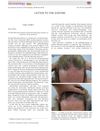
June 2018 in “Australasian Journal of Dermatology” Stopping sunscreen use on the forehead led to hair regrowth in a woman with frontal fibrosing alopecia.
July 2026 in “Dermatology Practical & Conceptual” This review assessed trichoscopic findings in folliculotropic mycosis fungoides of the scalp, reporting features like milky-red globules and distinct vascular patterns, but noted the predominance of small studies and the need for larger research to validate trichoscopy's diagnostic utility for this condition.
 3 citations
,
November 2020 in “Clinical, Cosmetic and Investigational Dermatology”
3 citations
,
November 2020 in “Clinical, Cosmetic and Investigational Dermatology” This review summarizes the current treatment modalities for frontal fibrosing alopecia and provides a practical guide for clinicians, but reports no new clinical results.
 339 citations
,
February 2014 in “Journal of The American Academy of Dermatology”
339 citations
,
February 2014 in “Journal of The American Academy of Dermatology” This study found that eyelash loss, facial papules, and body hair involvement were linked to severe frontal fibrosing alopecia, and antiandrogens were the most effective treatment.
3 citations
,
December 2024 in “Stem Cell Reports” In this study, researchers observed that low levels of fucose-binding lectin staining characterize limbal epithelial progenitor cells, which maintain a high proliferative capacity and may be enhanced by inhibiting fucosylation, offering insights for regenerative therapy of the limbal stem cell niche.
 2 citations
,
April 2023 in “Cutis”
2 citations
,
April 2023 in “Cutis” This systematic review discusses the treatment characteristics and outcomes for frontal fibrosing alopecia specifically in Black patients with skin of color, addressing a gap in clinical evidence due to underrepresentation in studies.
 July 2024 in “Iranian journal of pathology”
 This study described the clinicopathological features of patients with frontal fibrosing alopecia who underwent skin biopsies.
April 2024 in “Journal of clinical medicine” This review discusses various therapeutic options for frontal fibrosing alopecia and highlights the need for more research, as existing data are largely retrospective and lack precise treatment guidelines.
This study found that fibroblast growth factor 20 (Fgf20) orchestrates the movement and behavior of dermal fibroblasts, directing their formation into dermal condensates during hair follicle development in mice.
 102 citations
,
April 2014 in “International Journal of Dermatology”
102 citations
,
April 2014 in “International Journal of Dermatology” This study found that early intervention and treatment with intralesional triamcinolone acetonide may stabilize hairline recession in patients with frontal fibrosing alopecia, although further research is needed for definitive treatment guidelines.
4 citations
,
April 2019 in “DOAJ (DOAJ: Directory of Open Access Journals)” This review highlights available treatments for frontal fibrosing alopecia, noting that 5-alpha reductase inhibitors, intralesional steroids, and hydroxychloroquine currently have the most evidence supporting their use, while other treatments show variable results and require further study.
 April 2024 in “International Journal of Women’s Dermatology”
 This case report highlights the potential for laser hair reduction treatments to trigger Fox-Fordyce disease, a chronic skin disorder, and underscores the need for awareness and management strategies among patients and clinicians.