July 2024 in “Clinical Case Reports” This study suggests that young females may experience a rare coexistence of Frontal Fibrosing Alopecia and ophiasis pattern Alopecia Areata, possibly sharing a common underlying pathophysiology.
 October 2020 in “International Journal of Research in Dermatology”
 This review discusses the possible immune-mediated and environmental factors contributing to frontal fibrosing alopecia but reports no new clinical findings, emphasizing the need for standardized treatment evaluations.
 2 citations
,
July 2021 in “JAAD Case Reports”
2 citations
,
July 2021 in “JAAD Case Reports” This case study suggests that trichoscopic examination of the beard can aid in diagnosing frontal fibrosing alopecia in men, especially when challenging to differentiate from androgenetic alopecia.
 20 citations
,
January 2016 in “Intractable & Rare Diseases Research”
20 citations
,
January 2016 in “Intractable & Rare Diseases Research” In this clinical experience, treating frontal fibrosing alopecia with oral finasteride, hydroxychloroquine, tacrolimus, and excimer laser was associated with optimal results in patients with active inflammation.
 May 2015 in “Journal of the American Academy of Dermatology”
 Certain drugs and supplements may contribute to hair loss in the frontal hairline in older women.

In this retrospective study, researchers at a Spanish hospital found that the severity of frontal fibrosing alopecia, primarily affecting postmenopausal women, was correlated with the duration of the disease, though inflammatory signs were not linked with its progression.

This review discusses the potential link between contact allergy and frontal fibrosing alopecia, noting the presence of implicated allergens in current literature, but reports no new clinical findings.
 1 citations
,
November 2023 in “Contact dermatitis”
1 citations
,
November 2023 in “Contact dermatitis” In this study, sensitization to ethylhexyl salicylate was found in 27.3% of patients with frontal fibrosing alopecia, suggesting it may be a potential contact allergen for this condition.
November 2021 in “CRC Press eBooks” This article discusses female pattern androgenic alopecia, emphasizing its impact on women's lives and highlighting the need for further research into effective treatments, but reports no new clinical results.
3 citations
,
January 2025 in “Journal of the American Academy of Dermatology” Early diagnosis and a multidisciplinary approach are crucial for managing Frontal Fibrosing Alopecia.
 September 2017 in “Journal of Dermatology & Cosmetology”
 This study reports a case of frontal fibrosing alopecia associated with hepatitis C treatment involving interferon and ribavirin.
June 2020 in “International Journal of Women’s Dermatology” This case report highlights the importance of considering frontal fibrosing alopecia in young women, emphasizing early diagnosis to preserve hair and limit inflammation.
8 citations
,
July 2020 in “Clinical, cosmetic and investigational dermatology” This review hypothesizes that excessive facial photo-protection may contribute to frontal fibrosing alopecia by disrupting immunological homeostasis through the aryl hydrocarbon receptor-kynurenine pathway, but it reports no new clinical results.
October 2025 in “Clinical and Experimental Dermatology” Among patients with biopsy-proven FAPD in specialized hair clinics, this study found the condition is common in females around 52.5 years old, with treatment generally stabilizing or slightly improving hair loss, despite challenges in differentiating FAPD from androgenetic alopecia.
 May 2019 in “Anais brasileiros de dermatologia/Anais Brasileiros de Dermatologia”
 This study reviewed 38 cases of frontal fibrosing alopecia, observing that diagnosis often occurs years after onset and is more prevalent in postmenopausal women.
 98 citations
,
January 2013 in “Journal of The American Academy of Dermatology”
98 citations
,
January 2013 in “Journal of The American Academy of Dermatology” This study reported that while various treatments for frontal fibrosing alopecia showed limited effectiveness, dutasteride most effectively stabilized the condition among patients at Duke University.
23 citations
,
May 2017 in “Journal of the American Academy of Dermatology” This study found that patients with frontal fibrosing alopecia had lower epidermal melanocyte counts and reduced epidermal thickness compared to lichen planopilaris patients and controls, suggesting a link with hypopigmentation.
This study found that the Arabidopsis thaliana protein Formin 2 localizes to plasmodesmata and is crucial for regulating their permeability by anchoring actin filaments, which affects virus susceptibility.
This study examined epidemiological data on patients with frontal fibrosing alopecia in Greece and found demographic patterns consistent with international studies.
July 2019 in “Medical Science and Discovery” This study retrospectively analyzed 14 postmenopausal women with frontal fibrosing alopecia, noting that 57% experienced total eyebrow loss, and all received various steroid treatments, highlighting the importance of early diagnosis to potentially delay disease progression.
7 citations
,
December 2023 in “International Journal of Molecular Sciences” This study demonstrated that Forsythiaside A protected against oxidative stress in both cell models and a mouse model of liver damage, suggesting its potential as a liver-protective agent.
4 citations
,
April 2019 in “DOAJ (DOAJ: Directory of Open Access Journals)” This review highlights available treatments for frontal fibrosing alopecia, noting that 5-alpha reductase inhibitors, intralesional steroids, and hydroxychloroquine currently have the most evidence supporting their use, while other treatments show variable results and require further study.
1 citations
,
January 2024 in “Journal of personalized medicine” This narrative review suggests a strong association between abrupt hormonal imbalances and frontal fibrosing alopecia in women, especially related to reduced fertile years and certain hormonal therapies.
54 citations
,
November 2007 in “Actas Dermo-Sifiliográficas” Early diagnosis of frontal fibrosing alopecia is crucial to prevent permanent hair loss.
 17 citations
,
October 2017 in “Journal of Cutaneous Medicine and Surgery”
17 citations
,
October 2017 in “Journal of Cutaneous Medicine and Surgery” This review discusses the various treatment options for frontal fibrosing alopecia but reports no definitive results, as no treatment has proven effective in halting hairline recession or promoting hair growth.
 5 citations
,
August 2014 in “Journal of The American Academy of Dermatology”
5 citations
,
August 2014 in “Journal of The American Academy of Dermatology” This article notes slow progression and spontaneous stabilization in untreated cases of a specific scarring alopecia and reports no new results; the authors call for randomized trials to confirm the treatment's benefit.
April 2021 in “Aktuelle Dermatologie” This review discusses frontal fibrosing alopecia, noting its clinical characteristics, possible environmental factors, and lack of evidence-based therapies, but reports no new research findings.
 April 2023 in “Journal of Investigative Dermatology”
 This study suggests that linalool, a common allergen in personal care products, may contribute to frontal fibrosing alopecia pathogenesis by triggering immune responses and depleting hair follicle stem cells, especially in sensitized individuals.
 16 citations
,
January 2007 in “Actas dermo-sifiliográficas/Actas dermo-sifiliográficas”
16 citations
,
January 2007 in “Actas dermo-sifiliográficas/Actas dermo-sifiliográficas” This review discusses frontal fibrosing alopecia and reports no clinical results; the authors note that no therapeutic options tested, including corticosteroids, finasteride, and minoxidil, have shown clear benefits.
 16 citations
,
February 2010 in “Journal of the European Academy of Dermatology and Venereology”
16 citations
,
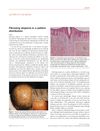
February 2010 in “Journal of the European Academy of Dermatology and Venereology” This article is a letter to the editor about fibrosing alopecia in a pattern distribution and reports no new research findings.