This study found that fibroblasts from Emery-Dreifuss muscular dystrophy patients with certain genetic mutations overexpress markers of fibrosis, and gene correction techniques reduced fibrogenic molecule expression in cell models, suggesting potential therapeutic applications.
 1 citations
,
August 2023 in “The Journal of Pathology”
1 citations
,
August 2023 in “The Journal of Pathology” In this source, recent single-cell RNA-sequencing advances reveal significant transcriptional heterogeneity among skin fibroblasts, and the discussion focuses on the distinct subtypes' roles in skin homeostasis, repair, and their evolution in fibrotic diseases like keloid scars and cancer.
159 citations
,
September 2018 in “Journal of Investigative Dermatology” This study identified two cell surface markers, FAP and CD90, that distinguish between papillary and reticular fibroblasts in human skin, suggesting distinct functions and distribution in dermal layers.
November 2025 in “OPAL (Open@LaTrobe) (La Trobe University)” In this study, researchers conducted additional IHC staining on equine skin sections and found that collagen type III primarily labels the extracellular matrix, while anti-PDGFR-antibody staining highlights cells with long-shaped processes mainly arranged around hair follicles.
3 citations
,
May 2024 in “Indian Journal of Dermatology” In this case report, researchers identified a potential adverse skin reaction, called SDRIFE or Baboon syndrome, caused by the drug tofacitinib in a 19-year-old woman being treated for alopecia subtotalis, leading the authors to recommend discontinuation of the drug.
 16 citations
,
February 2018 in “Journal of The American Academy of Dermatology”
16 citations
,
February 2018 in “Journal of The American Academy of Dermatology” This study found that scalp involvement in dermatomyositis consistently shows a nonscarring pattern with chronic telogen effluvium, featuring telangiectasia and mucin deposition as universal histologic markers.
September 2017 in “Journal of Investigative Dermatology” RCS-01 is safe and may help rejuvenate aging skin.
 5 citations
,
January 2017 in “Anais brasileiros de dermatologia/Anais Brasileiros de Dermatologia”
5 citations
,
January 2017 in “Anais brasileiros de dermatologia/Anais Brasileiros de Dermatologia” This review reports two new cases of porokeratotic eccrine and hair follicle nevus and analyzes all known cases in the Spanish and English literature, suggesting a link to a GJB2 gene mutation.
June 2024 in “Annals of Medicine and Surgery” Surgeons should know about pilomatricoma for accurate diagnosis, even though it's rare.
29 citations
,
February 1989 in “Journal of Cutaneous Pathology” This case report identifies a new type of hair matrix tumor called "rippled pattern trichomatricoma," distinguished by its unique cell arrangement and differentiation features.

In this case report, researchers detailed a giant proliferating pilomatrixoma in a 36-year-old woman, emphasizing the importance of complete excision to prevent recurrence or potential malignant transformation, distinguishing it from malignancies like angiosarcoma or melanoma.
August 2022 in “Actas Dermo-Sifiliográficas” 18 citations
,
March 2009 in “Experimental Dermatology” This study suggests that pilomatricoma can differentiate towards various hair follicle structures, including hair matrix, hair cortex, follicular infundibulum, outer root sheath, and hair bulge.
 January 2025 in “International Journal of Dermatology”
 This case report describes a patient with eruptive tumor of follicular infundibulum, emphasizing the need for dermatologists to include it in the differential diagnosis of acquired facial hypopigmentation.
2 citations
,
January 2019 in “Skin appendage disorders” This article reports a case of frontal fibrosing alopecia in its early inflammatory stage that responded positively to intralesional steroid treatment.
 February 2026 in “Journal of Cutaneous and Aesthetic Surgery”
 In this study, a case of a 20-year-old woman revealed ectopic acanthosis nigricans at a post-syndactyly-release surgical site, suggesting this rare condition could result from epidermal–dermal mismatch and altered growth factor signaling in grafted skin, without indicating any metabolic or malignancy concerns.
 23 citations
,
January 2015 in “Journal of The American Academy of Dermatology”
23 citations
,
January 2015 in “Journal of The American Academy of Dermatology” This study found that patients with myotonic dystrophy type 1 had higher numbers of nevi, dysplastic nevi, melanomas, and pilomatrixomas compared to age- and sex-matched controls.
January 1982 in “Clinical Cosmetic and Investigational Dermatology” This case report describes a 54-year-old woman with familial dyskeratotic comedones who experienced slight improvement in her skin lesions after three months of treatment with topical retinoids and urea cream.
 1 citations
,
January 2019 in “Acta dermato-venereologica”
1 citations
,
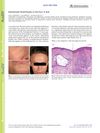
January 2019 in “Acta dermato-venereologica” The woman's skin and hair symptoms were confirmed as frontal fibrosing alopecia, and while facial papules are common in such cases, there's no effective local treatment, but systemic treatments can help.
 December 2020 in “Dermatología argentina”
 This case report describes a patient with psoriasis who developed vesiculobullous dermatitis on the palms and soles after starting treatment with secukinumab.
September 2023 in “Journal of the American Academy of Dermatology” A rare benign scalp tumor in an infant requires surgical removal.
 4 citations
,
December 2017 in “International Journal of Biomedicine”
4 citations
,
December 2017 in “International Journal of Biomedicine” In this study, the introduction of autofibroblasts into ischemic wounds was found to be slightly less favorable for regenerative histogenesis compared to a dermal equivalent with heterofibroblasts, with minor differences in epidermis thickness, collagen fiber area, and blood vessel area.
 4 citations
,
May 2021 in “The American Journal of Surgical Pathology”
4 citations
,
May 2021 in “The American Journal of Surgical Pathology” This study suggests that cutaneous lymphadenoma is a distinct benign lymphoepithelial tumor characterized by androgen receptor expression, hair follicle stem cell markers, and common EGFR gene mutations.
 32 citations
,
January 2012 in “International Journal of Dermatology”
32 citations
,
January 2012 in “International Journal of Dermatology” This study reported that the most common skin side effect of epidermal growth factor receptor inhibitors was a papulopustular rash, treatable with symptom-targeted therapies, while drug suspension was rarely needed.
 11 citations
,
August 2017 in “American Journal of Dermatopathology”
11 citations
,
August 2017 in “American Journal of Dermatopathology” This study found that the Elastic Verhoeff–Van Gieson stain may help differentiate between follicular streamers and scars in cicatricial and noncicatricial alopecias by highlighting differences in the elastic fiber network on horizontal scalp biopsy sections.
40 citations
,
August 2021 in “International Journal of Molecular Sciences” This review discusses the role of fascial mobilization in wound healing and its potential implications for treating chronic skin wounds and scarring, but reports no new clinical results.
 January 2023 in “Indian dermatology online journal”
 This case study highlights that sarcoidosis lesions can occur following hair removal by waxing, emphasizing the need to consider superficial traumas as potential triggers for cutaneous sarcoidosis.
323 citations
,
November 1984 in “Journal of Investigative Dermatology” July 2024 in “LA Referencia (Red Federada de Repositorios Institucionales de Publicaciones Científicas)” This study observed that while anomalous adipose tissue and displaced eccrine glands were common in certain types of scarring alopecia, these findings did not assist in diagnosis.