March 2024 in “International journal of molecular sciences” This study found that human meibomian glands differ significantly from free and hair-associated sebaceous glands in morphology and lipid composition, making them highly specialized holocrine glands.
October 2024 in “Dermatology Practical & Conceptual” This study found that trichoscopy is a valid and sensitive tool for diagnosing and evaluating eyebrow involvement in lichen planopilaris and frontal fibrosing alopecia.
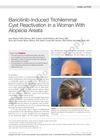
Baricitinib may reactivate trichilemmal cysts in people with a history of these cysts.
19 citations
,
July 1997 in “British Journal of Dermatology” This study successfully developed and characterized a monospecific monoclonal antibody, LHTric-1, that specifically localizes to the pre-cortical region of the hair follicle and can aid research on hair and nail formation.
11 citations
,
January 2016 in “Biointerphases” This study suggests that the outermost hair cuticle surface is rich in 18-methyleicosanic acid (18-MEA), supporting previous findings of its multilayer lipid and protein structure.
 December 2024 in “Genome Biology and Evolution”
 This study found that the Florida worm lizard has lost certain genes associated with claw development, which are present in other lizard species with claws, suggesting a link between the evolution of their limbless body and the loss of claw-related genes.
 2 citations
,
August 2012 in “Journal of the American Academy of Dermatology”
2 citations
,
August 2012 in “Journal of the American Academy of Dermatology” This correspondence describes two patients with both epidermolysis bullosa simplex, Dowling-Meara type, and loose anagen hair syndrome, an association not previously reported in the literature.
17 citations
,
November 1967 in “American Journal of Anatomy” This study observed that the catagen phase in hairless mice displayed a slower shortening of the mutant epithelial column, resulting in longer total follicle length and abnormalities in the connective tissue sheath and glassy membrane.
December 2001 in “中華皮膚科醫學雜誌” This case report describes a rare instance of sebaceous trichofolliculoma identified in an 18-year-old boy, characterized by a dermal nodule on the nasal bridge with distinct histological features.
 March 2025 in “Canadian dermatology today.”
 In this case series, treatment with clascoterone cream 1% was reported to be effective and well tolerated for diverse acne vulgaris patients, improving clinical outcomes whether used alone or in combination with other therapies, and addressing various other skin conditions.
January 2024 in “Skin Appendage Disorders” July 2025 in “Dermatologic Surgery” 15 citations
,
November 2009 in “Journal of Comparative Pathology” Epidermolysis bullosa in calves was not caused by mutations in the keratin genes bKRT5 and bKRT14.
43 citations
,
July 1994 in “Journal of Cell Science” This study found that the extraction-resistant structures in hair, feathers, and hagfish teeth are due to ε-(γ-glutamyl)lysine cross-linked proteins, emphasizing their role in maintaining the integrity of these materials.
 44 citations
,
March 1991 in “International Journal of Dermatology”
44 citations
,
March 1991 in “International Journal of Dermatology” This article presents two cases of tinea capitis in postpubertal individuals highlighting the importance of early treatment to prevent scarring and permanent hair loss; it reports no new clinical results.
 3 citations
,
August 2019 in “Journal of The American Academy of Dermatology”
3 citations
,
August 2019 in “Journal of The American Academy of Dermatology” Clascoterone safely promotes hair growth similar to minoxidil.
 23 citations
,
September 2014 in “JEADV. Journal of the European Academy of Dermatology and Venereology/Journal of the European Academy of Dermatology and Venereology”
23 citations
,
September 2014 in “JEADV. Journal of the European Academy of Dermatology and Venereology/Journal of the European Academy of Dermatology and Venereology” This case report describes successful CO2 ablation treatment of porokeratotic adnexal ostial nevus in an 8-year-old boy, with marked improvement over a 12-year follow-up.
4 citations
,
May 2013 in “JAMA Facial Plastic Surgery” In this study, most patients who underwent endoscopic brow-lift reported being satisfied with the procedure, noting improvements in appearance and confidence, with minimal and short-lived side effects.
5 citations
,
January 2021 in “Indian Journal of Pathology and Microbiology” This case report describes a rare occurrence of a solitary fibrofolliculoma in the right lower eyelid of a 50-year-old man, confirmed through histopathological examination.
19 citations
,
October 2022 in “The Ocular Surface” June 2021 in “Faculty Opinions – Post-Publication Peer Review of the Biomedical Literature” The researchers reported that basement membrane heterogeneity, especially laminin α5 composition, plays a critical role in distinct inter-tissue interactions and hair cycle regulation in mouse hair follicles.
 1 citations
,
January 2006
1 citations
,
January 2006 This study found a positive association between bilateral diagonal earlobe crease and bilateral preauricular crease with coronary artery disease, with both creases together predicting the disease with 90% accuracy.
 17 citations
,
January 2009 in “Nippon Ishinkin Gakkai Zasshi”
17 citations
,
January 2009 in “Nippon Ishinkin Gakkai Zasshi” This case report details a 10-year-old boy diagnosed with kerion celsi caused by Microsporum gypseum, successfully treated with itraconazole over 4.5 months.
 7 citations
,
November 2017 in “Cureus”
7 citations
,
November 2017 in “Cureus” This report introduces a new potential sign, paired ear creases of the helix, which may have relevance to cardiovascular disease similar to diagonal ear lobe creases, in a case of coronary artery disease.
 April 2023 in “bioRxiv (Cold Spring Harbor Laboratory)”
 This study identifies key transcriptomic features and a necessary dermal niche for eccrine gland development, advancing potential regenerative approaches for these vital skin appendages.
October 2025 in “Indian Dermatology Online Journal” This study explored how using kitchen-related analogies for dermatological signs, like comparing certain appearances to common culinary items, can enhance understanding and retention of complex medical concepts in dermatology.
 March 2026 in “Zenodo (CERN European Organization for Nuclear Research)”
 This review compiles existing knowledge on the botanical characteristics, traditional uses, phytochemistry, and pharmacological activities of Eclipta alba, highlighting its potential therapeutic properties and encouraging further pharmacological and phytochemical exploration of this traditionally used medicinal plant.
11 citations
,
January 1977 in “Archives of dermatological research” Mouse tail skin has different keratinization near hair follicles and scales.
 3 citations
,
April 2016 in “Dermatologic Surgery”
3 citations
,
April 2016 in “Dermatologic Surgery” This abstract provides author contact details but presents no study findings or results.
 July 2026 in “International Journal of Drug Delivery Technology”
 This research reported that liposomal systems made from pig-derived skin lipids enhanced finasteride delivery to hair follicles for treating androgenetic alopecia, showing improved drug deposition, hair length, and growth compared to conventional finasteride forms in vitro.