2 citations
,
October 2025 in “Antimicrobial Agents and Chemotherapy” This study found that cepharanthine may be a promising treatment for enterovirus infections, as it offered full protection to mice against lethal EV71 challenges and reduced viral titers and pathology.
 15 citations
,
September 2018 in “Dermatologic therapy”
15 citations
,
September 2018 in “Dermatologic therapy” In this study, the use of two emollients significantly reduced itching severity in individuals with xerotic eczema, starting 30 minutes post-application, and improved skin moisture and lipid content over 14 days, while demonstrating good tolerance with few adverse events.
 July 2022 in “Dermatology Reports”
 This report details a case of a 58-year-old male diagnosed with erosive pustular dermatosis of the scalp, which improved following 3-5 weeks of treatment with topical clobetasol proprionate.
 October 2018 in “Journal of the European Academy of Dermatology and Venereology”
 This abstract provides issue information for the Journal of the European Academy of Dermatology and Venereology without presenting any new research results.
36 citations
,
September 2015 in “Orphanet Journal of Rare Diseases” This review discusses ichthyosis with confetti, highlighting its genetic basis, clinical features, diagnostic criteria, and current treatment options but reports no new clinical results.
 June 2019 in “Journal of Aesthetic Nursing”
 This article describes Amy Senior's evolving views on the Joint Council for Cosmetic Practitioners and reports no new research findings.
 November 2020 in “bioRxiv (Cold Spring Harbor Laboratory)”
 This study found that the Polycomb Repressive Complex 2, particularly its component Ezh2, is crucial in regulating dermal fibroblast differentiation and epidermal keratinocyte proliferation during murine skin development.
60 citations
,
December 1988 in “Journal of Biochemical Toxicology” In this study, TCDD administered to male rats down-regulated EGF receptor in liver plasma membranes and increased protein kinase activity, suggesting EGF receptor–mediated toxicological effects.
 August 2023 in “Eureka: Health Sciences”
 In this study, researchers investigated the prevalence and types of skin diseases among elders at a medical facility in India, finding that generalised pruritus, seborrheic keratosis, and fungal infections were common, while education on proper skin care may help reduce these conditions.
 43 citations
,
August 2016 in “International Journal of Nanomedicine”
43 citations
,
August 2016 in “International Journal of Nanomedicine” This study found that a eupafolin nanoparticle delivery system improved water solubility and skin penetration, enhancing its antioxidant and anti-inflammatory effects against particulate matter-induced stress in skin cells.
January 2026 in “Journal of the European Academy of Dermatology and Venereology”  June 2020 in “bioRxiv (Cold Spring Harbor Laboratory)”
 This study found that the HoxC gene cluster is crucial for the development of hair and nails in mice, with key regulation by two mammalian-specific enhancers.
1 citations
,
June 2025 in “Journal of Veterinary Internal Medicine” In this case study, a miniature donkey with multisystemic eosinophilic epitheliotropic disease was euthanized due to laminitis despite treatment for pruritus, inappetence, hypertriglyceridemia, and alopecia.
 November 2010 in “Value in Health”
 Treating chronic hand eczema costs about the same in statutory and occupational health insurances in Germany, but work-related cases may lead to higher indirect costs due to longer work absences.
 6 citations
,
September 2022 in “Frontiers in pharmacology”
6 citations
,
September 2022 in “Frontiers in pharmacology” In this study, Epimedii Folium extract was found to enhance melanin production and promote pigmentation through mechanisms involving the MAPK/ERK1/2 pathway in both in vitro and in vivo models.
75 citations
,
January 2004 in “Molecular and Cellular Biology” In this study, EDA-A2 transgenic mice exhibited multifocal myodegeneration dependent on XEDAR, suggesting a potential role for XEDAR in skeletal muscle homeostasis.
August 2026 in “Acta Innovations” This study found that Eclipta alba (L.) Hassk herbal oil formulated with VCO demonstrated enhanced antioxidant, anti-inflammatory, and antibacterial activities, and provided UV protection, with EHO-18 identified as the best-performing version.
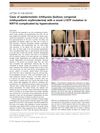 October 2011 in “Journal of dermatology”
 A man with a rare skin condition and a new gene mutation developed high calcium levels due to his treatment.
 1 citations
,
April 2023 in “Frontiers in Genetics”
1 citations
,
April 2023 in “Frontiers in Genetics” This report on individuals with AEBP1-related classical-like EDS confirmed previous findings and identified hair loss as a potential characteristic feature of this rare condition for the first time. Additionally, cardiovascular complications observed in some individuals suggest that cardiovascular monitoring may be necessary.
 April 2023 in “bioRxiv (Cold Spring Harbor Laboratory)”
 This study identifies key transcriptomic features and a necessary dermal niche for eccrine gland development, advancing potential regenerative approaches for these vital skin appendages.
 September 2020 in “Kocatepe Veterinary Journal”
 This study suggests that equine adipose tissue stem cells may be a promising option for cellular regenerative therapy in equines due to their differentiation capabilities and proliferation potential, but further molecular characterization is needed.

In this laboratory study, the methanolic extract of Eclipta alba demonstrated significant anthelmintic activity against earthworms (Pheretima posthuma), causing paralysis and death at doses of 50-100 mg/ml, with stronger effects observed at higher concentrations compared to the standard treatment, albendazole.
 January 2023 in “Indian dermatology online journal”
 This case report describes a novel NECTIN4 gene mutation linked to ED-syndactyly syndrome 1 in a young girl, contributing to the understanding of this rare ectodermal dysplasia.
January 2026 in “Al-Furat Journal for Health and Medical Sciences” This study observed that individuals with alopecia areata who had the gut bacterium Enterococcus faecalis exhibited serum biomarker levels closer to healthy controls, suggesting potential benefits for hair growth and immune modulation through its immunoregulatory effects.
November 2025 in “Chemistry - An Asian Journal” This perspective reviews enzyme-instructed self-assembly (EISA) as a conceptual framework for supramolecular chemical biology, emphasizing its innovative role in developing adaptive biomaterials and synthetic cellular machines without providing new experimental results.
 243 citations
,
October 2003 in “Developmental biology”
243 citations
,
October 2003 in “Developmental biology” This study identified ectodin as a novel BMP inhibitor that modulates BMP signaling in ectodermal development by interacting with SHH and FGF pathways.
 31 citations
,
August 2005 in “The American Journal of Dermatopathology”
31 citations
,
August 2005 in “The American Journal of Dermatopathology” This study investigated the histopathology of ectodermal dysplasia/skin fragility syndrome, identifying specific skin and hair abnormalities associated with PKP1 gene mutations in two young female patients.
164 citations
,
December 1984 in “Proceedings of the National Academy of Sciences” This study found that TCDD significantly reduced EGF receptor binding in various animal models, linked to toxic symptoms like weight loss and developmental delays, with receptor phosphorylation persisting several days.
9 citations
,
May 2022 in “Actas Dermo-Sifiliográficas” This study found that basal cell carcinoma exhibits altered expression patterns of CD10, p63, BCL-2, and EMA proteins compared to normal skin, with notable differences in staining and reactivity.
May 2024 in “NATIONS UNIVERSITY INTERNATIONAL JOURNAL OF MULTI-DISCIPLINARY STUDIES” This study aimed to determine the phenolic compound composition in Equisetum arvense stem extracts using HPLC, as the plant is commonly used in cosmetics for skin and hair care, but results are not reported here.