 3 citations
,
April 2014 in “Journal of Dietary Supplements”
3 citations
,
April 2014 in “Journal of Dietary Supplements” This study found that CARI ONE, a herbal mixture, promotes hair growth in mice by inducing the transition from telogen to anagen phase and enhancing hair follicle development, compared to control and minoxidil treatments.
 January 2023 in “Frontiers in bioscience”
 This study suggests that Artemis, particularly phosphorylated at serine 516, may have roles in hair follicle growth by influencing differentiation, proliferation, apoptosis, and cell cycling.
 April 2023 in “The journal of investigative dermatology/Journal of investigative dermatology”
 This study found that inhibiting the Mitochondrial Pyruvate Carrier in human hair follicles ex vivo activated the integrated stress response, affecting cell proliferation and metabolism.
This study found that the survival and proliferation of mouse melanocytes expressing the GNAQQ209L oncogene were impaired by interactions with the epidermal microenvironment, suggesting a possible mechanism for the rarity of these mutations in epidermal melanomas.
 87 citations
,
August 2017 in “Scientific Reports”
87 citations
,
August 2017 in “Scientific Reports” This study found that PCL-based nanofiber scaffolds enhanced cell proliferation and extracellular matrix deposition, suggesting they show promise as a cell delivery system for improving skin wound healing.
71 citations
,
October 2014 in “The Journal of Steroid Biochemistry and Molecular Biology” This study highlights the complex role of the vitamin D receptor in skin processes, where its disruption, along with calcium and co-regulator imbalances, could contribute to skin cancer development by altering skin differentiation and hair follicle cycling.
 48 citations
,
March 2019 in “Frontiers in Physiology”
48 citations
,
March 2019 in “Frontiers in Physiology” This review discusses the typical wound healing process in skin and the oral cavity, and emphasizes the research focus on achieving scarless healing in adult skin, but reports no new clinical results.
4 citations
,
December 1995 in “Archives of Dermatological Research” November 2024 in “Journal of Investigative Dermatology” This study found that recombinant human ADM2 treatment inhibited cell proliferation and induced apoptosis in human hair follicles, contrasting with the previously documented pro-proliferative and anti-apoptotic functions of ADM2.
 6 citations
,
April 1996 in “Journal of histochemistry and cytochemistry/The journal of histochemistry and cytochemistry”
6 citations
,
April 1996 in “Journal of histochemistry and cytochemistry/The journal of histochemistry and cytochemistry” This study suggests that TGF-alpha may function in an autocrine or juxtacrine manner rather than promoting cell proliferation during hair growth cycles in ferrets and sheep.
 57 citations
,
March 2018 in “International Journal of Molecular Sciences”
57 citations
,
March 2018 in “International Journal of Molecular Sciences” This review highlights recent advances in understanding how the extracellular matrix regulates epidermal stem cell fate, emphasizing the importance of the hair follicle stem cell niche, but reports no new empirical findings.
 10 citations
,
January 2019 in “Biomarker Insights”
10 citations
,
January 2019 in “Biomarker Insights” This article explores the potential of combining biomarkers to assess and improve treatments for chemotherapy-induced alopecia, highlighting the limited availability of data on hair follicle damage markers with and without scalp cooling.
 1 citations
,
August 2011 in “Planta Medica”
1 citations
,
August 2011 in “Planta Medica” This study reported that bimatoprost significantly increased hair growth in rat vibrissa follicles by enhancing dermal papilla cell proliferation and upregulating cell cycle proteins like CDK2, Cyclin E, and β-catenin.
 April 2023 in “The journal of investigative dermatology/Journal of investigative dermatology”
 This study reported that in mouse models, deletion of EGFR resulted in stem cell hyper-proliferation followed by apoptosis, leading to scarring alopecia, and implicated EGFR's role in maintaining hair follicle quiescence and immune privilege during inflammation.
 April 2017 in “Journal of Investigative Dermatology”
 This study suggests that sirolimus and propranolol may reduce abnormal lymphatic endothelial cell proliferation in lymphatic malformations, potentially improving vessel function and patient outcomes.

This review discusses caffeine's potential role in treating androgenetic alopecia by counteracting DHT effects on hair follicles and enhancing cell proliferation, but reports no new clinical results.

This study found that αvβ6 integrin inhibits keratinocyte proliferation during wound healing and hair regeneration, suggesting its downregulation may enhance recovery and influence epidermal stem cell behavior.
11 citations
,
January 1976 in “International Journal of Radiation Biology and Related Studies in Physics Chemistry and Medicine” This study found that a single X-radiation treatment in rat skin reduced collagen concentration over multiple hair-cycles by diminishing the fibroblasts' capacity for proline hydroxylation, potentially contributing to delayed skin lesions.
467 citations
,
May 1999 in “Molecular Cell” In this study, activation of c-MycER in adult mouse epidermis rapidly induced proliferation and disrupted keratinocyte differentiation, causing changes similar to precancerous lesions, which regressed once c-MycER was deactivated.
221 citations
,
July 2012 in “Proceedings of the National Academy of Sciences of the United States of America” This study found that the circadian clock in mouse skin regulates cell proliferation and affects sensitivity to UVB-induced DNA damage, with potential implications for understanding human skin cancer risk.
 121 citations
,
March 1989 in “Journal of Investigative Dermatology”
121 citations
,
March 1989 in “Journal of Investigative Dermatology” Minoxidil can help grow hair in mice by making cells grow and improving hair quality. More research needed.
 80 citations
,
April 2017 in “Frontiers in Pharmacology”
80 citations
,
April 2017 in “Frontiers in Pharmacology” This review examines experimental and clinical evidence on PDRN, a drug derived from salmon DNA that acts via the adenosine A2A receptor and shows promise for tissue repair and treatment of diabetic foot ulcers in regenerative medicine.
 76 citations
,
August 2018 in “International Journal of Cosmetic Science”
76 citations
,
August 2018 in “International Journal of Cosmetic Science” This review discusses the use of Dermal Papilla cells as in vitro models for studying hair growth modulators, emphasizing their role in aiding the development of new hair treatments, but reports no new clinical results.
 44 citations
,
December 1991 in “Annals of the New York Academy of Sciences”
44 citations
,
December 1991 in “Annals of the New York Academy of Sciences” This study observed that epidermal growth factor and fibroblast growth factor have distinct roles in sheep skin, with EGF involved in differentiation and FGF in bulb proliferation and fiber growth.
 19 citations
,
January 2015 in “Scientific Reports”
19 citations
,
January 2015 in “Scientific Reports” This study found that the GPR39 receptor plays a novel role in accelerating wound healing in mouse skin, although it is not essential for skin development or homeostasis.
 16 citations
,
April 2021 in “International Journal of Molecular Sciences”
16 citations
,
April 2021 in “International Journal of Molecular Sciences” This study found that micro-current electrical stimulation may promote hair growth in human hair follicle-derived papilla cells and a mice model by enhancing cell proliferation, migration, and activating key growth pathways.
 11 citations
,
January 1997 in “Skin Pharmacology and Physiology”
11 citations
,
January 1997 in “Skin Pharmacology and Physiology” This study found that bisindolylmaleimide PKC inhibitors increased DNA synthesis in mouse hair follicles, suggesting that PKC may inhibit hair follicle proliferation.
 9 citations
,
July 2018 in “Current Pharmaceutical Design”
9 citations
,
July 2018 in “Current Pharmaceutical Design” This review discusses the importance of heme oxygenase in skin physiology and disease, but it reports no new clinical results; the authors highlight its potential as a treatment target for conditions like atopic dermatitis and psoriasis.
 4 citations
,
November 2016 in “Dermatologic Therapy”
4 citations
,
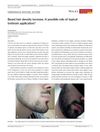
November 2016 in “Dermatologic Therapy” Topical tretinoin may increase beard hair density.
 3 citations
,
May 2021 in “Archiv der Pharmazie”
3 citations
,
May 2021 in “Archiv der Pharmazie” This study found that the FGF-2 mimetic SUN11602 and VEGF mimetic ONO-1301 had unique effects on skin fibroblasts and keratinocytes, indicating potential for improving wound healing.