 29 citations
,
June 2013 in “Journal of the Saudi Society of Dermatology & Dermatologic Surgery”
29 citations
,
June 2013 in “Journal of the Saudi Society of Dermatology & Dermatologic Surgery” This review outlines the mechanisms, clinical features, and management strategies for alopecia areata and presents no new experimental findings.
54 citations
,
November 2014 in “JEADV. Journal of the European Academy of Dermatology and Venereology/Journal of the European Academy of Dermatology and Venereology” This study found that combining low-fluence Q-switched Nd: YAG laser and intense pulsed light led to faster and more effective melasma treatment compared to using the laser alone, though recurrence still occurred.
 4 citations
,
May 2018 in “International Journal of Molecular Sciences”
4 citations
,
May 2018 in “International Journal of Molecular Sciences” This review discusses genetically-engineered mouse models for studying melanocytes and reports no new experimental findings; it emphasizes their potential to address unanswered questions in melanoma biology.
September 2025 in “Journal of Clinical Medicine” This study found that patients with vitiligo and alopecia areata had significantly higher serum granulysin levels compared to healthy controls, indicating a potential pathogenic role and suggesting that elevated levels may serve as a biomarker for monitoring disease activity, particularly in active vitiligo cases.
132 citations
,
November 1998 in “Journal of the American Academy of Dermatology” This review evaluates the efficacy and safety of topical sensitizers in treating alopecia areata but reports no new clinical findings.
97 citations
,
December 2021 in “Cells” This review outlines key considerations for designing fluorescence microscopy experiments in cell biology, discussing the importance of hardware availability, suitability of biological models, and imaging agents to achieve high-resolution and informative images.
26 citations
,
December 2022 in “Molecules” This review discusses various nanotechnology-based strategies for managing melasma and reports no new clinical results, highlighting the potential of innovative drug delivery systems in treating hyperpigmentation.
 21 citations
,
July 2022 in “Orphanet journal of rare diseases”
21 citations
,
July 2022 in “Orphanet journal of rare diseases” This review discusses recent advancements in therapies for ichthyosis, highlighting promising prospects in protein replacement and gene therapy, but it reports no new clinical results.
10 citations
,
June 2021 in “EMBO reports” This study found that in skin blister healing, hair follicle development is compromised as stem cells repair wounds at the expense of morphogenesis gene expression.
 August 2023 in “International Journal of Molecular Sciences”
 This review discusses the use of human-to-mouse xenografting to study human skin processes in vivo, highlighting its importance for understanding skin regeneration and pathology while identifying knowledge gaps and challenges in applying these findings to human skin.
180 citations
,
January 2011 in “EMBO Reports” This review discusses strategies for identifying and characterizing adult stem cells in mice and highlights their potential and limitations, but reports no new experimental results.
48 citations
,
June 2003 in “Journal of Investigative Dermatology Symposium Proceedings” This review assesses the effectiveness of various alopecia areata treatments and concludes that only contact sensitizers like diphenylcyclopropenone and squaric acid dibutylester have shown efficacy in evidence-based studies, but it reports no new clinical results.
21 citations
,
March 2018 in “American Journal Of Pathology” In this study, it was observed that NIPAL4 mutations linked to autosomal recessive congenital ichthyosis lead to abnormal skin barrier function due to cytotoxic effects disrupting lipid structure and organization, which topical treatments only partially ameliorated.
6 citations
,
November 2023 in “Stem Cell Reports” In this discussion, the authors highlight the murine cornea as a powerful model for stem cell research, revealing new insights into stem cell properties, differentiation flexibility, and the importance of the stem cell niche, with potential implications for understanding various tissues, diseases, and therapies.
1 citations
,
August 2005 in “Springer eBooks” Alopecia areata is an autoimmune disease with genetic links, treatable with certain medications, and can affect mental health.
13 citations
,
October 2019 in “Oncology Reports” This review discusses the complex relationship between anabolic substances and colorectal cancer risk, reporting ambiguous findings on their carcinogenic properties, potential synergy with risk factors, and protective roles.
December 2018 in “European Journal of Pediatric Dermatology/PD. European journal of pediatric dermatology” This article discusses the potential involvement of hair follicle melanocytes in follicular vitiligo, noting a pattern of depigmentation centered on follicles and supported by inflammatory infiltrates, without reporting new clinical results.
36 citations
,
September 2015 in “Orphanet Journal of Rare Diseases” This review discusses ichthyosis with confetti, highlighting its genetic basis, clinical features, diagnostic criteria, and current treatment options but reports no new clinical results.
22 citations
,
September 2014 in “JAMA dermatology” This study identified major criteria including ectodermal malformations for diagnosing ichthyosis with confetti, and revealed significant genetic variation in the disease locus within the general population.
 7 citations
,
July 2014 in “BMJ case reports”
7 citations
,
July 2014 in “BMJ case reports” This article reviews the rare skin disorder ichthyosis with confetti, highlighting the potential for future therapies using revertant stem cells, and reports no new clinical results.
 1 citations
,
October 2022 in “Springer eBooks”
1 citations
,
October 2022 in “Springer eBooks” This review discusses the roles of hormonal pathways in regulating male sexual function, particularly highlighting the impact of testosterone, and reports no new research findings.
6 citations
,
October 2001 in “British Journal of Ophthalmology” This article discusses the potential of intralesional cidofovir for treating SCC without systemic toxicity, noting that surgical excision remains the best treatment option; it reports no new clinical results.
February 2013 in “Journal of the American Academy of Dermatology” Follicular red dots can appear where alopecia areata and vitiligo overlap.
2 citations
,
July 2016 in “Veterinary dermatology” This study reports that hyperaesthetic leucotrichia primarily affects Arabian and American paint horses, occurring mainly in summer, with histological differences from erythema multiforme despite some shared features.
 November 2020 in “Journal of The American Academy of Dermatology”
 This study examined dermoscopic features in African-American women with different types of alopecia and found that a perifollicular pink blush, potentially indicating inflammation, was common, particularly resolved with anti-inflammatory treatment, suggesting dermoscopy could aid in management.
2 citations
,
September 2021 in “JAAD case reports” This report describes a case of trichodysplasia spinulosa in a renal transplant patient, characterized by unique dermatoscopic features and highlighting the need for timely diagnosis.
 3 citations
,
March 2014 in “Veterinary dermatology”
3 citations
,
March 2014 in “Veterinary dermatology” This study reports the first documentation of mural, mucinotic, isthmus folliculitis alopecia in Norwegian puffin dogs, noting that ciclosporin treatment led to remission while other treatments were less effective.
 1 citations
,
January 2019 in “Acta dermato-venereologica”
1 citations
,
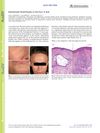
January 2019 in “Acta dermato-venereologica” The woman's skin and hair symptoms were confirmed as frontal fibrosing alopecia, and while facial papules are common in such cases, there's no effective local treatment, but systemic treatments can help.
September 2021 in “Pediatrics in review” This case report describes a 2-year-old girl with Majocchi granuloma, a deep granulomatous folliculitis, which improved after treatment with oral terbinafine despite relapses leading to multiple treatment courses.
September 2011 in “Archives of dermatology” The child was diagnosed with cutaneous leishmaniasis.