 4025 citations
,
December 2003 in “Human Reproduction”
4025 citations
,
December 2003 in “Human Reproduction” This review discusses the evolution of diagnostic criteria for polycystic ovary syndrome and emphasizes its association with various metabolic and cardiovascular risks, but it provides no new research findings.
 16 citations
,
September 2018 in “Clinical Biochemistry”
16 citations
,
September 2018 in “Clinical Biochemistry” This paper discusses the link between polycystic ovarian syndrome (PCOS) and health issues like infertility and cardiovascular diseases, caused by both genetic and environmental factors, but reports no new clinical findings.
 97 citations
,
February 2007 in “Clinical Obstetrics and Gynecology”
97 citations
,
February 2007 in “Clinical Obstetrics and Gynecology” This article reviews the diagnostic criteria and prevalence of PCOS, emphasizing its status as the most common endocrine disorder among women of reproductive age, with no new clinical results reported.
21 citations
,
August 2002 in “British Journal of Ophthalmology” This article discusses topical and intralesional cidofovir use for SCC and suggests a successful outcome in one case, with no systemic toxicity observed so far.
This review discusses the diagnostic criteria and management challenges for polycystic ovarian syndrome and reports no clinical results, highlighting complications associated with pregnancy in women with the condition.
 989 citations
,
August 2007 in “The Lancet”
989 citations
,
August 2007 in “The Lancet” This article reviews the clinical features, diagnostic criteria, and possible genetic and environmental influences of polycystic ovary syndrome but provides no new research findings.
 8 citations
,
September 2024 in “BMC Genomics”
8 citations
,
September 2024 in “BMC Genomics” In this study, researchers found that the novel gene circCFAP20DC enhances the proliferation of goat follicular granulosa cells by activating the RB pathway, facilitating their progression from the G1 to S phase during follicular development.
 March 2023 in “Scholars international journal of obstetrics and gynecology”
 This article reviews the metabolic and endocrine complexities of PCOS, emphasizing the importance of lifestyle changes and medical management in addressing its various symptoms and complications, but reports no new clinical results.
 July 2014 in “Journal of the Portuguese Society of Dermatology and Venereology”
 This review covers current knowledge of tricoscopy's applications in diagnosing and monitoring scalp and hair disorders but presents no new clinical results.
44 citations
,
January 1999 in “Dermatology” This article reviews different perspectives on nevus comedonicus, discussing its classification and potential associations with systemic findings, but it reports no new results.
15 citations
,
November 2024 in “EClinicalMedicine” This abstract does not report specific study results but describes the funding and collaboration involved in developing the International PCOS Guidelines by multiple health research organizations.
1 citations
,
May 2013 in “Oncology Times” This narrative review reflects on the challenges faced by FDA's Oncologic Drugs Advisory Committee members, highlighting public pressure, decision-making complexity, and the evolving landscape of cancer drug development.
 November 2018 in “International Journal of Current Pharmaceutical Research”
 This review discusses the causes, underlying mechanisms, diagnosis, and treatment strategies for polycystic ovary syndrome but reports no new clinical findings.
 July 2023 in “British journal of dermatology/British journal of dermatology, Supplement”
 In this study, researchers analyzed skin tumors from patients with CYLD cutaneous syndrome and found that loss of CYLD function is linked to changes in cellular signaling pathways, particularly NF-κB signaling, and leads to increased secretion of specific extracellular matrix proteins.
This pilot study found that Optical Coherence Tomography can non-invasively resolve hair follicle density and hair shaft and follicle diameters in patients at varying stages of hair loss.
 31 citations
,
June 2015 in “British Journal of Dermatology”
31 citations
,
June 2015 in “British Journal of Dermatology” Hormonal treatments are effective as a second-line option for moderate-to-severe acne in females, but should be used with caution due to health risks.
August 2025 in “Obstetrics and gynecology.” This article reviews the management of polycystic ovarian syndrome, highlighting lifestyle modification and individualized pharmacological treatment strategies, and reports no new clinical results.
October 2021 in “bioRxiv (Cold Spring Harbor Laboratory)” This study introduces the Hair Cell Analysis Toolbox (HCAT), a machine-learning software that automates the analysis of cochlear hair cells, enabling unbiased and comprehensive imaging data interpretation.
June 2025 in “Journal of Ovarian Research” This case report underlines the importance of considering alternative diagnoses like ovarian steroid cell tumors in adolescent females with PCOS-like symptoms when standard treatments fail, highlighting the need for thorough evaluation and early intervention.
 1 citations
,
November 2018 in “Dermatologic Therapy”
1 citations
,
November 2018 in “Dermatologic Therapy” This report describes the use of compounded topical preparations to treat two severe psoriasis patients and calls for further studies on their regulation, protocol, and stability evaluation.
 September 2015 in “University of Southern Denmark Research Portal (University of Southern Denmark)”
 This guideline provides a concise evidence-based overview of various aspects of polycystic ovary syndrome, including diagnosis and follow-up of secondary effects, but reports no new clinical results.
14 citations
,
February 2011 in “Experimental dermatology” This study identifies cartilage oligomeric matrix protein (COMP) as a key extracellular matrix component in human hair follicle cycling, potentially regulated by TGFβ signaling, and suggests its importance in normal hair follicle biology.
 January 2026 in “Dermatology Online Journal”
 This case report highlights that CCCA can present with multifocal patchy hair loss in younger men of African descent, suggesting the need for careful evaluation when diagnosing atypical alopecia patterns.
 October 2016 in “Journal of the Dermatology Nurses’ Association”
 This update discusses guidelines for dermatology nurses and nurse practitioners on polycystic ovary syndrome but presents no new research findings; it emphasizes their role in early diagnosis through recognizing skin symptoms.
 27 citations
,
January 2016 in “Quality of Life Research”
27 citations
,
January 2016 in “Quality of Life Research” This study developed and validated a 50-item questionnaire, the PCOSQ-50, to effectively assess the quality of life in Iranian women with polycystic ovary syndrome, addressing aspects often missed by previous questionnaires.
 5 citations
,
October 2016 in “European Journal of Obstetrics & Gynecology and Reproductive Biology”
5 citations
,
October 2016 in “European Journal of Obstetrics & Gynecology and Reproductive Biology” This study found that women with PCOS had significantly prolonged nasal mucociliary clearance time, which may increase their susceptibility to respiratory tract and middle ear infections.

This article discusses the challenges in diagnosing and treating polycystic ovary syndrome in adolescents, emphasizing the importance of lifestyle changes and a systematic therapeutic approach but reports no new clinical findings.
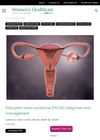 September 2022 in “Women's healthcare”
 This review discusses various aspects of polycystic ovary syndrome, including its prevalence, diagnosis, and treatment options, and reports no new empirical results.
 March 2025 in “Pakistan Journal of Scientific & Industrial Research Series A Physical Sciences”
 This abstract discusses the challenges of diagnosing and managing PCOS, highlighting that individualized management, lifestyle modifications, and medical treatments such as contraceptives and metformin are recommended to address hormonal imbalances and co-morbidities.
 2 citations
,
May 2010 in “Journal of Obstetrics and Gynaecology Canada”
2 citations
,
May 2010 in “Journal of Obstetrics and Gynaecology Canada” This review summarizes best practices for diagnosing and managing PCOS, emphasizing accurate biochemical assessments and individualized treatment approaches, but reports no new clinical results.