 April 2016 in “The journal of investigative dermatology/Journal of investigative dermatology”
 This study found that topical bortezomib increased cell proliferation in hair follicles and sebaceous glands in mice and may activate hair keratin gene expression through GATA-3 transcription factors.
475 citations
,
October 2006 in “Proceedings of the National Academy of Sciences” This study suggests that folliculin, mutated in Birt–Hogg–Dubé syndrome, and its partner FNIP1 may play a role in energy and nutrient sensing through the AMPK and mTOR pathways.
2 citations
,
January 2024 in “Revista Paulista de Pediatria” In this case report, researchers described a 6-year-old girl with severe mandibuloacral dysplasia type A, noting unique physical deformities and a rare homozygous LMNA gene mutation not commonly associated with the condition.
 January 2013 in “International Journal of Trichology”
 This case report highlights the discovery of a novel TRPS1 gene mutation in a 17-year-old with TRPS type I, underscoring the diagnostic importance of hair symptoms in congenital hair diseases.
12 citations
,
June 2016 in “Clinical and experimental dermatology” This study reported a previously undescribed G573V point mutation in the TRPV3 gene as a cause of familial Olmsted syndrome in a Mongolian family.
 14 citations
,
July 2010 in “Experimental Dermatology”
14 citations
,
July 2010 in “Experimental Dermatology” A new mutation in the HR gene causes hair loss in a specific family.
10 citations
,
January 1992 in “Screening” This study concluded that newborn screening for biotinidase deficiency effectively identified cases and likely prevented irreversible complications from the disorder in some infants.
 July 2024 in “British journal of dermatology/British journal of dermatology, Supplement”
 This study identified a new pathogenic variant, c.1081G>T; p.(Glu361*), in the KRT31 gene as a cause of autosomal-dominant monilethrix, highlighting the role of hair keratin proteins in hair and nail tissue disorders.
In this study, researchers identified the c.296C>T (p.T99I) variant in the KRT32 gene, which co-segregates with loose anagen hair syndrome, and found it decreases binding affinity to KRT82, potentially weakening hair anchorage.
1 citations
,
August 2020 This study found that mutations affecting hair keratin expression on Chromosome 15 in mice may cause altered hair and skin features similar to other known mouse mutations.
1 citations
,
October 2023 in “Heliyon” In this study, the researchers reported a new case of Hutchinson-Gilford progeria syndrome with a novel LMNA mutation and successful surgical intervention for airway obstruction.
 October 2023 in “Psychiatry research. Case reports”
 In this study, researchers observed that twins with a novel de novo nonsense variant in HRAS exhibited distinctive features, including neuropsychiatric symptoms, potentially indicating a wider clinical spectrum for conditions known as RASopathies.
 29 citations
,
April 2019 in “Acta neuropathologica communications”
29 citations
,
April 2019 in “Acta neuropathologica communications” This study found that β-sitosterol, a brain-penetrable phytosterol, reduced melanoma cell growth and brain metastasis formation by interfering with mitochondrial respiration, suggesting its potential as an adjuvant therapy to BRAF inhibitors for patients with melanoma brain metastases.
 November 2022 in “Journal of Investigative Dermatology”
 This study developed a novel method to analyze the effects of COL7A1 mutations using mRNA from peripheral blood mononuclear cells, aiding genetic diagnosis and potential therapies for dystrophic epidermolysis bullosa.
 14 citations
,
March 2016 in “Mechanisms of Development”
14 citations
,
March 2016 in “Mechanisms of Development” This study found that BNC2 is critical for hair follicle regeneration and other developmental processes, as Bnc2−/− mice exhibit incomplete hair follicle development and developmental defects, and BNC1 cannot substitute for BNC2.
2 citations
,
August 2022 in “World Journal of Clinical Cases” In this study, researchers found multiple somatic mutations and copy number variations in a patient with Cronkhite-Canada syndrome, providing novel insights into its potential genetic mechanisms.
2 citations
,
July 2021 in “Genes” This study identified a new genetic variant in the KRT71 gene responsible for a breed-specific form of hypotrichosis in Hereford cattle, potentially serving as a model for similar human conditions.
2 citations
,
September 1998 in “Der Hautarzt” A gene mutation causes a rare hereditary hair loss, offering potential for new treatments.
 17 citations
,
November 2017 in “Asian-Australasian journal of animal sciences”
17 citations
,
November 2017 in “Asian-Australasian journal of animal sciences” This study found that mutations in certain keratin genes significantly affect wool traits in Chinese Merino sheep, suggesting these genes could be important for sheep breeding to improve wool quality.
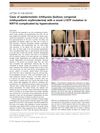 October 2011 in “Journal of dermatology”
 A man with a rare skin condition and a new gene mutation developed high calcium levels due to his treatment.
3 citations
,
April 2020 in “American Journal of Case Reports” This case report describes the first instance of juvenile hemochromatosis type 2A associated with secondary hypothyroidism, linked to a novel mutation in the HJV gene.
 November 2025 in “Frontiers in Immunology”
 In this study, researchers found significant links between specific metabolic reprogramming-related genes and alopecia areata risk, highlighting increased SQSTM1 expression in affected hair follicles compared to healthy ones.
153 citations
,
April 1998 in “Current Biology” This study found that benign tumors with a high risk of malignant progression primarily arise from hair follicle cells when a mutant ras gene is expressed in a specific population of epidermal cells in mice.
16 citations
,
January 2019 in “Aging” This study found that transgenic mice expressing a mutant CYLD protein lacking deubiquitinase function showed signs of premature aging and spontaneous tumor development, likely due to over-activation of specific molecular pathways and chronic inflammation.
18 citations
,
February 2001 in “Der Hautarzt” This case study of a 50-year-old woman with myotonic dystrophy and multiple basal cell carcinomas suggests there could be a genetic predisposition for certain cutaneous tumors in such patients.
3 citations
,
November 2024 in “Egyptian Journal of Medical Human Genetics” This bibliometric analysis identified SGK1 as a key factor in cancer, showing that its dysregulation can lead to tumor growth and treatment resistance. The authors highlighted SGK1's potential as a therapeutic target, but note that further research is needed to develop effective treatment strategies.
14 citations
,
July 2019 in “Journal of Investigative Dermatology” In this study, targeted inactivation of the integrin-linked kinase gene in melanoblasts led to defects in cell migration, proliferation, and ability to populate the skin, implicating an integrin-linked kinase-Rac1 connection in melanocyte function.
75 citations
,
March 1998 in “Journal of Investigative Dermatology” This study reports that transgenic mice carrying Clone B DNA developed spontaneous melanomas likely due to an interruption in genes regulating cell growth in melanin-producing cells, offering a model for melanoma research.
53 citations
,
August 2005 in “The Journal of Cell Biology” This study found that the absence of Sgk3 in mice leads to impaired hair follicle maturation, characterized by reduced cell proliferation, increased apoptosis, and premature regression.
 68 citations
,
September 2003 in “British Journal of Dermatology”
68 citations
,
September 2003 in “British Journal of Dermatology” This study found that in thin cutaneous melanomas, tumor regression is associated with a higher risk of sentinel lymph node involvement.