31 citations
,
March 1963 in “American journal of diseases of children” This report details a case of acrodermatitis enteropathica in a 4-month-old infant, noting the disorder's rarity and familial transmission, and includes a literature review with no new clinical results.
 8 citations
,
March 2020 in “Frontiers in Cell and Developmental Biology”
8 citations
,
March 2020 in “Frontiers in Cell and Developmental Biology” This study developed a DPC cell line by introducing mutant CDK4, Cyclin D1, and TERT, making it a promising tool to study downstream signaling pathways activated by testosterone in androgenetic alopecia.
August 2026 in “Acta Dermato Venereologica” This study found that women with central centrifugal cicatricial alopecia had a substantial prevalence of systemic comorbidities, including strong associations with dyslipidemia, uterine leiomyomas, and anxiety disorders.
 5 citations
,
February 2017 in “Australasian Journal of Dermatology”
5 citations
,
February 2017 in “Australasian Journal of Dermatology” This report describes three cases of hair loss that appear consistent with cicatricial pattern hair loss, a possible new subtype of scarring alopecia presenting in a female pattern hair loss distribution.
10 citations
,
January 2012 in “Case reports in medicine” This report describes two cases where patients developed vitiligo as a side effect of diphencyprone treatment for alopecia areata, highlighting the need to inform patients about this potential adverse effect.
 9 citations
,
April 2016 in “Australasian journal of dermatology”
9 citations
,
April 2016 in “Australasian journal of dermatology” This study suggests that adding imiquimod to diphenylcyclopropenone treatment significantly improves outcomes for alopecia areata patients who initially do not respond to diphenylcyclopropenone alone.
January 2025 in “Dermatology Online Journal” The man's hair loss and skin papules were diagnosed as atrichia with papular lesions, not alopecia areata universalis.
 4 citations
,
January 2025 in “Clinical Cosmetic and Investigational Dermatology”
4 citations
,
January 2025 in “Clinical Cosmetic and Investigational Dermatology” This article reviews the characteristics, differential diagnosis, and management options for papular acantholytic dyskeratosis of the vulva, illustrated by a case of a 21-year-old patient, but reports no new clinical results.
 1 citations
,
June 2012 in “Actas Dermo-Sifiliográficas”
1 citations
,
June 2012 in “Actas Dermo-Sifiliográficas” This article discusses primary cicatricial alopecia, highlighting the need for early and precise diagnosis to effectively manage and treat these complex inflammatory hair disorders, but presents no new clinical results.
3 citations
,
December 1975 in “PubMed” This study found that acid and alkaline phosphatases serve different functions in Beagle dog skin, with ALP primarily involved in growth processes and ACP in phospholipid breakdown.
This study introduced Cadd4, a peptide-based degrader developed using computer-aided drug design, which effectively reduced PCSK9 levels and increased LDL receptor expression, resulting in decreased plasma cholesterol and LDL-C levels in hypercholesterolemic mice, without liver toxicity.
 2 citations
,
October 2023 in “Philosophical transactions - Royal Society. Biological sciences”
2 citations
,
October 2023 in “Philosophical transactions - Royal Society. Biological sciences” This article reports that mutations in the PADI3 gene, affecting its activity or localization, cause uncombable hair syndrome and are linked to central centrifugal cicatricial alopecia, particularly among women of African ancestry.
 December 2013 in “International Journal of Dermatology”
 The clinical signs of Adams-Oliver syndrome can vary greatly, even among family members.
May 2026 in “Frontiers in Medicine” This study describes a patient with Rothmund–Thomson syndrome-like symptoms who displayed hair improvement after combination therapy, despite carrying an ANAPC1 gene variant of uncertain significance.
 April 2024 in “Research Square (Research Square)”
 This case report describes a 27-year-old male with autoimmune polyglandular syndrome type 1, characterized by symptoms including fever, dysarthria, dysphagia, oral candidiasis, nail dystrophy, alopecia, hypoparathyroidism, and dilated cardiomyopathy. The study highlights unique bilateral symmetrical brain calcifications and underscores the syndrome’s diverse manifestations.
 July 2021 in “International journal of dermatology, venereology and leprosy sciences”
 This study found that diphenylcyclopropenone (DPCP) was more effective and better tolerated than dinitrochlorobenzene (DNCB) in promoting hair regrowth in patients with alopecia areata.
September 2024 in “Clinical Case Reports” This case report highlights a rare presentation of APS-1 in a 28-year-old Pakistani male with cardiovascular and pulmonary symptoms, illustrating the importance of early recognition and multidisciplinary management for improved patient outcomes.
41 citations
,
November 2015 in “The journal of investigative dermatology. Symposium proceedings/The Journal of investigative dermatology symposium proceedings” This study found that diphenylcyclopropenone therapy resulted in over 50% hair regrowth in 71% of alopecia totalis patients, with a significant relapse association with thyroid disease, suggesting treatment could be viable but should continue for at least two years.
11 citations
,
May 2018 in “Frontiers in plant science” This study found that overexpressing the PCaP2 protein in Arabidopsis enhanced drought tolerance by influencing ABA and SA signaling pathways and regulating root hair growth, suggesting a key role in water deficit response.
January 2019 in “11th World congress for hair research” 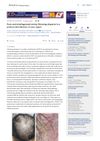 March 2023 in “Journal of Cosmetic Dermatology”
 This case report illustrates that fibrosing alopecia in a pattern distribution may be misdiagnosed as androgenetic alopecia due to similar hair loss patterns, but distinctive trichoscopic and histopathologic features help differentiate it.
27 citations
,
August 2008 in “Mayo Clinic proceedings” This review discusses the diagnosis, management, and treatment options for peripheral arterial disease and does not report new clinical findings; the authors emphasize the need for early diagnosis and comprehensive management.
October 1993 in “The Journal of Clinical Pharmacology” 11 citations
,
January 2021 in “British Journal of Dermatology” This report describes a new case of syndromic ichthyosis caused by compound heterozygous mutations in AP1B1, detailing the associated clinical features and molecular consequences in the patient.
 March 2025 in “International Journal of Trichology”
 This case report describes the first observed instance of fibrosing alopecia in a pattern distribution in a child, suggesting the condition is not solely androgen dependent.
 January 2022 in “Clinical Cases in Dermatology”
 This review discusses the pathogenesis, diagnosis, and treatment strategies for Central Centrifugal Cicatricial Alopecia, emphasizing a multifactorial approach and reporting no new clinical results.
5 citations
,
September 1989 in “Pediatric dermatology” Persistent papular plaques on children's faces need better understanding and treatment.
12 citations
,
July 2004 in “Molecular genetics and genomics” This study identifies a new mutation in the Scd1 gene in a strain of Kunming mice, causing skin and hair defects with the mildest impact among similar mutations.
 July 2026 in “bioRxiv (Cold Spring Harbor Laboratory)”
 In this study, researchers found that the efflux of calcium in root hairs of Arabidopsis thaliana, particularly through the ER-localized ACA2 and ACA7, is crucial for modulating cytoplasmic calcium signals and enabling proper root hair growth, with disruptions leading to impaired elongation.
 April 2018 in “Journal of Investigative Dermatology”
 In this study, researchers identified CENPV as a new CYLD interacting partner that localizes to primary cilia and regulates acetylated tubulin levels, offering insights into the pathogenesis of skin appendage tumors.