34 citations
,
August 2007 in “PubMed” This study found a strong association between androgenetic alopecia and hypertension in Caucasian men, independent of age.
 125 citations
,
May 2007 in “Journal of The American Academy of Dermatology”
125 citations
,
May 2007 in “Journal of The American Academy of Dermatology” This study describes the development of the BASP classification system, providing a universal and systematic approach for classifying pattern hair loss in both men and women.
 56 citations
,
April 2007 in “Journal der Deutschen Dermatologischen Gesellschaft”
56 citations
,
April 2007 in “Journal der Deutschen Dermatologischen Gesellschaft” This study found that 12 months of minoxidil treatment increased hair density and thickness in women with androgenetic alopecia, while alfatradiol primarily stabilized hair loss.
63 citations
,
January 2006 in “Journal of cosmetic and laser therapy” This study found that pulsed infrared diode laser therapy (904 nm) was effective in promoting hair regrowth in 94% of patients with resistant patches of alopecia areata.
 12 citations
,
December 2005 in “PubMed”
12 citations
,
December 2005 in “PubMed” This study suggests that some men with premature androgenic alopecia may have hormonal profiles similar to women with polycystic ovary syndrome, potentially indicating a male equivalent of the condition.
 17 citations
,
August 2002 in “Dermatologic Surgery”
17 citations
,
August 2002 in “Dermatologic Surgery” This study found that topical fluridil increased the anagen hair percentage in men with androgenetic alopecia without causing irritation or systemic absorption over 9 months.
 65 citations
,
April 2002 in “Journal of Alternative and Complementary Medicine”
65 citations
,
April 2002 in “Journal of Alternative and Complementary Medicine” This study found that 60% of men with mild to moderate androgenetic alopecia showed improvement after treatment with botanically derived 5AR inhibitors, suggesting these compounds may be effective, though larger trials are needed.
 236 citations
,
July 2001 in “Trends in Molecular Medicine”
236 citations
,
July 2001 in “Trends in Molecular Medicine” This review discusses common hair loss conditions and explores how advancements in hair follicle biology might lead to more effective treatments but reports no new results.
3 citations
,
July 2001 in “PubMed” This article reviews various treatment options for androgenetic alopecia, like finasteride, camouflage agents, and surgical methods, emphasizing patient education about each approach's limitations, but reports no new clinical results.
 50 citations
,
March 2001 in “Clinics in Dermatology”
50 citations
,
March 2001 in “Clinics in Dermatology” Genes and hormones cause hair loss, with four genes contributing equally.
 89 citations
,
January 2001 in “Dermatologic Surgery”
89 citations
,
January 2001 in “Dermatologic Surgery” Hair loss in women is common, starts in late 20s, and affects 30% of women over 50.
 50 citations
,
July 2000 in “Dermatologic Surgery”
50 citations
,
July 2000 in “Dermatologic Surgery” Female and male AGA are different diseases.
 65 citations
,
October 1999 in “Journal of The American Academy of Dermatology”
65 citations
,
October 1999 in “Journal of The American Academy of Dermatology” In this study, finasteride doses as low as 0.2 mg per day significantly reduced both scalp skin and serum DHT levels in men with androgenetic alopecia.
 46 citations
,
October 1999 in “Journal of The American Academy of Dermatology”
46 citations
,
October 1999 in “Journal of The American Academy of Dermatology” This study found that finasteride at 1 mg/day was the most effective dose for treating male pattern hair loss, with similar efficacy to 5 mg/day and better results than lower doses.
 180 citations
,
September 1999 in “British Journal of Dermatology”
180 citations
,
September 1999 in “British Journal of Dermatology” This review discusses the psychological and social impacts of androgenetic alopecia and suggests that medical treatments can have some positive psychological effects, highlighting the condition's moderate stress and impact on body image.
 32 citations
,
August 1999 in “Journal of Investigative Dermatology”
32 citations
,
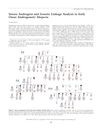
August 1999 in “Journal of Investigative Dermatology” This study found that individuals with early onset extensive androgenetic alopecia have an elevated ratio of DHT to testosterone, but no significant genetic linkage to markers on chromosomes 2 or 5 was detected.
 179 citations
,
September 1998 in “BMJ”
179 citations
,
September 1998 in “BMJ” This article reviews the pathogenesis, genetic basis, and recent treatment breakthroughs for androgenetic alopecia but reports no new clinical findings.
169 citations
,
June 1998 in “Journal of Investigative Dermatology” This study found no significant genetic association between the 5α-reductase enzyme genes and male pattern baldness, suggesting a polygenic etiology rather than simple inheritance.
 54 citations
,
May 1998 in “Urology”
54 citations
,
May 1998 in “Urology” This study demonstrates that patients with benign prostatic hyperplasia have a higher severity and frequency of male pattern baldness compared to a control group.
 416 citations
,
September 1997 in “Journal of Investigative Dermatology”
416 citations
,
September 1997 in “Journal of Investigative Dermatology” People with hair loss have more androgen receptors and enzymes in certain follicles, with men and women showing different patterns.
 59 citations
,
September 1994 in “The Journal of Clinical Endocrinology and Metabolism”
59 citations
,
September 1994 in “The Journal of Clinical Endocrinology and Metabolism” This study found that 4 weeks of finasteride treatment significantly decreased DHT levels in bald scalp to levels similar to hair-containing scalp in men with male pattern baldness.
 71 citations
,
May 1991 in “Clinical and Experimental Dermatology”
71 citations
,
May 1991 in “Clinical and Experimental Dermatology” Young men with male pattern baldness lose hair density over time without treatment.
 3 citations
,
January 1989 in “PubMed”
3 citations
,
January 1989 in “PubMed” This paper discusses various histologic features to distinguish types of alopecia and reports no new clinical findings.
 57 citations
,
July 1987 in “Journal of The American Academy of Dermatology”
57 citations
,
July 1987 in “Journal of The American Academy of Dermatology” In this study, minoxidil treatment was associated with an increase in nonvellus scalp hairs, but this effect was not sustained once the treatment was stopped.
 53 citations
,
March 1987 in “Journal of The American Academy of Dermatology”
53 citations
,
March 1987 in “Journal of The American Academy of Dermatology” Minoxidil effectively regrows hair in male pattern baldness.
203 citations
,
November 1984 in “Journal of the American Academy of Dermatology” This study presents evidence suggesting that androgenetic alopecia is most likely inherited through a polygenic model, challenging the traditional view that it is caused by a simple Mendelian autosomal dominant gene.
 23 citations
,
July 1982 in “International Journal of Dermatology”
23 citations
,
July 1982 in “International Journal of Dermatology” The review concludes that accurate diagnosis of different types of hair loss requires proper biopsy techniques and understanding the hair growth cycle and underlying causes.
 86 citations
,
September 1977 in “BMJ”
86 citations
,
September 1977 in “BMJ” Minoxidil effectively controls blood pressure in severe cases, but has serious side effects and causes hair growth in women.
 33 citations
,
September 1961 in “Archives of Dermatology”
33 citations
,
September 1961 in “Archives of Dermatology” This letter clarifies that colchicine induces anagen hair loss, as shown in animal studies, and corrects a misquotation by Kligman, who suggested it caused telogen effluvium.