 1 citations
,
January 2022 in “Cell Biology International”
1 citations
,
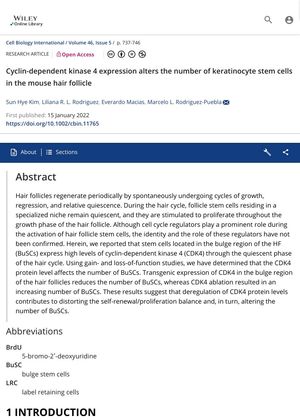
January 2022 in “Cell Biology International” This study found that altering cyclin-dependent kinase 4 (CDK4) levels in the bulge region of hair follicles affects the balance of stem cell numbers, potentially influencing hair follicle self-renewal and proliferation.
2 citations
,
July 2017 in “Oncology Letters” This study found that ablating cyclin D3 in a Ras-dependent skin carcinogenesis model increased apoptosis in hair follicles, reducing papilloma development but potentially facilitating malignant progression when CDK6 is overexpressed.
44 citations
,
March 2012 in “Molecular Carcinogenesis” This study found that keratin 15 expressing cells from the hair follicle contribute to the development and long-term persistence of cutaneous papillomas in transgenic mice, with a subset showing the Ha-ras mutation.
 759 citations
,
February 2009 in “Current Biology”
759 citations
,
February 2009 in “Current Biology” This review summarizes fundamental concepts and recent advancements in hair follicle biology, including insights from mouse models into broader molecular and cellular processes relevant to regeneration and development.
415 citations
,
January 2008 in “Cell” NFATc1 controls hair stem cell activity, affecting hair growth and could be a target for hair loss treatments.
141 citations
,
May 2007 in “Cancer Research” This study found that CD34 is necessary for TPA-induced activation of hair follicle stem cells and tumor formation in mice, with CD34 knockout mice showing delayed and reduced tumor development compared to wild-types.
1279 citations
,
November 2005 in “Nature Medicine”  384 citations
,
June 2005 in “Genes & development”
384 citations
,
June 2005 in “Genes & development” This study found that stabilized beta-catenin is crucial for activating stem cell transition from quiescence to proliferation in hair follicles by influencing gene expression within the stem cell niche.
387 citations
,
November 2003 in “Journal of Investigative Dermatology” The K15 promoter effectively targets stem cells in the hair follicle bulge.
561 citations
,
April 2003 in “Journal of Investigative Dermatology” CD34 is a marker for isolating stem-like cells in mouse hair follicles.
949 citations
,
January 2001 in “Cell” This study demonstrated that multipotent stem cells in adult mice whisker follicles migrate to produce whisker growth, and that this process requires precise control of stem cell trafficking.
 1113 citations
,
August 1999 in “The New England Journal of Medicine”
1113 citations
,
August 1999 in “The New England Journal of Medicine” This article discusses the biologic and psychosocial significance of hair, the current limitations in hair growth drugs, and anticipates future therapies based on advancing hair follicle research.