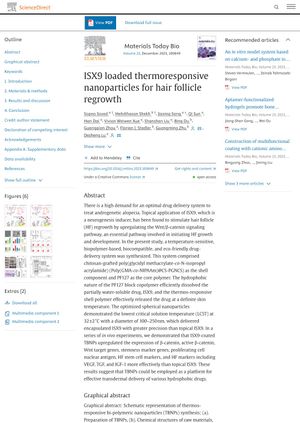
11 citations
,
February 2023 in “British Journal of Pharmacology” This study found that ISX9 may activate the Wnt/β-catenin signaling pathway and holds potential as a therapeutic agent for treating alopecia.
17 citations
,
November 2021 in “Journal of Cosmetic Dermatology” This review discusses treatment options for androgenetic alopecia, highlighting the need for personalized, evidence-based approaches but reports no new clinical results.
 96 citations
,
September 2021 in “International Journal of Molecular Sciences”
96 citations
,
September 2021 in “International Journal of Molecular Sciences” This review highlights recent advances in chitosan-based nanoparticles (CS NPs) for drug delivery, discussing their modifications, preparation methods, production with organic and inorganic materials, and their latest implementations in the field, emphasizing the role of CS NPs in improving drug transport and release properties.
34 citations
,
January 2020 in “Expert opinion on drug delivery” This review discusses various novel drug delivery approaches to enhance scalp drug penetration for alopecia treatment but reports no new clinical results.
 117 citations
,
August 2019 in “Drug Design Development and Therapy”
117 citations
,
August 2019 in “Drug Design Development and Therapy” This review article provides an updated overview of the pharmacology, mechanism of action, clinical efficacy, and adverse events associated with topical minoxidil, a widely used treatment for androgenetic alopecia and other hair loss conditions, while noting that its exact mechanism is still not fully understood.
88 citations
,
June 2019 in “Cell reports” This study found that activating autophagy with specific small molecules and drugs can stimulate hair growth by initiating the anagen phase in dormant hair follicles, suggesting a potential treatment for hair loss.
 110 citations
,
August 2016 in “Drugs”
110 citations
,
August 2016 in “Drugs” Minoxidil is the only FDA-approved topical drug for treating male or female pattern hair loss, and other medications like finasteride and dutasteride can also increase hair growth.
 3 citations
,
January 2016 in “Annals of Dermatology”
3 citations
,
January 2016 in “Annals of Dermatology” This study suggests that 2% minoxidil and Kerium may promote hair regrowth in rats, while Aminexil showed the least effect among tested treatments; human-use products varied in efficacy in this animal model.
 788 citations
,
February 2007 in “Nature”
788 citations
,
February 2007 in “Nature” This review explores how adult skin epithelia preserve stem cell populations for hair follicle regeneration and wound healing, but reports no new experimental results.
78 citations
,
October 2003 in “Cochrane library” This review found that adding cyproterone acetate to estradiol showed a subjective improvement in hirsutism versus placebo, but comparisons with other therapies revealed no clinical differences.