717 citations
,
June 2010 in “Nature” This study identified key genetic regions associated with alopecia areata, highlighting both acquired and innate immune involvement, with a novel link to the upregulation of ULBP ligands in autoimmune disease.
244 citations
,
January 2010 in “Journal of the American Academy of Dermatology” This review discusses treatment options for alopecia areata and suggests tailored treatment plans, noting the challenges posed by spontaneous remission and limited high-quality clinical trials.
 391 citations
,
January 2010 in “Journal of The American Academy of Dermatology”
391 citations
,
January 2010 in “Journal of The American Academy of Dermatology” This article reviews the clinical presentation and histopathologic features of alopecia areata and proposes a hypothesis for its development, but it reports no new clinical results.
 159 citations
,
November 2007 in “American Journal of Pathology”
159 citations
,
November 2007 in “American Journal of Pathology” In this study, researchers found that substance P triggered premature catagen development and immune changes in human scalp hair follicles, providing a possible biological link between stress and hair loss conditions like telogen effluvium and alopecia areata.
 185 citations
,
August 2005 in “Autoimmunity Reviews”
185 citations
,
August 2005 in “Autoimmunity Reviews” This review discusses alopecia areata as a model for studying tissue-directed autoimmune diseases and reports no new clinical findings.
143 citations
,
January 2004 in “Journal of Investigative Dermatology Symposium Proceedings” This review discusses the autoimmune nature of alopecia areata, potential therapeutic targets, and highlights the need for further studies on immunomodulatory treatments and genetic factors, but it reports no new clinical results.
 37 citations
,
November 2003 in “Veterinary pathology”
37 citations
,
November 2003 in “Veterinary pathology” This study showed that in C3H/HeJ mice, focal follicular inflammation starts before overt hair loss, with inflammation severity possibly reaching a threshold causing hair follicle dystrophy prior to visible hair loss.
148 citations
,
September 2003 in “Journal of Investigative Dermatology Symposium Proceedings” Alopecia areata is an autoimmune disorder causing hair loss, linked to specific hair follicle antigens and genetic factors.
 23 citations
,
June 2003 in “Journal of Investigative Dermatology Symposium Proceedings”
23 citations
,
June 2003 in “Journal of Investigative Dermatology Symposium Proceedings” This review discusses rodent models of alopecia areata and suggests they are crucial for understanding the autoimmune mechanisms and potential treatments but reports no new clinical results.
 19 citations
,
December 2001 in “Dermatologic Therapy”
19 citations
,
December 2001 in “Dermatologic Therapy” This study reports that horizontal sections of scalp biopsies improve the diagnosis of alopecia areata, especially when characteristic inflammatory infiltrates are missing.
127 citations
,
January 2000 in “Journal of Investigative Dermatology” This study found that pro-inflammatory cytokines and apoptotic mechanisms, specifically involving granzyme B and Fas pathways, are associated with chronic alopecia areata, indicating their potential role in the disease's persistence.
 64 citations
,
July 1997 in “Journal of The American Academy of Dermatology”
64 citations
,
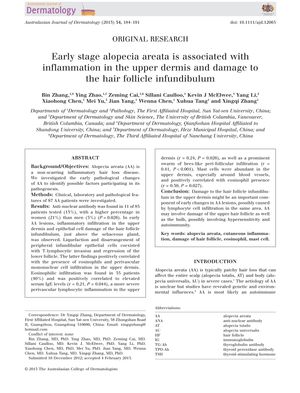
July 1997 in “Journal of The American Academy of Dermatology” This study found that eosinophils are a useful diagnostic feature for alopecia areata, especially when the typical "swarm of bees" lymphoid infiltrate is absent, helping differentiate it from trichotillomania.
 122 citations
,
April 1995 in “Journal of Cutaneous Pathology”
122 citations
,
April 1995 in “Journal of Cutaneous Pathology” The document describes how to tell different types of non-scarring hair loss apart by looking at hair and scalp tissue under a microscope.
78 citations
,
July 1984 in “Journal of Investigative Dermatology”