 77 citations
,
July 2012 in “Journal of Investigative Dermatology”
77 citations
,
July 2012 in “Journal of Investigative Dermatology” The researchers observed that overexpression of Wnt10b in a mouse model can induce hair follicle regeneration by switching follicles from the resting phase to the growth phase via the Wnt-β-catenin signaling pathway.
 60 citations
,
April 2012 in “Physiology”
60 citations
,
April 2012 in “Physiology” This article explores how extrafollicular environments and stem cell configurations influence hair and feather regeneration but provides no new experimental results.
 59 citations
,
February 2012 in “Journal of Dermatological Science”
59 citations
,
February 2012 in “Journal of Dermatological Science” This review discusses the multiple layers of environmental controls on hair stem cell homeostasis and suggests that targeting these layers could offer safer regenerative medicine therapies without directly using stem cells.
 293 citations
,
November 2011 in “Nature”
293 citations
,
November 2011 in “Nature” This study found that the circadian clock regulates the activation state of murine epidermal stem cells, affecting tissue homeostasis and susceptibility to tumorigenesis when disrupted.
 499 citations
,
September 2011 in “Cell”
499 citations
,
September 2011 in “Cell” This study found that intradermal adipocyte lineage cells in mice are necessary and sufficient to activate follicular stem cells, highlighting their role in regulating skin stem cell activity.
 260 citations
,
June 2011 in “Cell”
260 citations
,
June 2011 in “Cell” This study found that Wnt signaling in the hair follicle is crucial for coordinating the behavior of epithelial and melanocyte stem cells, which drives hair regeneration and melanocyte differentiation in mice.
 176 citations
,
April 2011 in “Science”
176 citations
,
April 2011 in “Science” This study found that in a population of hair follicles, regenerative cycling stages are regulated by both intrinsic and extrinsic signals, with WNT/BMP signaling mediating interactions among follicles for adaptability.
 1039 citations
,
February 2009 in “Nature Reviews Molecular Cell Biology”
1039 citations
,
February 2009 in “Nature Reviews Molecular Cell Biology” This review discusses the reuse of molecular mechanisms involved in embryonic skin development for maintaining adult epidermal homeostasis and reports no new results.
 835 citations
,
October 2008 in “Nature Genetics”
835 citations
,
October 2008 in “Nature Genetics” Lgr5 is a marker for active, long-lasting stem cells in mouse hair follicles.
 829 citations
,
May 2007 in “Nature”
829 citations
,
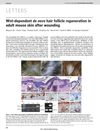
May 2007 in “Nature” Hair follicles can regrow in wounded adult mouse skin using a process like embryo development.
176 citations
,
September 2006 in “Stem Cells” This study found that active BMP signaling prevents epithelial stem cell activation and expansion in hair follicles, while its inhibition leads to HF stem/progenitor cell overproduction and matricomas.
1279 citations
,
November 2005 in “Nature Medicine”  291 citations
,
October 2005 in “Proceedings of the National Academy of Sciences of the United States of America”
291 citations
,
October 2005 in “Proceedings of the National Academy of Sciences of the United States of America” This study found that rat whisker follicle stem cells can be expanded in culture and transplanted to form functional hair follicles, demonstrating their multipotency and potential for regenerative medicine.
 384 citations
,
June 2005 in “Genes & development”
384 citations
,
June 2005 in “Genes & development” This study found that stabilized beta-catenin is crucial for activating stem cell transition from quiescence to proliferation in hair follicles by influencing gene expression within the stem cell niche.
 131 citations
,
March 2004 in “The American journal of pathology”
131 citations
,
March 2004 in “The American journal of pathology” This study found that modulating BMP activity in transgenic mice affects the development and characteristics of several ectodermal organs, such as skin, hair, and claws, highlighting a stage-dependent influence on organogenesis.
250 citations
,
November 2003 in “The Journal of Cell Biology” This study found that BMP receptor IA is crucial for hair progenitor cell differentiation in mice, and its sequential inhibition and activation are necessary to generate a functioning hair shaft.
387 citations
,
November 2003 in “Journal of Investigative Dermatology” The K15 promoter effectively targets stem cells in the hair follicle bulge.
 211 citations
,
October 2001 in “The FASEB Journal”
211 citations
,
October 2001 in “The FASEB Journal” This study found that the BMP antagonist noggin induces hair growth in postnatal skin by neutralizing BMP4's inhibitory activity, potentially mediated by changes in Shh expression.