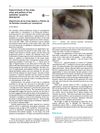
May 2013 in “Optometry and vision science” This abstract provides summaries of multiple clinical reports on topics like macular holes with posterior uveal melanoma, hemolacria, trichotillomania management with bimatoprost, Demodex identification methods, and psychological factors in contact lens discomfort, but reports no new research findings.
 1 citations
,
January 2015 in “Actas dermo-sifiliográficas/Actas dermo-sifiliográficas”
1 citations
,
January 2015 in “Actas dermo-sifiliográficas/Actas dermo-sifiliográficas” Latanoprost eye drops caused excessive cheek hair growth and eyelash whitening in a woman.
13 citations
,
October 2001 in “British Journal of Ophthalmology” This report discusses the use of intralesional cidofovir and suggests it might be a viable option for treating SCC due to its successful outcome without observed systemic toxicity in this case.
 9 citations
,
January 2014 in “Dermatology online journal”
9 citations
,
January 2014 in “Dermatology online journal” This pilot study evaluated bimatoprost ophthalmic solution 0.03% for eyebrow hair regrowth in ten female patients, but reports no new clinical results.
February 2006 in “Inpharma Weekly” 6 citations
,
April 2015 in “Plastic surgical nursing” This study reports that applying bimatoprost ophthalmic solution 0.03% to the upper eyelid margin enhances eyelash growth by increasing length, thickness, and darkness, with a favorable safety profile.
15 citations
,
August 2011 in “Lasers in medical science” This study reported that a single treatment with a short-pulsed 755-nm alexandrite laser effectively treated trichostasis spinulosa in patients with skin types II to V, providing rapid results with minimal pain and no recurrence during a 3-month follow-up.
4 citations
,
April 2014 in “Lasers in Surgery and Medicine” This observational study reports that a TRASER device using specific wavelengths for vascular and follicular targets showed both clinical responses and histological changes, suggesting its potential as an effective vascular and hair removal tool.
11 citations
,
January 2017 in “Skin Appendage Disorders” This study associated ivory-colored areas observed through trichoscopy with steroid deposits in the dermis among patients with steroid-induced atrophy on the scalp.
3 citations
,
September 1973 in “Archives of dermatology” This study reports that daily topical application of a 0.05% tretinoin solution can eliminate the hair plugs and symptoms associated with trichostasis spinulosa.
 7 citations
,
May 2018 in “Curēus”
7 citations
,
May 2018 in “Curēus” In this case report, a 60-year-old woman with eyebrow hypotrichosis experienced significant and lasting eyebrow growth after daily use of bimatoprost 0.03% solution, highlighting its potential as an effective treatment for eyebrow hair restoration.
 7 citations
,
March 2019 in “Dermatologic surgery”
7 citations
,
March 2019 in “Dermatologic surgery” In this randomized trial, bimatoprost 0.01% significantly improved eyebrow hair density and diameter in patients with eyebrow hypotrichosis compared to a placebo, with minimal adverse effects, suggesting it is an effective and safe treatment option.
August 2017 in “Journal of the Dermatology Nurses' Association” This article reviews the usage, efficacy, side effects, and alternatives of topical bimatoprost 0.03% for dermatological applications but does not present new clinical findings.
April 2010 in “PubMed Central” This abstract discusses the FDA approval of Latisse (bimatoprost) for increasing eyelash growth in patients with eyelash hypotrichosis and highlights its efficacy while noting unresolved effectiveness in certain conditions and potential side effects.
 September 2021 in “CRC Press eBooks”
 This chapter reviews the use of trichoscopy in hair transplantation, offering tips for hair restoration surgeons and assisting pathologists in understanding the procedure, but reports no new clinical results.
 March 2024 in “Frontiers in medicine”
 In this nonrandomized controlled trial, tenon capsule injection of platelet-rich plasma improved capillary perfusion and may enhance short-term vision in patients with acute nonarteritic anterior ischemic optic neuropathy.
This study involved using smartphone applications and low-cost trichoscopy devices to assess various hair and scalp conditions, with diagnoses confirmed through detailed imaging during remote consultations and in-person evaluations.
4 citations
,
July 2019 in “Journal of cosmetic dermatology” This clinical study reported that while both 0.01% and 0.03% bimatoprost significantly improved eyebrow density and diameter in patients with eyebrow hypotrichosis, the 0.03% concentration was more clinically preferred by patients.
January 2022 in “Essentials in ophthalmology” This review discusses risk factors for intraoperative floppy iris syndrome, emphasizing tamsulosin and other α1 blockers, and underscores the importance of preoperative screening to mitigate surgical complications, but it reports no new results.
In this phase 2 trial, STS01 1% significantly improved hair regrowth in patients with mild to moderate patchy alopecia areata compared to placebo, with a manageable skin irritation side effect profile.
August 2025 in “Saudi Pharmaceutical Journal” This study developed a new suspended ointment formulation containing neomycin sulfate and triamcinolone acetonide, which showed promise for treating neurodermatitis and chronic eczema by ensuring stable composition, effective skin penetration, and no skin irritation.

In this study, researchers assessed the stability of various formulations in the TrichoConcept™ line for customized alopecia treatment. They found that the combinations remained stable from 14 to 180 days, supporting the use of these vehicles for enhancing therapeutic outcomes in hair loss treatments.
 August 2024 in “Journal of Personalized Medicine”
 In this study using a rabbit model, higher incidences of intraoperative floppy iris syndrome were observed in animals given the α-blocker tamsulosin, suggesting a potential association with increased iris billowing during eye surgery.
 1 citations
,
January 2018 in “Indian journal of dermatopathology and diagnostic dermatology”
1 citations
,
January 2018 in “Indian journal of dermatopathology and diagnostic dermatology” This review discusses the use of trichoscopy as a valuable diagnostic and prognostic tool for various hair and scalp disorders, reporting no new clinical results.
 28 citations
,
August 2018 in “Dermatologic Clinics”
28 citations
,
August 2018 in “Dermatologic Clinics” This article discusses various aspects of trichoscopy for diagnosing hair and scalp disorders and reports no clinical results, offering guidance and highlighting pitfalls for better application of this tool by dermatologists.
 1 citations
,
January 2021 in “Dermatologic Therapy”
1 citations
,
January 2021 in “Dermatologic Therapy” In this study, the TRICHOBIOLIGHT protocol showed effectiveness in treating androgenetic alopecia and telogen effluvium, with 82.5% of 103 patients experiencing excellent to good outcomes after mesotherapy and LED photobiostimulation on the scalp.
 2 citations
,
September 2023 in “Curēus”
2 citations
,
September 2023 in “Curēus” This study reported that topical spironolactone improved lid margin vascularity, corneal fluorescein staining, and disease severity scores in patients with ocular graft-versus-host disease, suggesting a potential therapeutic role by enhancing corneal lipid production with minimal adverse effects.
 July 2013 in “Journal of clinical & experimental dermatology research”
 This study found that prototype right heart circulatory assist devices significantly improved hemodynamics and reduced pulmonary vascular resistances in piglet models of acute hemodynamic shock.
 February 2022 in “Scientia Pharmaceutica”
 This study validated that six out of seven tested topical formulations for alopecia are compatible for 6-month use, suggesting they may be practical for compounding pharmacies.
May 2022 in “International Journal of Trichology”