 88 citations
,
February 2008 in “Journal of Medicinal Chemistry”
88 citations
,
February 2008 in “Journal of Medicinal Chemistry” Scientists made the first metal-based compounds from a nonsteroidal antiandrogen drug, which showed potential in fighting both hormone-dependent and independent prostate cancer cells.
June 2022 in “Zenodo (CERN European Organization for Nuclear Research)” This study evaluated a hydrogel containing extracts from azadirachta indica and tridax procumbens for treating seborrheic dermatitis, finding it passed various tests, including skin irritation and stability, suggesting potential future applications in herbal formulations.
 6 citations
,
January 2024 in “ACS Medicinal Chemistry Letters”
6 citations
,
January 2024 in “ACS Medicinal Chemistry Letters” This study found that the alkaloids cepharanthine and berbamine bind to SK2 and SK3 channel subtypes with affinities that match their concentrations active against various diseases, prompting further investigation into SK channels' role in their therapeutic effects.

This invention reports piperazine derivatives as potent inhibitors of type 3 17β-hydroxysteroid dehydrogenase, suggesting potential therapeutic applications in treating prostate cancer, acne, and androgenic alopecia.
 6 citations
,
April 2014 in “European journal of medicinal chemistry”
6 citations
,
April 2014 in “European journal of medicinal chemistry” This study found that several newly synthesized dihydrobenzopyran compounds inhibited insulin secretion and had vasorelaxant activity, with some more potent than reference KATP channel activators, though compound 21 functioned as a Ca2+ entry blocker.
This chapter reviews various types of aromatic compounds and provides references, but reports no new experimental results.
 89 citations
,
February 1993 in “Journal of Medicinal Chemistry”
89 citations
,
February 1993 in “Journal of Medicinal Chemistry” This research article focuses on nonsteroidal inhibitors of human type I steroid 5-alpha-reductase but reports no new results.
 4 citations
,
December 2020 in “International journal of research - granthaalayah”
4 citations
,
December 2020 in “International journal of research - granthaalayah” This study found that tetracycline can adhere to hair follicle structures and disrupt cell metabolism, potentially damaging healthy human cells as well as pathogens.
This study evaluated amphiphilic self-assembling peptides as drug delivery systems and found they effectively ensured prolonged release and therapeutic efficacy for timolol in glaucoma and for chemotherapy agents in cancer treatment, with significant tumor size reduction observed in animal models.
April 2011 in “ChemInform” A new compound may effectively inhibit the enzyme linked to BPH and hair loss.
5 citations
,
January 2024 in “Crystals” This study characterized the crystal structures and supramolecular architectures of new salts made from 2,4-diaminopyrimidine and different dicarboxylic acids, revealing subtle differences in crystal packing and hydrogen-bonding patterns, particularly influenced by sulfur atom interactions, through Hirshfeld analysis and enrichment ratios.
 8 citations
,
January 2013 in “Medicinal chemistry”
8 citations
,
January 2013 in “Medicinal chemistry” This study reported that among 10 tested 2-(4-chlorophenyl)-5-aryl-1,3,4-oxadiazole compounds, compound 4c showed the highest activity against cancer cell lines, with a 95.37% average growth rate.
 13 citations
,
October 2017 in “Bioorganic & Medicinal Chemistry”
13 citations
,
October 2017 in “Bioorganic & Medicinal Chemistry” This study found that compound 3, a tetrahydropyridoindole carboxymethylated at position 5, significantly inhibited sorbitol accumulation in both rat eye lenses and tissues affected by diabetes, indicating its potential as a lead compound for ALR2 inhibition.
5 citations
,
September 2015 in “Medical hypotheses” This article suggests that a topical sulfonylurea drug may inhibit excessive hair growth caused by diazoxide without affecting its beneficial effects on beta cells, potentially offering a treatment for various forms of hypertrichosis and hirsutism.
 13 citations
,
August 2007 in “Bioorganic & medicinal chemistry letters”
13 citations
,
August 2007 in “Bioorganic & medicinal chemistry letters” This study developed a new competitive 5alpha-reductase inhibitor with an IC(50) of 0.84 microM using a novel chemical structure.
 December 2023 in “Natural product research”
 This study found that compound 4 from Urtica triangularis subsp. pinnatifida exhibited stronger anti-BPH activity against BPH-1 cells with an IC50 of 79.75 μM compared to finasteride's IC50 of 91.8 μM, while compounds 1, 2, and 5 showed moderate activity.
2 citations
,
October 2025 in “Antimicrobial Agents and Chemotherapy” This study found that cepharanthine may be a promising treatment for enterovirus infections, as it offered full protection to mice against lethal EV71 challenges and reduced viral titers and pathology.
30 citations
,
December 2021 in “Frontiers in Microbiology” In this study, researchers found that cepharanthine significantly inhibited HSV-1 replication in vitro by interfering with specific signaling pathways, arresting the cell cycle, and inducing apoptosis in infected cells, highlighting its potential as an antiviral agent.
 18 citations
,
April 2001 in “Bioorganic & Medicinal Chemistry Letters”
18 citations
,
April 2001 in “Bioorganic & Medicinal Chemistry Letters” This study identified the N-(iodopropenyl) derivative 13 as a promising candidate for development as a radioiodinated androgen receptor ligand due to its binding affinity.
 118 citations
,
May 2015 in “European journal of pharmaceutics and biopharmaceutics”
118 citations
,
May 2015 in “European journal of pharmaceutics and biopharmaceutics” This study found that the pH-sensitive hydrogel HECHA13, containing isoliquiritigenin, effectively inhibited the growth of Propionibacterium acnes and showed promise for transdermal delivery in acne treatment.
 February 1999 in “Analytical Sciences”
 A new antiandrogen compound was made and its detailed three-dimensional shape was described.
18 citations
,
April 2011 in “Neuropharmacology” This study found that metyrapone and etomidate provide dose-dependent anticonvulsant effects against seizures, with delayed effectiveness linked to increased neurosteroid levels.
 4 citations
,
January 1998 in “Heterocycles”
4 citations
,
January 1998 in “Heterocycles” Researchers made two new compounds that could be used for medicine.
 4 citations
,
January 2014 in “RSC Advances”
4 citations
,
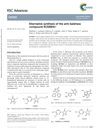
January 2014 in “RSC Advances” A new, less toxic and more efficient method to create the anti-baldness compound RU58841 was developed in 2014.
 8 citations
,
July 2019 in “Pure and Applied Chemistry”
8 citations
,
July 2019 in “Pure and Applied Chemistry” This study identified natural compounds from Iris plants that showed potential as inhibitors of urease and carbonic anhydrase-II enzymes, suggesting their possible use in treating related disorders.
![Benzo[c]quinolizin-3-ones Theoretical Investigation: SAR Analysis and Application to Untested Compounds](/images/assets/6712367a-949f-47c7-a756-2bfe6316fc69/small/15331.jpg) 6 citations
,
August 2004 in “Journal of Chemical Information and Computer Sciences”
6 citations
,
August 2004 in “Journal of Chemical Information and Computer Sciences” This study found that certain molecular quantum descriptors can be directly correlated with the biological activity of benzo[c]quinolizin-3-ones, potentially aiding in the identification and design of active compounds.
8 citations
,
June 2017 in “Steroids” This study evaluated novel steroid compounds for their ability to inhibit 5α-reductase, showing that compound 16a significantly reduced rat prostate weight more than epristeride and exhibited excellent in vitro inhibitory potency, indicating its potential as a lead candidate for further benign prostatic hyperplasia drug research.
5 citations
,
January 2011 in “International Journal of Cosmetic Science” This study found that 1,2,3,4-tetrahydroquinoline derivatives, particularly N-methyl-7-amino-1,2,3,4-tetrahydroquinoline, may be excellent blue dye candidates for human hair, offering superior color purity, stability, and fastness compared to 2,3-dihydroindoles.
![Synthesis and 5α-Reductase Inhibitory Activity of 8-Substituted Benzo[ƒ]Quinolinones Derived from Palladium Mediated Coupling Reactions](/images/assets/2aedba8c-b0ac-4fa3-9ac7-9f375a016bba/small/15581.jpg) 14 citations
,
February 1998 in “Bioorganic & Medicinal Chemistry Letters”
14 citations
,
February 1998 in “Bioorganic & Medicinal Chemistry Letters” This study explored how modifying the 8-substituent of 8-bromobenzoquinolinone affects its selectivity in inhibiting both 5 alpha-reductase isozymes in the scalp.