 May 2023 in “Frontiers in Endocrinology”
 This study found that tildacerfont treatment in males with congenital adrenal hyperplasia reduced androgen levels and improved markers of testicular function, suggesting potential benefits for male reproductive health.
August 2026 in “Cosmoderma” This study observed that cyclosporine, an immunosuppressive drug used in renal transplantation, can cause temporary hypertrichosis, with patients experiencing significant hair loss after discontinuing the medication.
 35 citations
,
August 2001 in “Journal of Cutaneous Medicine and Surgery”
35 citations
,
August 2001 in “Journal of Cutaneous Medicine and Surgery” This paper reviews the use of tacrolimus for various conditions, noting its effectiveness in treating certain skin disorders but highlighting that some findings remain anecdotal due to limited case numbers.
January 2013 in “프로그램북(구 초록집)” This review discusses the efficacy and safety of cyclosporine, methotrexate, and acitretin for managing psoriasis and reports no new clinical results; cyclosporine showed a rapid onset for severe psoriasis, methotrexate highlighted liver concerns, and acitretin was noted for its non-immunosuppressive benefits.
 December 2016 in “Springer eBooks”
 This review examines the clinical features, causes, diagnosis, and treatment of Chrousos syndrome but reports no new experimental findings on this condition.
12 citations
,
July 2016 in “Journal of dermatology” This study found that intramuscular triamcinolone acetonide may be an effective and safe treatment option for managing refractory alopecia areata, showing a 63% response rate in patients and hair regrowth negatively correlated with initial scalp involvement.
9 citations
,
November 1980 in “Geburtshilfe und Frauenheilkunde” In this study, prolonged intravenous Fenoterol infusion was associated with intensive hair growth in most patients, although hormonal changes typically linked to such effects were not observed.
January 2026 in “International Journal of Medical and All Body Health Research” This study found that both intralesional corticosteroids (TAC) and platelet-rich plasma (PRP) are effective for treating patchy alopecia areata, with TAC providing faster early results but PRP offering better long-term safety and lower relapse rates.
 2 citations
,
May 2021 in “Clinical Pharmacology in Drug Development”
2 citations
,
May 2021 in “Clinical Pharmacology in Drug Development” This phase 1 study reported that after administering supratherapeutic doses of cortexolone 17α‐propionate, a topical antiandrogen intended for hair loss treatment, there was no effect on the QTc interval, indicating no measurable cardiac safety concerns in the concentration range tested.
284 citations
,
May 2002 in “Proceedings of the National Academy of Sciences” In vitro, this study suggests that CRH may act as an autocrine hormone in human sebocytes, influencing lipid synthesis and potentially impacting skin disorders related to alterations in sebaceous lipid formation.
75 citations
,
September 1971 in “British Journal of Dermatology” This study found that both intralesional triamcinolone acetonide and triamcinolone hexacetonide promote continuous hair growth in alopecia areata, with effects lasting at least 9 months after a single injection.
 February 2022 in “Cleveland Clinic Journal of Medicine”
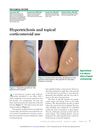
 This case report observed hypertrichosis on the left forearm of an 80-year-old woman, possibly linked to her previous use of the topical steroid betamethasone butyrate propionate for dermatitis.
10 citations
,
April 1964 in “Journal of the American Geriatrics Society” This article reviews triamcinolone acetonide as an intramuscular long-acting steroid therapy for dermatologic disorders but reports no new clinical results.
11 citations
,
January 2017 in “Skin Appendage Disorders” This study associated ivory-colored areas observed through trichoscopy with steroid deposits in the dermis among patients with steroid-induced atrophy on the scalp.

This study found that local therapy with trichoriboside and trichosaccharide significantly increased cAMP levels in hair follicles of men with androgenic alopecia, with trichoriboside showing greater activity.
3 citations
,
January 1996 in “Journal of Dermatological Treatment” In this study, twice daily application of 3 μg/g calcitriol ointment was reported to be safe, effective, and well tolerated for treating moderate to severe chronic plaque psoriasis on the face and surrounding areas.
 October 2023 in “Dermatology practical & conceptual”
 This study found that pulse corticosteroids effectively induce hair regrowth in alopecia areata, with betamethasone showing higher efficacy but more side effects, and treatment success varying depending on age, onset time, and disease type.
3 citations
,
October 2024 in “Experimental Dermatology” This study found that patients with alopecia areata exhibited increased CRHR1 expression on circulating monocytes compared to controls, suggesting that stress-related factors like CRH and CRHR1 may contribute to the development and progression of the condition, particularly in chronic cases and those with larger lesions.
This study, involving patients with early rheumatoid arthritis, found that treatment regimens combining methotrexate and glucocorticoids, with or without initial high-dose methylprednisolone, showed higher remission rates over one year compared to methotrexate or leflunomide alone, and all regimens were generally well-tolerated.
April 2023 in “Journal of Investigative Dermatology” This study suggests that monitoring CD8+ TEMRA cells in patients with rapidly progressive alopecia areata treated with intravenous corticosteroids could help predict therapeutic outcomes.
8 citations
,
August 2016 in “Journal of the European Academy of Dermatology and Venereology” Oral tacrolimus helped a rheumatoid arthritis patient regrow hair lost due to alopecia areata.
 November 2024 in “Journal of the European Academy of Dermatology and Venereology”
 In this pilot study, cryotherapy using a device that precisely controls cooling duration improved hair regrowth for patchy alopecia areata when applied for 20 seconds with two freeze-thaw cycles, similar to standard triamcinolone acetonide injections, but not when applied for 10 seconds.
 149 citations
,
June 2002 in “Veterinary record/The veterinary record”
149 citations
,
June 2002 in “Veterinary record/The veterinary record” This study found that trilostane was effective in resolving symptoms such as polyuria and polydipsia in many dogs with pituitary-dependent hyperadrenocorticism, with significant hormone level reductions observed.
 80 citations
,
August 1991 in “The journal of allergy and clinical immunology/Journal of allergy and clinical immunology/The journal of allergy and clinical immunology”
80 citations
,
August 1991 in “The journal of allergy and clinical immunology/Journal of allergy and clinical immunology/The journal of allergy and clinical immunology” This study found that low-dose methotrexate significantly reduced the steroid requirement in subjects with corticosteroid-requiring asthma without altering their clinical status or causing significant complications.
 October 2023 in “Journal of the American Academy of Dermatology”
 This source reports that clascoterone cream has been approved in the U.S. for treating acne vulgaris in patients aged 12 and older, suggesting it works by competing with dihydrotestosterone at androgen receptors to mitigate acne's effects.
 17 citations
,
August 1967 in “JAMA”
17 citations
,
August 1967 in “JAMA” In this study, a plasma-fluorescent corticoid test effectively differentiated patients with adrenal insufficiency from those with normal adrenal function based on their response to corticotropin.
 47 citations
,
February 2015 in “European Journal of Clinical Investigation”
47 citations
,
February 2015 in “European Journal of Clinical Investigation” This review discusses Chrousos syndrome, a rare condition caused by NR 3C1 gene mutations leading to glucocorticoid resistance, and reports no new clinical results; early identification and genetic testing are recommended for diagnosis.
14 citations
,
January 2015 in “Annals of dermatology/Annals of Dermatology” This study found that corticosteroid pulse therapy may be more effective than oral cyclosporine with corticosteroid for patients with severe alopecia areata, especially for those with the plurifocal type or a short disease duration.
 June 2016 in “Annals of the rheumatic diseases”
 This study found that methotrexate, when administered according to current recommendations, effectively manages rheumatoid arthritis for many patients in Poland, although regular monitoring is necessary due to possible adverse effects.
March 2023 in “Reactions Weekly”