
The document recommends a multidisciplinary approach and experience sharing to advance facial feminization surgery as a medical field.
 September 2016 in “Elsevier eBooks”
 Different types of hair loss in dogs and cats have various causes and treatments, with outcomes ranging from good to uncertain.
 April 2016 in “Journal of The American Academy of Dermatology”
 People with Down syndrome are more likely to experience hair loss, and using dermoscopy can help diagnose it.
 January 2016 in “Springer eBooks”
 This review examines the clinical presentation and management strategies for alopecia areata, focusing on pediatric patients, and highlights the need for addressing its psychological impacts; it reports no new clinical findings.
August 2015 in “Han'gug dongmul jawon gwahag hoeji/Han-guk dongmul jawon gwahak hoeji/Journal of animal science and technology” This study reported variable expression levels of TRα and CRABPII genes during the prenatal development of cashmere goats, contributing to an understanding of hair follicle formation in these animals.
 March 2015 in “CRC Press eBooks”
 This article discusses telogen effluvium in women, its causes, and typical diagnostic methods, but reports no new research findings on clinical outcomes or treatments.
January 2015 in “The Annals of Clinical and Analytical Medicine” This retrospective study evaluated demographic characteristics of alopecia areata patients in a Turkish region, finding no significant differences in most lab parameters compared to controls, but higher TSH levels in patients.
April 2014 in “Emergency Medicine News” This case report highlights the diagnostic challenges of thyroid storm, emphasizing the importance of a thorough history and review of systems to differentiate it from other conditions.
 March 2014 in “Journal of the American Academy of Dermatology”
 Alopecia areata is relatively common in children, has a variable course, and shows different responses to treatment; thyroid testing is recommended for those affected.
 January 2014 in “Pathology”
 The document concludes that understanding nail anatomy is key for diagnosing nail diseases, early signs of nail melanoma may allow for less aggressive treatment, and specific genetic mutations are important in thyroid cancer prognosis and treatment.
 December 2013 in “대한피부과학회지”
 In this study, Korean women with female pattern hair loss were found to have higher levels of ferritin, testosterone, and vitamin D compared to the average Korean adult women.
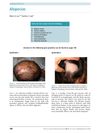 February 2013 in “Archives of Disease in Childhood: Education & Practice”
 Different types of alopecia in children require specific diagnoses and treatments.
 January 2013 in “Psychiatry and clinical neurosciences”
 This case report emphasizes the importance of investigating physical symptoms in patients with depression, as persistent loss of libido in this patient led to the diagnosis of craniopharyngioma.
January 2013 in “Refubium (Universitätsbibliothek der Freien Universität Berlin)” This study observed that hormone replacement therapy and autoimmune diseases may be more common among women with frontal fibrosing alopecia compared to those with androgenetic alopecia.
research 1249
December 2012 in “Critical Care Medicine” This case report describes a rare presentation of myxedema coma in a 46-year-old woman, initially identified by acute pulmonary embolism, which was managed successfully with thyroid hormone and corticosteroid treatment.
 March 2012 in “Journal of Pediatric and Adolescent Gynecology”
 This study found significant variability among NASPAG members in diagnostic approaches for PCOS, though there was more agreement on recommended first-line therapies such as oral contraceptives and lifestyle changes.
December 2011 in “Thorax” In this study, researchers reported that individuals from iodine-deficient regions have an increased risk of developing hypothyroidism from MDR-TB treatment regimens containing PAS and/or Prothionamide.
 October 2011 in “Dermato-endocrinology”
 Hormones significantly affect skin health, with vitamin D playing a key role.
 January 2011 in “Elsevier eBooks”
 Alopecia in animals can be hereditary, congenital, or acquired, with treatments and outcomes varying widely.
 January 2011 in “Journal of pediatric endocrinology & metabolism/Journal of pediatric endocrinology and metabolism”
 This case study reported hyperandrogenism in non-obese triplet sisters with one sister's hyperthyroidism masking its clinical and biochemical signs until treatment increased her androgen levels and hirsutism.
 December 2010 in “Bariatric Nursing and Surgical Patient Care”
 This article provides a clinical Q&A on bariatric nursing and surgical patient care and reports no new research findings.
 September 2010 in “Companion Animal”
 This article reviews a clinician's approach to diagnosing and managing canine alopecia and reports no new clinical findings.
 January 2010 in “Journal of The American Academy of Dermatology”
 The document provided instructions for completing a CME exam on diagnosing and managing hair loss.
January 2010 in “The Internet Journal of Family Practice” This article reviews the clinical features, incidence, and systemic effects of hypothyroidism across different age groups and reports no new clinical findings.
 December 2009 in “DergiPark (Istanbul University)”
 This study found that low levels of ferritin and iron were common among women with diffuse hair loss, suggesting these tests could be useful in evaluating such patients.
 January 2009 in “Side effects of drugs annual”
 This chapter reviews drugs affecting blood coagulation and details the increased hemorrhage risk associated with warfarin interactions, liver disease, heart failure, and antiphospholipid antibodies but reports no new clinical results.
January 2009 in “Beijing Medical Journal” This study found that combined therapy, including oral and topical treatments, was effective in improving severe alopecia areata, with injection site pain and facial hair changes as common side effects.
January 2008 in “HAL (Le Centre pour la Communication Scientifique Directe)” This study identified complex regulatory elements and interactions involving the Hr gene and HR protein that are crucial for hair follicle formation and cycling in mammals.
This study found that premenopausal exercising women with oligomenorrhea had lower triiodothyronine levels and truncal fat percentage compared to other groups, suggesting distinct energetic and reproductive profiles.
August 2006 in “Experimental dermatology” This study suggests that human scalp hair follicles express erythropoietin and its receptor, up-regulating receptor expression under hypoxic conditions, and may mimic another hypothalamus–pituitary axis equivalent involving the TRH-TSH system.