 July 2025 in “Bulgarian Portal for Open Science”
 In this study, researchers explained that healing of extensive skin defects involves granulation filling the wound cavity, followed by epithelialization from skin edges and hair follicles, which are crucial steps in wound healing.
3 citations
,
April 2000 in “Plastic and Reconstructive Surgery” This journal overview describes the scope of Plastic and Reconstructive Surgery® and reports no new research findings, focusing instead on updates in techniques and medicolegal news.
 3 citations
,
October 2021 in “Indian Journal of Plastic Surgery”
3 citations
,
October 2021 in “Indian Journal of Plastic Surgery” This review discusses the evolution of follicular unit extraction techniques for hair transplant, highlighting various devices and methods but reports no clinical results; it emphasizes advancements in tools and techniques over the years.
1 citations
,
January 1997 in “European journal of plastic surgery” This case report describes a 45-year-old man with androgenetic alopecia who developed painful abscesses after monacrylic hair fiber implantation, requiring surgical intervention with tissue expansion and flap repair.
 January 2016 in “Hair transplant forum international”
 This article reports a notification from Dr. Greg Williams to the FUE Research Committee, but it provides no new research findings.
 January 2024 in “Indian Journal of Plastic Surgery/Indian journal of plastic surgery”
 This case report describes a flap advancement technique following skin expansion as a successful method to address primary essential cutis verticis gyrata, preserving hair growth and improving cosmetic outcomes.
 February 2018 in “Dermatologic Surgery”
 This study found that nonshaven follicular unit extraction is an effective method for pubic hair restoration in women with pubic atrichosis or hypotrichosis, based on high satisfaction scores from both patients and the surgeon.
 2 citations
,
April 2014 in “International Wound Journal”
2 citations
,
April 2014 in “International Wound Journal” The authors reported that V-Y-S plasty was a safe one-stage method for reconstructing very large scalp alopecia following burns or surgeries.
 May 2022 in “Hair transplant forum international”
 This article outlines a 15-step process for safe and efficient follicular extraction using the follicular unit excision technique, but it reports no new clinical results.
2 citations
,
June 2018 in “Dermatologic Surgery” This overview details the Dermatologic Surgery journal's expansive focus on cosmetic and reconstructive skin surgery but reports no new research findings.
 15 citations
,
May 2004 in “Facial Plastic Surgery Clinics of North America”
15 citations
,
May 2004 in “Facial Plastic Surgery Clinics of North America” This article describes a technique for improving the aesthetic results of surgical hair restoration by recycling plug grafts into smaller grafts, which can be combined with other procedures like scalp lifting and reductions.
 15 citations
,
May 2005 in “Seminars in Plastic Surgery”
15 citations
,
May 2005 in “Seminars in Plastic Surgery” This article details techniques for eyebrow and eyelash reconstruction surgery with hair follicular unit transplantation but reports no new clinical results; the author describes the advantages over other methods.
 1 citations
,
October 2021 in “PubMed”
1 citations
,
October 2021 in “PubMed” This case report describes a 43-year-old woman with scarring burn alopecia treated with tissue expansion and local flap reconstruction, who experienced reversible acute hair loss (Telogen Effluvium) after the procedure.
20 citations
,
January 2013 in “Plastic & Reconstructive Surgery” In a swine model, this study found that a novel micro-coring needle device increased skin thickness and collagen content, suggesting potential as a safer, cost-effective alternative to laser resurfacing for skin rejuvenation.
 January 2021 in “Journal of Cutaneous and Aesthetic Surgery”
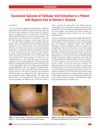
 Follicular unit extraction successfully restored hair growth in a leprosy patient without disease relapse.
 1 citations
,
March 2013 in “International Society of Hair Restoration Surgery”
1 citations
,
March 2013 in “International Society of Hair Restoration Surgery” This case report describes a patient who experienced recalcitrant folliculitis leading to atrophic scarring following eyebrow transplantation.

In this retrospective analysis, researchers evaluated 54 patients undergoing soft tissue reconstruction for scalp and forehead defects and reported excellent aesthetic outcomes with local flaps for defects up to 50 cm², while larger defects typically required additional skin grafting.
 August 2026 in “npj Regenerative Medicine”
 This study found that hair follicle micro-graft transplantation significantly improved scar remodeling outcomes in 40 patients, with greater reductions in scar volume, lower scar scores, and enhanced skin characteristics compared to punch excision alone, potentially due to activation of the PI3K-AKT pathway.
 1 citations
,
January 2010 in “Elsevier eBooks”
1 citations
,
January 2010 in “Elsevier eBooks” The document concludes that local flaps are effective for reconstructive surgery in the head and neck, offering good skin match and function.
May 2024 in “International Society of Hair Restoration Surgery” This advanced training course for dermatologists and plastic surgeons in eyebrow transplantation reports no new research findings.
August 2002 in “British journal of ophthalmology” This article reports that while surgical excision is often the best treatment for SCC, intralesional cidofovir also showed success without systemic toxicity in the case discussed.
August 2026 in “Frontiers in Surgery” This review article from the examined literature highlights the shift in eyebrow reconstruction techniques from traditional methods to minimally invasive and regenerative approaches, evaluating their principles, outcomes, and challenges to inform future clinical practices.
 71 citations
,
May 1975 in “The American journal of surgery”
71 citations
,
May 1975 in “The American journal of surgery” This case report describes a 19-year-old female who experienced reversible severe alopecia and ascites after a large partial hepatectomy for minimal deviation hepatoma, despite incomplete liver regeneration.
 February 2026 in “Trials”
 The Exfoliate-Dissolve-Repair skincare approach may effectively treat keratosis pilaris and reduce the need for corticosteroids.
5 citations
,
January 2016 in “Indian dermatology online journal” This case report describes a 25-year-old male with multiple keratoacanthomas that responded to intralesional methotrexate and oral acitretin treatment.
 April 2018 in “Deleted Journal”
 This article reviews various skin grafting techniques for treating large wounds, particularly in animals, but does not present new experimental data.
88 citations
,
January 2010 in “Escritura pública” This article discusses the combined use of strip method and FUE techniques for hair transplantation along with a real-time intraoperative calculation model to reduce graft over-extraction and wastage, but reports no new clinical results.
 1 citations
,
January 2019 in “Springer eBooks”
1 citations
,
January 2019 in “Springer eBooks” Hidradenitis Suppurativa is a chronic skin condition best treated early with surgery for better outcomes and less recurrence.
April 2025 in “ALEXMED ePosters” This study found that nanofat injections significantly improved scar characteristics, including collagen deposition, epidermal thickness, and vascularity, due to its anti-inflammatory and immunomodulatory properties.
 September 2024 in “Journal of Medicine and Life”
 In this study, researchers identified a recurrent nonsense mutation, c.409C>T (p.Arg137*), in the COL7A1 gene through whole exome sequencing in a family with autosomal recessive dystrophic epidermolysis bullosa, demonstrating the importance of this method for diagnosing genetically complex conditions.