 15 citations
,
October 2018 in “Reproductive Biomedicine Online”
15 citations
,
October 2018 in “Reproductive Biomedicine Online” This study suggests that the anogenital distance measure AGDAC may moderately discriminate the presence of polycystic ovarian syndrome and could be a useful clinical tool.
 August 2018 in “Journal of The American Academy of Dermatology”
 Older men's scalp damage increases with age and sun exposure, a baby girl in the Philippines has Schimmelpenning syndrome, and thyroid screening is advised for children with hair loss and certain risk factors.
 1 citations
,
January 2017 in “ARC journal of dermatology”
1 citations
,
January 2017 in “ARC journal of dermatology” This study introduced and evaluated Ahmad's NPRT system for documenting hair loss, finding it helpful in assessing the specific state of male pattern baldness in 500 patients.
18 citations
,
January 2021 in “Theranostics” This study found that actively targeted AN2728-loaded nanocarriers reduced inflammation and improved skin condition in a mouse model of psoriasiform inflammation compared to free drug and non-targeted nanoparticles.
 July 2023 in “Journal of exploratory research in pharmacology”
 In this case report, a 47-year-old man with extensive psoriasis saw significant improvement in scaling and itching after using a new lotion containing clobetasol and other ingredients for one week, but further research is needed to confirm these findings.
December 2012 in “http://isrctn.org/>”  April 2026 in “Zenodo (CERN European Organization for Nuclear Research)”
 This research presents the Dodatek A model, elaborating on androgen function through new mathematical indices and methodological improvements, shifting focus from serum hormone concentrations to system interactions to better describe androgen activity comprehensively.
 70 citations
,
January 2000 in “Hormone Research in Paediatrics”
70 citations
,
January 2000 in “Hormone Research in Paediatrics” This article reviews the characteristics and classification of SAHA syndrome and its relationship with other conditions, without presenting new clinical findings.
 49 citations
,
January 2003 in “Clinical and Experimental Dermatology”
49 citations
,
January 2003 in “Clinical and Experimental Dermatology” This report from the UK reviews the literature on post-menopausal frontal fibrosing alopecia and highlights its under-recognition and distinctive characteristics compared to lichen planopilaris, but does not provide new results.
 August 2023 in “Skin Research and Technology”
 This study found that using planimetric surface area measurement might be a useful supplementary method to improve the accuracy of SALT scoring in alopecia areata, particularly for scores S1 to S3.
 October 2023 in “International Journal of Science and Research (IJSR)”
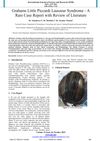
 This paper describes Grahams Little Piccardi Lassueur Syndrome, a rare type of Lichen Planopilaris that causes different types of alopecia and distinctive skin papules, primarily affecting females aged 40 to 70, and notes the current challenges in treatment options, particularly once scarring occurs.
 October 2022 in “Aesthetic Cosmetology and Medicine”
 This study reviews polycystic ovary syndrome, focusing on its hormonal and metabolic disturbances and related skin lesions, but provides no new clinical findings.
March 2026 in “Pediatric Dermatology” This study observed that GPT-4o, a generative AI model, showed high concordance with human providers in automating image-based SALT scores for assessing alopecia areata, suggesting its potential in assisting clinical evaluations without additional training.
28 citations
,
June 1995 in “The Journal of Dermatology” This study reports that flaky skin mice exhibit skin and nail features that closely resemble human psoriasis vulgaris, suggesting they may serve as a natural model for this condition.
 March 2024 in “Journal of Rawalpindi Medical College/Journal Rawalpindi Medical College”
 This study observed that skin conditions like hirsutism, acne, and androgenic alopecia were common in PCOS patients and may aid in its diagnosis.
 December 2021 in “THE THERAPIST (Journal of Therapies & Rehabilitation Sciences)”
 This review highlights the increased need for awareness about Polycystic Ovarian Syndrome (PCOS) and suggests that more research is necessary to understand its management through lifestyle modifications.
January 2016 in “Zurich Open Repository and Archive (University of Zurich)” This study concludes that dietary L-serine supplementation shows promise as a long-term therapy for hereditary sensory and autonomic neuropathy type 1, reducing neurotoxic 1-deoxysphingolipid levels and improving symptoms in severe cases.
 31 citations
,
September 2012 in “Human Brain Mapping”
31 citations
,
September 2012 in “Human Brain Mapping” In this study, patients with seasonal affective disorder were found to have increased functional connectivity in certain brain networks and higher low-frequency fluctuations compared to healthy controls, which aligns with their attentional and psychomotor symptoms.
 November 2022 in “International Journal of General Medicine”
 This study found that non-alcoholic fatty pancreas disease is significantly more prevalent in women with polycystic ovary syndrome, and is associated with metabolic syndrome, insulin resistance, and hyperandrogenism.
 January 2021 in “International Journal of Research in Pharmaceutical Sciences”
 This review discusses the diagnosis and treatment strategies for polycystic ovary syndrome, particularly using the "MY PCOS" mnemonic, and reports no new experimental results.
97 citations
,
January 1999 in “International Journal of Dermatology” Pityriasis rubra pilaris is a rare skin disorder with reddish-orange patches and thickened skin, needing better treatment understanding.
 July 2018 in “European Medical Journal”
 This meeting review discusses recent advances in systemic psoriasis treatments, emphasizing the impact of dimethylfumarate monotherapy on understanding psoriasis and treatment strategies; it reports no new clinical results.
 April 2023 in “Journal of Investigative Dermatology”
 This research reexamined transcriptomic data to study stem and progenitor cell proliferation in psoriasis, finding that the number of committed progenitor cells increased eight-fold in psoriatic skin without altering stem cell numbers, potentially identifying new therapeutic targets.
March 2026 in “Journal of the European Academy of Dermatology and Venereology” This study introduced and validated the VESALT, a visual extension of the Severity of Alopecia Tool, finding it offers improved reliability and user-friendliness over SALT by incorporating pattern recognition and broader coverage, including non-scalp regions, in assessing alopecia areata severity.
 4 citations
,
January 1970 in “Journal of Bangladesh College of Physicians and Surgeons”
4 citations
,
January 1970 in “Journal of Bangladesh College of Physicians and Surgeons” This report highlights a case of adrenoleukodystrophy, a rare disease, diagnosed in a young boy with neuropsychiatric symptoms and Addison's disease, stressing the importance of early diagnosis and genetic counseling.
5 citations
,
September 2021 in “Clinical case reports” This case report documents the first known instance of Graham‐Little Piccardi Lassueur Syndrome in Saudi Arabia, observed in an adult dark-skinned male.
 March 2026 in “Mendeley Data”
 This tool was developed to enhance reproducibility and sensitivity in measuring partial hair regrowth in alopecia areata patients, particularly those undergoing JAK inhibitor therapy, using scalp photographs.
 5 citations
,
November 2021 in “Saudi medical journal”
5 citations
,
November 2021 in “Saudi medical journal” This report describes three Saudi sisters with Woodhouse-Sakati syndrome, who exhibited typical features of the condition along with unusual gynecological anomalies.
 April 2017 in “European Psychiatry”
 This study found that females treated with atypical anti-psychotics had a higher prevalence of probable polycystic ovarian syndrome compared to normal controls.
February 2026 in “Australasian Journal of Dermatology” This study developed a handheld card to simplify the calculation of the SALT score for assessing alopecia areata severity, noting that while it accelerates the process, formal validation against existing methods is still needed.