 46 citations
,
August 2019 in “Journal of Ethnopharmacology”
46 citations
,
August 2019 in “Journal of Ethnopharmacology” This review compiles current information about Eclipta prostrata, traditional uses, and its promising pharmacological properties, like hepatoprotective and anti-inflammatory effects, but emphasizes that more research is needed to fully understand its mechanisms and ensure safety for clinical application.
31 citations
,
January 2014 in “The Scientific World JOURNAL” This study found that the water extract of Eclipta prostrata L. may protect skin cells against UVB-induced damage, likely due to its antioxidant properties and absorption of UVA and UVB radiation.
 21 citations
,
November 2021 in “Biomolecules”
21 citations
,
November 2021 in “Biomolecules” This review compiles information on traditional uses, phytoconstituents, and biological activities of Eclipta prostrata but reports no new experimental results; the authors call for more studies to understand its pharmacological mechanisms.
 7 citations
,
January 2019 in “Pharmaceutical Biology”
7 citations
,
January 2019 in “Pharmaceutical Biology” This study suggests that Eclipta prostrata may promote hair growth in mice and human dermal papilla cells through regulating FGF-7 and mTOR signaling.
6 citations
,
October 2023 in “Pharmaceuticals” This study found that the extract of Eclipta prostrata L. demonstrated high antioxidant and anti-acetylcholinesterase activities, moderate inhibition of enzymes linked to diabetes, and favorable ADMET properties, suggesting potential cognitive and diabetes management benefits.
 6 citations
,
January 2022 in “GSC Biological and Pharmaceutical Sciences”
6 citations
,
January 2022 in “GSC Biological and Pharmaceutical Sciences” This review discusses the ethnobotanical use and bioactivity of Eclipta prostrata, highlighting its potential in treating various conditions and linking its effects to secondary metabolites.
 6 citations
,
December 2020 in “Biological & Pharmaceutical Bulletin”
6 citations
,
December 2020 in “Biological & Pharmaceutical Bulletin” This study found that certain fatty acids and triterpenoid-glycosides from Eclipta prostrata L. leaves exhibit potent inhibitory effects on the protein tyrosine phosphatase 1B enzyme, suggesting potential anti-diabetic and anti-obesity benefits.
4 citations
,
December 2020 in “Natural Product Sciences” This study identified ten compounds from Eclipta prostrata, with some displaying potent inhibitory effects against α-glucosidase and acetylcholinesterase enzymes.
 4 citations
,
August 2018 in “International Journal of Current Microbiology and Applied Sciences”
4 citations
,
August 2018 in “International Journal of Current Microbiology and Applied Sciences” This study identified various phytochemicals and compounds in Eclipta prostrata leaves using qualitative tests, FTIR, and GC-MS analysis, highlighting the presence of phytol and squalene among others.
 1 citations
,
February 2023 in “Plant disease”
1 citations
,
February 2023 in “Plant disease” This study reports the first identification of 'Candidatus Phytoplasma aurantifolia' in the invasive weed Eclipta prostrata in Taiwan, linked to symptoms such as branch proliferation and phyllody.
 1 citations
,
July 2022 in “Plant Cell, Tissue and Organ Culture (PCTOC)”
1 citations
,
July 2022 in “Plant Cell, Tissue and Organ Culture (PCTOC)” This study identified that the biosynthetic pathways for coumestans in Eclipta prostrata are derived from acetate and shikimate pathways, while phenylpropanoid biosynthesis is exclusively from the shikimate pathway.
1 citations
,
January 2022 This book chapter reviews the taxonomy, traditional uses, pharmacological effects, and safety of Eclipta prostrata, emphasizing its potential therapeutic applications, but it reports no new clinical results.
 1 citations
,
January 2019 in “International Journal of ChemTech Research”
1 citations
,
January 2019 in “International Journal of ChemTech Research” This study reviews the pharmacological properties of the plant Eclipta prostrata, highlighting its potential in treating various conditions including wound healing, diabetes, liver protection, alopecia, gum disease, cancer prevention, bone health, and antimicrobial effects, alongside its traditional use in tropical regions.
 1 citations
,
January 2013 in “African Journal of Pharmacy and Pharmacology”
1 citations
,
January 2013 in “African Journal of Pharmacy and Pharmacology” This study found that ultrasound assisted microwave extraction was more efficient than other methods for extracting luteolin from Eclipta prostrata, reducing extraction time and simplifying the process.
 May 2026 in “Zenodo (CERN European Organization for Nuclear Research)”
 In this study, researchers developed a polyherbal antidandruff shampoo using medicinal plant extracts and found it exhibited significant antioxidant and antimicrobial properties, including activity against bacteria and fungi linked to scalp infections, suggesting it as a natural alternative to synthetic shampoos.
 May 2026 in “Zenodo (CERN European Organization for Nuclear Research)”
 This study found that the polyherbal anti-dandruff shampoo formulated from medicinal plants like Azadirachta indica and Hibiscus rosa-sinensis demonstrated significant antioxidant and antimicrobial activities, including effects against dandruff-causing microorganisms, suggesting it could be a natural alternative to synthetic shampoos.
 March 2026 in “International Journal of Science and Research (IJSR)”
 This research focused on Eclipta prostrata, revealing unique anatomical features and bioactive compounds such as alkaloids and flavonoids that can aid in reliable identification and quality control of this medicinal herb, commonly used for hair growth and liver health.
 March 2026 in “Israel Journal of Plant Sciences”
 This study investigated the endophytic bacterial community of Eclipta prostrata, finding that these microorganisms contribute to the plant’s stress tolerance and detoxification, which may enhance its medicinal properties by supporting the synthesis and stability of beneficial metabolites.
 July 2025 in “International Journal of Allied Medical Sciences and Clinical Research”
 This review compiles current knowledge of Eclipta prostrata's botanical details, ethnomedical uses, phytochemical components, and various pharmacological activities, emphasizing its potential for modern pharmaceutical formulations based on its anti-inflammatory, antioxidant, anticancer, and other therapeutic properties.
April 2025 in “The Journal of Agriculture and Development” In this study, researchers optimized the extraction conditions for polyphenols from the medicinal herb Eclipta prostrata, achieving the highest polyphenol content under specific conditions of temperature, solvent concentration, and time, and found the extract to have significant antioxidant activity.
August 2024 in “HAYATI Journal of Biosciences” This study assessed the therapeutic potential of Eclipta prostrata extracts in antibacterial and antioxidant applications, reporting that fractionated compounds showed enhanced efficacy and higher phenolic content compared to crude extracts, though some fractions also displayed high cytotoxicity, indicating a need for further evaluation.
 January 2024 in “International Journal For Multidisciplinary Research”
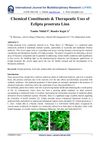
 This review examines existing studies on Eclipta prostrata, highlighting its diverse bioactive compounds and potential therapeutic benefits in traditional medicine, and underscores the need for further research to fully develop its medicinal promise.
August 2023 in “Apple Academic Press eBooks” This review highlights that various parts of Eclipta prostrata contain compounds with potential antioxidant, anti-inflammatory, hepatoprotective, and hair growth-promoting effects, among other activities.
 May 2022 in “International Journal for Research in Applied Science and Engineering Technology”
 This study reported that Eclipta prostrata contains active phytochemicals and demonstrated antibacterial properties in methanolic extracts, suggesting potential antibiotic uses.
 April 2022 in “Research Square (Research Square)”
 This study found that the biosynthetic pathways of coumestans in Eclipta prostrata are derived from acetate and shikimate pathways, while 3,5-di-O-caffeoylquinic acid biosynthesis originates exclusively from the shikimate pathway.
January 2022 in “Zenodo (CERN European Organization for Nuclear Research)” This review discusses the various traditional uses and reported bioactivities of Eclipta prostrata but does not present new research findings.
 January 2017 in “Bulletin of Pharmaceutical Research”
 This study developed chemical fingerprints to differentiate Eclipta prostrata and Wedelia calendulacea, two plants often confused and adulterated in the Indian herbal market, identifying distinct chemical profiles that can prevent such adulteration.
 May 2019 in “Asian Journal of Pharmaceutical and Clinical Research”
 This study found that the ethyl acetate and chloroform fractions of Eclipta prostrata Linn. exhibited significant anti-inflammatory activity in a carrageenan-induced paw edema model and showed notable anti-arthritic potential in a formaldehyde-induced arthritis model.
January 2025 in “SSRN Electronic Journal”  3 citations
,
November 2020 in “Phyton-international Journal of Experimental Botany”
3 citations
,
November 2020 in “Phyton-international Journal of Experimental Botany” This review discusses the potential therapeutic applications of wedelolactone, a compound in Eclipta prostrata, for various chronic human diseases and reports no new clinical results.