 June 2026 in “Zenodo (CERN European Organization for Nuclear Research)”
 This research highlights the various traditional uses of E. alba (bhringraj), noting its benefits for hair growth, liver function, and skin conditions such as eczema and pruritis, though results are not reported in this abstract.
 June 2026 in “Zenodo (CERN European Organization for Nuclear Research)”
 In this review, researchers highlighted E. alba (bhringraj) for its traditional uses in treating liver and hair growth issues, skin conditions, and digestive health, emphasizing its purported benefits like hair growth promotion and liver function enhancement.
 June 2026 in “GSC Advanced Research and Reviews”
 This abstract highlights that jojoba is a versatile plant recognized for its drought resistance and utility in desert regions, with its oil offering various pharmacological benefits like antioxidant and anti-inflammatory effects, though commercial cultivation challenges exist due to seedling variability.
 March 2026 in “International Journal of Molecular Sciences”
 This review found that different monosaccharide compositions in polysaccharides from 72 medicinal plants are linked to varying biological activities, with glucans, galactans, mannans, fructans, and pectins showing significant roles in immunomodulation, antioxidant effects, and other health benefits.
 February 2026 in “IOP Conference Series Earth and Environmental Science”
 This study identified specific morphological characteristics and kinship relationships among 27 candlenut genotypes in Karo Regency, North Sumatra, highlighting variations in stem, leaf, flower, fruit, and kernel traits, with the closest relationship between MTB1 and MTB2 genotypes.
 December 2025 in “CyberLeninK (CyberLeninka)”
 This study evaluated the phytochemical composition of Tamarix aphylla (L.) Karst., revealing the presence of bioactive compounds like alkaloids, flavonoids, and phenolics, which may contribute to its various medicinal properties.

In this study, researchers analyzed the chemical constituents of male and female Gynostemma longipes plants and different parts like roots and leaves, identifying significant variations in metabolites which could aid in assessing and selecting quality medicinal materials.
November 2025 in “Preprints.org” This review reports that the monosaccharide composition of polysaccharides significantly impacts their bioactivity, highlighting various roles for glucans, galactans, mannans, fructans, and pectin in immune regulation, antioxidant effects, and other biological functions.
 November 2025 in “Frontiers of Agricultural Science and Engineering”
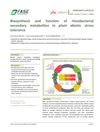
 This study observed that rhizobacterial strain RT3 significantly improved drought tolerance in lettuce by increasing survival rates and fresh biomass after rewatering, with metabolites such as proline and glycine enhancing stress resilience.
 November 2025 in “Clinical Cosmetic and Investigational Dermatology”
 This study found that a combination of five medicinal plants traditionally used in Chinese medicine significantly improved skin repair and delayed aging markers in laboratory models, suggesting synergistic anti-aging effects over individual ingredients.
 May 2025 in “GSC Biological and Pharmaceutical Sciences”
 This review highlights the potential use of herbal plants like Amla, Bhringraj, Hibiscus, and others in hair care, focusing on their bioactive compounds that may promote hair growth, reduce dandruff, and enhance hair texture.
 May 2025 in “Insights-Journal of Health and Rehabilitation”
 This study found that Aloe vera and Citrus lemon extracts demonstrated notable antibacterial effects against Propionibacterium acnes in both lab and human skin models, with combined use resulting in a 67% reduction in acne, suggesting potential for future therapeutic applications.
 December 2024 in “STUDIES IN ENGINEERING AND EXACT SCIENCES”
 In this study, solar drying of Punicagranatum was found to be the most effective, achieving a 65.26% drying rate compared to shade and convective drying methods.
 January 2024 in “Middle East Journal of Applied Science & Technology”
 This study formulated and evaluated a polyherbal body lotion using neem, tulsi, and aloe vera extracts, finding it met satisfactory physicochemical standards and was well received by users for skin smoothness and hydration without causing allergies.
September 2023 in “Zenodo (CERN European Organization for Nuclear Research)” This source compiles information on Calotropis gigantea, an Asclepiadaceae plant used in traditional medicine for treating conditions like leprosy, asthma, vertigo, and hair loss, highlighting its diverse medicinal potential.
March 2023 in “Agroland: The Agricultural Sciences Journal/Agroland : The Agricultural Sciences Journal” This review discusses the potential cosmeceutical benefits of Pontianak Aloe Vera, highlighting its use in products for skin and hair care, and reports no new results.
 February 2023 in “Molecules”
 In this study, N. ottonis cactus cell extract applied to mice promoted hair growth and increased the number of hair follicles, suggesting its potential as a hair-growth-promoting agent.
 August 2022 in “International Journal of Current Science Research and Review”
 This review discusses Ayurvedic detoxification methods for poisonous plants, known as Visha Dravyas, and reports no new clinical results.
 March 2021 in “International journal for research in applied science and engineering technology”
 In this study, researchers explored the use of natural herbal hair dyes made from tannin-producing plants like henna and pomegranate, reporting that these dyes can permanently color hair without causing damage or irritation, unlike synthetic dyes.
 July 2020 in “International journal of biology sciences”
 This study found that coconut oil mixed with egg yolk and vitamin E may enhance hair growth in male rabbits more efficiently than amla, reetha, and sikhakai oil.
This study concluded that the antioxidant and hair growth activity of Trigonella plants were higher compared to Geranium wallichianum, with a potential correlation between antioxidant activity and hair growth in albino rats.
January 2012 in “Journal of Beijing Normal University” In this study, canna was identified as the most effective plant for water purification in eutrophic conditions, supplemented by reed, with significant differences in pollutant absorption among the five plant species tested.
6 citations
,
November 2017 in “Journal of the Peripheral Nervous System” This study found that mercury chloride administration in rats led to decreased intraepidermal nerve fibers and increased Langerhans cells, suggesting small nerve fiber damage after mercury poisoning.
2 citations
,
November 2023 in “Global Advances in Integrative Medicine and Health” In this study, the authors reported preliminary evidence that programs combining nutrition and exercise interventions can significantly reduce BMI and LDL levels, suggesting these elements are important for lifestyle modification.
 2 citations
,
January 2022 in “Rasayan journal of Chemistry”
2 citations
,
January 2022 in “Rasayan journal of Chemistry” This study analyzed the affinity, stability, and pharmacokinetics of compounds from Sansevieria trifasciata, reporting that three compounds showed promising molecular docking results against the androgen receptor and satisfactory pharmacokinetic profiles, similar to minoxidil, in an in-silico setting.
 1 citations
,
October 2022
1 citations
,
October 2022 This study assessed the potential for Ocean Thermal Energy Conversion power in Fiji, finding higher power output and efficiency during summer due to greater temperature differences between surface and deep sea waters.
 April 2026 in “International Journal for Research in Applied Science and Engineering Technology”
 In this study, the developed polyherbal shampoo with Hibiscus rosa-sinensis exhibited good stability and cleansing properties, suggesting it may be an effective natural alternative to synthetic anti-hair fall products.
 April 2026 in “Zenodo (CERN European Organization for Nuclear Research)”
 This study investigated a herbal hair lotion using natural ingredients like rosemary and fenugreek extracts, finding that the F3 formulation had optimal spreadability, absorbency, washability, and stability, without causing skin irritation.
 April 2026 in “Zenodo (CERN European Organization for Nuclear Research)”
 This study reported the successful formulation and evaluation of a herbal hair lotion using natural ingredients; among tested versions, formulation F3 demonstrated superior spreadability, absorbency, and stability without causing skin irritation.

In this study, researchers developed a versatile sprayable hydrogel that promotes wound healing in mice by facilitating rapid gelation, reducing inflammation, and accelerating tissue regeneration, with potential applications in chronic wound treatment and beyond.