 July 2021 in “British Journal of Dermatology”
 This case report describes a novel instance of scarring alopecia with features of frontal fibrosing alopecia in a patient with systemic sclerosis, suggesting a potential link between the two conditions not previously reported.
2 citations
,
January 2012 in “Journal of Clinical & Experimental Dermatology Research” This study found that adding fexofenadine to DPCP treatment in non-atopic Alopecia areata patients did not significantly improve hair regrowth, but it did significantly reduce treatment-related discomfort.
 January 2020 in “Revista da Sociedade Portuguesa de Dermatologia e Venereologia”
 This study reports that frontal fibrosing alopecia in Brazilian patients is common in postmenopausal women and often associated with hypothyroidism and facial irritation from cosmetic products.
February 2026 in “Indian Dermatology Online Journal” This study reports that oral tofacitinib treatment in a patient with refractory lichen planus pigmentosus and frontal fibrosing alopecia resulted in near-complete resolution of hyperpigmentation and cessation of hairline recession over 18 months, and suggests it may be a promising therapy for these challenging conditions.
 May 2026 in “International Journal of Drug Delivery Technology”
 This case study highlights Erythromelanosis follicularis faciei et colli as an easily overlooked pigmentary disorder characterized by a distinctive triad requiring precise diagnosis for effective patient counseling and cosmetic management.
 February 2026 in “SHILAP Revista de lepidopterología”
 This study found that a family history of androgenetic alopecia and specific trichoscopic features are key factors in predicting female pattern hair loss, and the developed nomogram model may help improve disease management by assessing these risks.
 May 2024 in “JAMA Dermatology”
 In this study, researchers identified genetic factors associated with frontal fibrosing alopecia, noting a protective effect of a specific CYP1B1 gene variant, which may offer insights into the disease's pathogenesis and future risk mitigation strategies.
 January 2024 in “Dermatology practical & conceptual”
 In this study, researchers found that the peripilar sign in patients with androgenetic alopecia does not indicate perifollicular infiltrate but is more frequent in individuals with lighter skin types due to contrast with the skin.
May 2025 in “Indian Journal of Obstetrics and Gynecology Research” This study analyzed the relationship between clinical and anthropometric factors with the free androgen index to better evaluate polycystic ovarian syndrome, but results are not reported in the abstract.
 May 2025 in “Journal of Investigative Medicine”
 This study concluded that the Free Androgen Index (FAI) could serve as a reliable biomarker for hyperandrogenism in women with androgenetic alopecia, showing more predictive value than testosterone or SHBG alone.
 June 2019 in “Journal of Dermatological Treatment”
 This study reported that a novel filler, BM-PHA, demonstrated similar efficacy and safety to Restylane Perlane in treating moderate to severe nasolabial folds over 24 weeks, showing only minor local side effects and similar improvements in wrinkle severity scores between the two treatments.
December 2022 in “Plastic and Reconstructive Surgery” In this study, PRPF treatment was more effective than PRP alone in improving hair count and hair quality in androgenetic alopecia patients, with PRPF showing significant improvements in various hair growth parameters and having no statistical differences observed in the placebo group.
 10 citations
,
June 2005 in “The journal of investigative dermatology/Journal of investigative dermatology”
10 citations
,
June 2005 in “The journal of investigative dermatology/Journal of investigative dermatology” This study identified FP-1 as a highly specific extracellular matrix protein in follicular papilla cells, which may play a role in hair growth regulation during specific hair cycle phases.
 May 2022 in “Journal of Cosmetic Dermatology”
 This review discusses the characteristics and diagnostic challenges of fibrosing alopecia pattern distribution, proposing an algorithm for hair transplantation, but reports no new clinical results.
 8 citations
,
February 2010 in “Journal für Kardiologie (Krause & Pachernegg GmbH)”
8 citations
,
February 2010 in “Journal für Kardiologie (Krause & Pachernegg GmbH)” This study developed a detailed classification system for functional androgenization in females that may enhance diagnosis and personalized treatment by identifying individual dysfunctions.
 1 citations
,
January 2016 in “Journal of Microbial & Biochemical Technology”
1 citations
,
January 2016 in “Journal of Microbial & Biochemical Technology” This study found that the free androgen index (FAI) is a superior marker of hyperandrogenism in men with premature androgenetic alopecia compared to DHEAS and testosterone levels.
 July 2018 in “European Medical Journal”
 This meeting review discusses recent advances in systemic psoriasis treatments, emphasizing the impact of dimethylfumarate monotherapy on understanding psoriasis and treatment strategies; it reports no new clinical results.
 11 citations
,
March 2021 in “Dermatology and therapy”
11 citations
,
March 2021 in “Dermatology and therapy” This study developed the Alopecia Areata Patient Priority Outcome (AAPPO), a new tool designed to measure and capture the symptoms and impacts of alopecia areata that matter most to patients.
 August 2019 in “Journal of The American Academy of Dermatology”
 PFD patch helps laser tattoo removal, trichoscopy diagnoses AGA, and serum boosts SOD activity.
 11 citations
,
October 2020 in “Sensors”
11 citations
,
October 2020 in “Sensors” This study found that photoacoustic imaging can effectively measure follicle density and angles, even when follicles are not visible to the eye, providing a promising alternative to traditional photographic examination.
July 2024 in “Journal of Investigative Dermatology” The Fas/FasL pathway may play a role in alopecia areata.
 64 citations
,
June 2009 in “Journal of The American Academy of Dermatology”
64 citations
,
June 2009 in “Journal of The American Academy of Dermatology” This article discusses frontal fibrosing alopecia, noting potential connections to lichen planopilaris, but reports no new clinical findings.
 March 2021 in “CRC Press eBooks”
 This chapter reviews trichoscopic features of primary cicatricial alopecias, particularly lichen planopilaris and frontal fibrosing alopecia, and reports no new results.
 36 citations
,
December 2017 in “Journal of the American Academy of Dermatology”
36 citations
,
December 2017 in “Journal of the American Academy of Dermatology” This study observed that 70.7% of patients with frontal fibrosing alopecia stabilized with treatment, and patients using 0.3% tacrolimus were more likely to stabilize in 3 months compared to other treatments.
9 citations
,
July 2019 in “Dermatologic therapy” In this case report, a patient with frontal fibrosing alopecia and lichen planus responded well to treatment with alitretinoin, suggesting a potential therapeutic role for alitretinoin in similar cases.
2 citations
,
March 2019 in “PubMed” This report presents the early development of the Lupus Foundation of America's LFA-REAL™ patient-reported instrument, designed to enhance evaluation of lupus disease activity by combining patient and physician assessments.
 26 citations
,
June 2018 in “Australasian Journal of Dermatology”
26 citations
,
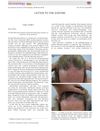
June 2018 in “Australasian Journal of Dermatology” Stopping sunscreen use on the forehead led to hair regrowth in a woman with frontal fibrosing alopecia.
 3 citations
,
September 2021 in “Experimental and Therapeutic Medicine”
3 citations
,
September 2021 in “Experimental and Therapeutic Medicine” This study described the clinical characteristics of keratosis pilaris atrophicans faciei in 14 patients, noting that earlier diagnosis may enable more targeted treatment options.
2 citations
,
January 2021 in “Journal of The American Academy of Dermatology” This pilot study found that examining changes in scalp scales after scraping may effectively distinguish seborrheic dermatitis associated with androgenetic alopecia from fibrosing alopecia in a pattern distribution.
4 citations
,
December 2017 in “Journal of zoo and wildlife medicine” This study proposes that seasonal alopecia and reproductive changes in six female fossas at the San Diego Zoo may be linked to hormonal changes associated with reproductive activity.