December 2025 in “Antibiotics” In this systematic review, researchers found that Tinea capitis in individuals aged 65 or older is frequently misdiagnosed, primarily affects women, and often presents with inflammatory symptoms; systemic antifungal therapy led to clinical cure in 91.2% of cases.
January 2022 in “Clinical Cases in Dermatology” This case report describes a unique instance of congenital triangular alopecia affecting the chin in a 12-year-old boy, noting the condition is typically benign with limited treatment options being necessary.
July 2024 in “Journal Archives of Health” This study reviewed existing literature on Tinea Capitis, highlighting its frequent occurrence in children, the ease of fungal spread from humans or animals, and the necessity for prompt and proper antifungal treatment due to potential drug resistance and complications like alopecia.
July 2026 in “Cosmoderma” In this case report, a 5-year-old boy presented with an itchy patch of hair loss in the frontotemporal region, with trichoscopy revealing specific hair shaft features, such as black dots and corkscrew hairs.
7 citations
,
August 2017 in “European journal of endocrinology” This study suggests that mutations in exon 10 of the POC1A gene may be linked to a distinct clinical condition characterized by extreme insulin resistance and short stature, differing from SOFT syndrome.
22 citations
,
May 2005 in “Journal of the European Academy of Dermatology and Venereology” This article discusses alopecia areata in individuals with Down syndrome and reports no new clinical findings.
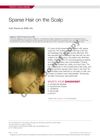
This case study describes a young girl with sparse, brittle scalp hair and multiple keratotic papules, but no systemic or familial abnormalities were found.
 September 2021 in “Research Square (Research Square)”
 This study reports that despite rescuing neurulation and skin barrier defects, Grhl3 gene overexpression in mice leads to hearing impairment, hair loss, and other developmental abnormalities, highlighting low tolerance for Grhl3 dysregulation.
10 citations
,
November 1946 in “Journal of the American Medical Association” This study reported that severe hair disturbances in infants and young children are associated with acute vitamin deficiencies in tropical America, unlike the milder cases observed in the United States.
 21 citations
,
February 2009 in “Journal of the American Academy of Dermatology”
21 citations
,
February 2009 in “Journal of the American Academy of Dermatology” This study presents three cases where tinea capitis in children mimicked cicatricial alopecia and explores host and fungal factors that may influence the disease's presentation and treatment.
5 citations
,
June 1993 in “Pediatric dermatology” Monilethrix Syndrome causes fragile, beaded hair that breaks easily and needs early diagnosis for better care.
13 citations
,
December 2012 in “Medical mycology case reports” In this case report, an atypical form of tinea favosa in an 11-year-old girl was initially misdiagnosed, highlighting the importance of mycological examination for accurate diagnosis, especially when diffuse scalp scaling is present.
2 citations
,
January 2024 in “Revista Paulista de Pediatria” In this case report, researchers described a 6-year-old girl with severe mandibuloacral dysplasia type A, noting unique physical deformities and a rare homozygous LMNA gene mutation not commonly associated with the condition.
 2 citations
,
January 2002 in “Dermatology + psychosomatics”
2 citations
,
January 2002 in “Dermatology + psychosomatics” This case study reports that a 15-year-old girl with epilepsy experienced reversible hair loss linked to topiramate adjunctive therapy.
 19 citations
,
December 2015 in “European Journal of Human Genetics”
19 citations
,
December 2015 in “European Journal of Human Genetics” This study found that a novel rare variant in ITGB6 may cause intellectual disability, alopecia, and dentogingival anomalies in a specific Pakistani family, highlighting a potential role for ITGB6 beyond enamel formation.
5 citations
,
August 1925 in “Archives of dermatology” This article presents a case of an 8-year-old boy with Recklinghausen's disease showing features such as café-au-lait spots, alopecia, and developmental anomalies, but reports no new findings beyond observation.
11 citations
,
November 2019 in “The FASEB Journal” In this study, a missense mutation in the MAP2 gene was found to be associated with reduced hair follicle density, leading to the hairless phenotype in pigs.
June 2011 in “European Journal of Pediatric Dermatology” This study diagnosed an 11-year-old girl with initial androgenetic alopecia and monilethrix after observing unique hair shaft abnormalities and skin conditions, unlike her affected parents.
November 2021 in “CRC Press eBooks” This article reviews the clinical challenges in diagnosing tinea capitis due to its varying symptoms and reports no new clinical findings, emphasizing the need for careful differential diagnosis.
24 citations
,
August 2007 in “Journal of pediatric surgery” This report of two pediatric cases suggests that careful diagnosis of scalp lesions as possible dermatophytic infections is crucial to avoid inappropriate surgical treatment and facilitate proper conservative management.
 4 citations
,
January 2018 in “International Journal of Trichology”
4 citations
,
January 2018 in “International Journal of Trichology” This case report describes a 4-year-old girl with hypotrichosis and juvenile macular dystrophy, linked to mutations in the cadherin 3 gene affecting P-cadherin expression.
 1 citations
,
August 2007 in “Indian Journal of Pediatrics”
1 citations
,
August 2007 in “Indian Journal of Pediatrics” This case report describes a 13-year-old girl with atypical symptoms leading to a delayed diagnosis of HIV infection with fatal disseminated cryptococcosis.
4 citations
,
January 2022 in “Actas Dermo-Sifiliográficas” This study reports an increase in tinea capitis cases in Spain caused by anthropophilic dermatophytes, associated with immigration from Africa, and highlights potential public health concerns due to easier transmission.
13 citations
,
March 2011 in “Acta Paediatrica” This case report describes a 5-year-old girl who developed kerion celsi from an untreated scalp infection, likely contracted from a guinea pig, leading to significant hair loss and the need for a wig.
1 citations
,
July 2007 in “Journal of Investigative Dermatology” The mutation causes hairless mice due to mislocalized and dysfunctional HR protein.
May 2017 in “Journal of the American Academy of Dermatology” Monilethrix is a rare, inherited condition causing fragile hair and hair loss, with no cure but some treatments may help.
 August 2023 in “Acta Scientific Paediatrics”
 This case study reported a neonate of Indian descent with localized hypotrichosis type 1 due to a likely pathogenic deletion in the DSG4 gene, marking the first such case from India.
3 citations
,
January 2020 in “International journal of trichology” This study reports that congenital triangular alopecia, which can be misdiagnosed as other conditions, lacks effective treatment and generally requires no therapeutic intervention.
13 citations
,
February 2002 in “Archives of dermatology” This abstract contains no research findings; it describes website service information and options for accessing content from JAMA Dermatology.
12 citations
,
September 2011 in “BMJ Case Reports” This case report describes a 2-month-old male with biotinidase deficiency whose seizures and skin symptoms improved dramatically with oral biotin supplementation.