This study suggests that Arabs with systemic lupus erythematosus in Dubai show similar clinical features to patients from other Arab and Western countries, with a notable prevalence of positive anti-Ro antibodies.
January 2005 in “Chinese Journal of Integrated Traditional and Western Nephrology” This study found that systemic lupus erythematosus in aging patients often presents with atypical clinical manifestations, leading to more frequent misdiagnosis, yet these patients may respond better to treatment.
 August 2001 in “Veterinary Dermatology”
 This article reviews topics from the American Academy of Veterinary Dermatology and American College of Veterinary Dermatology Annual Meeting and contains no new clinical findings.
September 2022 in “Medical Mycology” This study found that patients with androgenic alopecia exhibited higher levels of Malassezia colonization and altered sebum composition compared to individuals without AGA.
September 2022 in “Medical Mycology” This study suggests that the presence of Malassezia hyphae may contribute to the development of androgenetic alopecia, as treatment with antifungal agents reduced fungal load and halted hair loss.
April 2022 in “Microbiology and Immunology” This study suggests that a specific short sequence repeat in Malassezia restricta may be linked to increased colonization and the development or exacerbation of androgenetic alopecia.
146 citations
,
September 2013 in “Advances in nutrition” This review examines nutritional deficiencies after bariatric surgery, particularly in essential minerals like zinc and copper, and highlights the need for more research to improve post-surgery nutritional outcomes.
22 citations
,
February 2004 in “Journal of pediatric gastroenterology and nutrition” This study found that nutritional deficiencies and gastrointestinal abnormalities are uncommon in children with ichthyosis and growth failure, suggesting chronic hypovolemia may be more prevalent in this group.
 1 citations
,
June 2019 in “Current developments in nutrition”
1 citations
,
June 2019 in “Current developments in nutrition” This case study reports that pancreatic enzyme replacement and fatty acid supplementation improved symptoms of fat malabsorption and essential fatty acid deficiency in a patient with EDS-4.
 1 citations
,
June 2017 in “Skin”
1 citations
,
June 2017 in “Skin” This study is the first to report that apremilast may be effective in treating refractory lichen planopilaris and frontal fibrosing alopecia, though some patients experienced adverse effects leading to discontinuation.
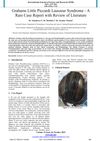 October 2023 in “International Journal of Science and Research (IJSR)”
 This paper describes Grahams Little Piccardi Lassueur Syndrome, a rare type of Lichen Planopilaris that causes different types of alopecia and distinctive skin papules, primarily affecting females aged 40 to 70, and notes the current challenges in treatment options, particularly once scarring occurs.
January 2000 in “대한피부과학회지” This study reviewed 45 cases of zinc deficiency manifesting as skin symptoms related to acrodermatitis enteropathica, emphasizing the need for zinc supplementation in chronic malabsorption conditions.
 June 1997 in “Australasian Journal of Dermatology”
 This article discusses hair and nail research contributions in dermatology but reports no new clinical findings.
 February 2006 in “Journal of The American Academy of Dermatology”
 This study found that Malassezia globosa, a scalp-associated fungus linked to dandruff, grows with saturated but not unsaturated fatty acids, potentially causing unsaturated fatty acid accumulation on the scalp and triggering dandruff-like flaking in susceptible individuals.
 January 1999 in “Current Problems in Pediatrics”
 Swimming in Lake Malawi can lead to schistosomiasis, hepatitis B vaccine might cause temporary hair loss, and certain drinks affect kidney stone risk.
 89 citations
,
May 1999 in “Allergy”
89 citations
,
May 1999 in “Allergy” This article reviews the role of Pityrosporum (Malassezia) in skin conditions such as pityriasis versicolor, seborrheic dermatitis, and atopic dermatitis, and discusses treatment approaches; it reports no new clinical results.
 January 2023 in “International Journal for Research in Applied Science and Engineering Technology”
 This review discusses the mechanism of "Malassezia" dandruff and the potential benefits of herbal treatments, focusing on phytoconstituents with anti-inflammatory, antibacterial, and antifungal properties, but reports no new experimental results.
 39 citations
,
January 2019 in “Journal of Dermatological Treatment”
39 citations
,
January 2019 in “Journal of Dermatological Treatment” This review found topical ketoconazole to be highly effective against Malassezia-related skin conditions, though other treatments may outperform it for Tinea and Candida infections.
1 citations
,
October 2016 in “The American Journal of Gastroenterology” This case report highlights that celiac disease may cause levothyroxine malabsorption in patients with Hashimoto's thyroiditis, and a gluten-free diet can lead to improvement in thyroid hormone absorption.
 May 2026 in “Journal of Asia Pacific Aesthetic Sciences”
 This case report highlights significant hair regrowth in a Malaysian woman with localized alopecia areata after intralesional triamcinolone acetonide treatment at a concentration of 5 mg/mL.
 October 2021 in “Journal of pharmaceutical research international”
 This study is set to evaluate the effectiveness of yoga (Malasana) on reducing anxiety and depression in women with polycystic ovarian disease, but it reports no new results yet.
7 citations
,
October 2020 in “Science and Innovations in Medicine” This review discusses how fibroblast metabolic processes and life span are influenced by the malate dehydrogenase shuttle system and highlights factors affecting fibroblast proliferative activity, without presenting new experimental results.
April 2026 in “Zenodo (CERN European Organization for Nuclear Research)” This single observational study reported that a combination of a morning Detox Drink regimen and Malasana yoga practice improved symptoms of chronic constipation in a 37-year-old woman over seven days.
 14 citations
,
January 2020 in “Korean Journal of Family Medicine”
14 citations
,
January 2020 in “Korean Journal of Family Medicine” This case study reported a rare occurrence of lepromatous leprosy with Lucio phenomenon in a 50-year-old Indonesian living in Malaysia, highlighting the necessity for primary care practitioners, even in non-endemic areas, to recognize this serious leprosy reaction to prevent complications and transmission.
 1 citations
,
March 2024 in “Psychiatry Neurology and Medical Psychology”
1 citations
,
March 2024 in “Psychiatry Neurology and Medical Psychology” This study examined the mental health of women with diffuse alopecia and found varied levels of mental maladjustment, with more patients with mixed alopecia showing adjustment disorders compared to those with metabolic alopecia. These findings could inform personalized treatment strategies for this condition.
June 2026 in “Psychiatry Neurology and Medical Psychology” In this study, researchers found that women with mixed-genesis alopecia exhibited more significant psychological maladaptation and disturbances in self-attitude than those with metabolic alopecia, suggesting the importance of tailored psychotherapeutic approaches to improve their psychological adaptation and quality of life.
April 2026 in “Zenodo (CERN European Organization for Nuclear Research)” In this case study, a daily morning Detox Drink combined with Malasana improved bowel frequency, stool consistency, and other constipation-related symptoms in a 37-year-old woman with chronic Malabaddha.
February 2026 in “International Journal of Clinical Dermatology” In this retrospective study, researchers observed that alopecia areata manifests in various forms among Malagasy children and presents challenges in treatment, with mixed regrowth results following corticosteroid therapy and methotrexate.
September 2022 in “Indian Journal of Paediatric Dermatology” This case report documents the first confirmed mutation-proved instance of Clouston syndrome in a large Chinese-Malaysian family, linked to the c.263C>T (A88V) mutation in the GJB6 gene, with no available treatment but highlighting the importance of genetic counseling.
January 2016 in “MRIMS Journal of Health Sciences” This study found that cultural hair care practices, such as frequent head baths and the use of Hibiscus leaf powder, may help prevent hair loss in Malayalam girls compared to Andhra girls.