241 citations
,
March 2000 in “The Journal of Urology” This review discusses the concept of andropause, preferring the term "androgen decline in the aging male" (ADAM), and emphasizes the need for urologists to recognize its manifestations and manage its treatment, but reports no new clinical results.
1 citations
,
September 2017 in “BMJ” The man has a disease causing skin patches, thickened nerves, and mild muscle weakness.
5 citations
,
April 2020 in “Journal of Mind and Medical Sciences” This review discusses underactive bladder, highlighting its poorly understood nature, diagnostic challenges, and limited treatment effectiveness, and reports no new clinical results.
 May 2023 in “The journal of investigative dermatology/Journal of investigative dermatology”
 In this study, researchers found that the expression of SLC1A6, a gene linked to calcium gradient and keratinocyte differentiation in the skin, significantly decreases with age, which may contribute to reduced skin barrier function in elderly individuals.
 5 citations
,
January 1998 in “Clinical and experimental dermatology”
5 citations
,
January 1998 in “Clinical and experimental dermatology” This article discusses the late presentation of myotonic dystrophy but reports no new clinical findings.
 January 2024 in “Wiadomości Lekarskie”
 This presentation explores burnout and compassion fatigue among healthcare professionals, detailing their causes, symptoms, and consequences, and emphasizes strategies for prevention and management, such as mindfulness and organizational support, to improve both provider and patient outcomes.
June 2025 in “Annals of the Rheumatic Diseases” This study reported that "brain fog" was experienced by 41.7% of systemic lupus erythematosus patients, identified as one of their most concerning and least addressed symptoms in treatment plans, underscoring a need for better symptom management.
 3 citations
,
April 2023 in “Clinical and Experimental Medicine”
3 citations
,
April 2023 in “Clinical and Experimental Medicine” This study classified long COVID patients into five symptom clusters and found that clusters 2 and 3 were associated with higher rates of autonomic dysfunction and work absences, respectively.
4 citations
,
January 2025 in “Clinical Nutrition” This study found that irregular breakfasts and late-night snacking were associated with a higher risk of metabolic dysfunction-associated steatotic liver disease and increased alcohol intake-related liver disease.
2 citations
,
July 2025 in “Journal of Ovarian Research” This study found that among women with PCOS, a bedtime after midnight was independently linked to higher androgen levels and decreased lean muscle mass.
September 2023 in “Journal of the American Academy of Dermatology” Guselkumab effectively reduces fatigue in Psoriatic Arthritis patients over two years.
 December 2024 in “Livers”
 This case report highlights a female patient with familial partial lipodystrophy who showed significant improvement in liver stiffness after starting leptin replacement therapy.
 4 citations
,
February 2022 in “International Journal of Molecular Sciences”
4 citations
,
February 2022 in “International Journal of Molecular Sciences” This review discusses the similarities between myotonic dystrophy and aging, highlighting the role of cellular senescence in its pathophysiology, and reports no new clinical findings; the authors note potential anti-aging therapy applications.
227 citations
,
November 2004 in “Medicine” This study found that late-onset systemic lupus erythematosus in a French cohort was characterized by a lower disease severity but reduced survival mainly attributed to aging-related factors.
 1 citations
,
May 2006 in “Thyroid Research and Practice”
1 citations
,
May 2006 in “Thyroid Research and Practice” In this study, 56% of patients with hypothyroidism had dry, coarse skin, while weight gain and lethargy were also common complaints.
 October 2015 in “Elsevier eBooks”
 Pramipexole can cause side effects like dizziness, sleepiness, hallucinations, and low blood pressure, and it's important to educate patients and keep doses low.
1 citations
,
January 2023 in “OALib” In this study, fatigue, loss of taste and smell, and cough were identified as the most common persistent symptoms of post-COVID syndrome among participants in Benghazi, with age and gender being predictors.
 2 citations
,
August 2016 in “kufa journal for nursing sciences”
2 citations
,
August 2016 in “kufa journal for nursing sciences” This study assessed nutritional status in residents of geriatric homes in Al-Furat Al-Awusat, finding that the majority were overweight and lacked routine vitamin and mineral intake.
 January 2013 in “Journal of dermatology”
 This letter to the editor raises the possibility of a new medical entity characterized by symptoms such as poikiloderma, hyperpigmentation, alopecia, malformed bones, lymphedema, and decreased cortisol, but provides no clinical results.
 1 citations
,
September 2021 in “Physiology News”
1 citations
,
September 2021 in “Physiology News” The abstract did not include specific study details, results, or conclusions; therefore, it remains unclear what this research aimed to investigate or reported.
1 citations
,
January 2021 36 citations
,
July 1996 in “The journal of investigative dermatology/Journal of investigative dermatology” This research reports a new autosomal recessive mutation in mice, 'lanceolate hair', causing generalized alopecia and hair shaft abnormalities, which may serve as a model for Netherton's syndrome in humans.
 4 citations
,
May 2021 in “medRxiv (Cold Spring Harbor Laboratory)”
4 citations
,
May 2021 in “medRxiv (Cold Spring Harbor Laboratory)” This review found that common post-acute COVID-19 symptoms include fatigue, dyspnea, insomnia, and anxiety, indicating they can persist beyond 60 days after initial infection.
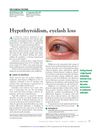 3 citations
,
November 2020 in “Cleveland Clinic Journal of Medicine”
3 citations
,
November 2020 in “Cleveland Clinic Journal of Medicine” Eyelash loss can be a sign of thyroid problems.
 19 citations
,
September 2017 in “The Journal of urology/The journal of urology”
19 citations
,
September 2017 in “The Journal of urology/The journal of urology” In this study, the researchers found that worse sleep scores were associated with progression of lower urinary tract symptoms and suggestively linked to their development in asymptomatic men.
 20 citations
,
January 2005 in “Australasian Journal of Dermatology”
20 citations
,
January 2005 in “Australasian Journal of Dermatology” This article describes a case of late-onset focal dermal elastosis in a 73-year-old woman, characterized by flat pale yellow lesions and increased normal elastic fibers, distinct from pseudoxanthoma elasticum.
1 citations
,
December 2025 in “Diagnostics” This case study reported a rare occurrence of cicatricial alopecia linked to zolpidem-induced sleep-related amnestic behavior, highlighting the importance of a comprehensive medication history for accurate diagnosis.
1 citations
,
January 2014 in “Assiut Veterinary Medical Journal/Maǧallaẗ Asyūṭ al-ṭibiyyaẗ al-baytariyyaẗ” This study in Aswan governorate reported that emaciated cattle showed decreased blood cell counts and serum minerals, as well as elevated liver enzymes, possibly associated with parasitic infections.
This article responds to "The Assessment and Treatment of Geezers" by highlighting that some individuals protest against perceived self-importance and verbosity despite fitting the geezer definition.