 November 2023 in “The journal of investigative dermatology/Journal of investigative dermatology”
 In this study, mice lacking the Mcpip1 gene in their myeloid cells did not develop SCC-like tumors but instead showed increased melanocyte activity and hair loss, indicating a distinct role for myeloid Mcpip1 in skin cancer development compared to keratinocyte Mcpip1.
 April 2023 in “Journal of Investigative Dermatology”
 The study identified increased IL-24 expression in keratinocytes and fibroblasts exposed to particulate matter, contributing to skin aging by promoting conditions similar to age-related changes such as increased MMP1 expression and decreased type I collagen production.
 8 citations
,
June 2012 in “PloS one”
8 citations
,
June 2012 in “PloS one” This study found that the Plcd3(mNab) mutation in mice worsens the alopecia caused by Plcd1 loss, suggesting synergistic effects between Plcd1 and Plcd3 on hair follicle health.
 5 citations
,
May 2023 in “European Journal of Human Genetics”
5 citations
,
May 2023 in “European Journal of Human Genetics” This study found that mutations in the TULP3 gene are associated with progressive degeneration of the liver, kidney, and heart in adults, highlighting the importance of early detection and management.
 22 citations
,
January 2018 in “Experimental Dermatology”
22 citations
,
January 2018 in “Experimental Dermatology” This article reviews insights into the pathogenesis of primary cicatricial alopecias, such as lichen planopilaris, provided by emerging technologies, but it does not report new clinical results.
 October 2025 in “Italian Journal of Dermatology and Venereology”
 This study reported that lichen planopilaris predominantly affects females over 60, with a registered prevalence rate of 0.02581%, and is often associated with autoimmune diseases like systemic lupus erythematosus, suggesting a need for further research to enhance treatment approaches.
5 citations
,
August 2001 in “International Journal of Dermatology” This case study reports a 20-year-old laborer's progressive hair loss with scalp and body lesions, diagnosed as lichen planopilaris, leading to scarring alopecia resembling male-pattern baldness.
January 2024 in “Journal of Scleroderma and Related Disorders” This study concluded that autologous platelet-rich plasma is a safe and effective technique for improving aesthetic concerns such as contour defects, pigmentation issues, and indurated lesions.
 45 citations
,
June 2004 in “Lasers in Medical Science”
45 citations
,
June 2004 in “Lasers in Medical Science” This study found that non-coherent intense pulsed light (IPL) treatment significantly reduced hair growth by about 80% in patients with skin type III-V without causing side effects.
April 2025 in “Dermatologic Surgery” This article reports no new research findings and corrects the affiliation for Dr. Shao-Wen Li in a previous publication.
 155 citations
,
June 2009 in “International Journal of Dermatology”
155 citations
,
June 2009 in “International Journal of Dermatology” This extensive review discusses the clinical manifestations, potential associations, and treatment approaches for lichen planus, but reports no new clinical results, highlighting gaps in evidence for therapeutic strategies.
 11 citations
,
March 2013 in “Gene”
11 citations
,
March 2013 in “Gene” This study reported that the IL1A 4-bp indel polymorphism is associated with a reduced risk of alopecia areata in Chinese populations, possibly through miR-122 mediated regulation of IL-1α expression.
3 citations
,
December 2024 in “Pediatric Dermatology” This review discusses the clinical and histopathologic features of pediatric lichen planopilaris and reports therapeutic responses to various treatments; the condition should be considered in cases of patchy hair loss in children.
January 2026 in “Nutrición Hospitalaria” In this study, researchers identified significant signals indicating previously unrecognized risks of lipid metabolism abnormalities for several drugs, urging the need for better monitoring and label updates.
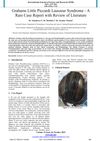 October 2023 in “International Journal of Science and Research (IJSR)”
 This paper describes Grahams Little Piccardi Lassueur Syndrome, a rare type of Lichen Planopilaris that causes different types of alopecia and distinctive skin papules, primarily affecting females aged 40 to 70, and notes the current challenges in treatment options, particularly once scarring occurs.
54 citations
,
November 2014 in “JEADV. Journal of the European Academy of Dermatology and Venereology/Journal of the European Academy of Dermatology and Venereology” This study found that combining low-fluence Q-switched Nd: YAG laser and intense pulsed light led to faster and more effective melasma treatment compared to using the laser alone, though recurrence still occurred.
 June 2026 in “Lasers in Medical Science”
 This randomized trial found that diode laser achieved more favorable long-term hair removal outcomes but induced more discomfort and transient adverse effects compared to intense pulsed light in women with Fitzpatrick skin types I-IV.
July 2004 in “Journal of Clinical Oncology” This study found therapeutic isolated limb perfusion with melphalan to be effective for in-transit melanoma metastases on a limb, with a high response rate and transient systemic toxicity.
 January 2026 in “DOAJ (DOAJ: Directory of Open Access Journals)”
 This study evaluated 129 patients with androgenetic alopecia and identified an inflammatory pattern of perifollicular infiltration linked to treatment resistance. Targeting both hormonal and immune pathways improved outcomes for 67% of patients, suggesting inflammation may play a role in some cases of stubborn hair loss.
 April 2023 in “IP Indian journal of clinical and experimental dermatology”
 This article reviews the pathogenesis, complications, and management of lichen planus, especially its persistent oral form, and highlights the need for further prospective studies.
 January 2005 in “Elektronische Hochschulschriften der LMU München (Ludwig-Maximilians-Universität München)”
 This study found that a significant portion of alopecia areata patients achieved at least partial hair regrowth with diphenylcyclopropenon therapy, which was more effective in certain subtypes and disease durations.
 April 2017 in “Australasian Journal of Dermatology”
 This study observed that systemic acitretin improved symptoms in 75% of lichen planopilaris patients, despite varied responses and a dominant female prevalence.
 9 citations
,
May 2012 in “PLOS ONE”
9 citations
,
May 2012 in “PLOS ONE” This study found that integrin-linked kinase is crucial for various epidermal functions, including differentiation and barrier formation, and also plays a previously unreported role in melanocyte development and function.
 July 2014 in “Plastic and Reconstructive Surgery”
 Sentinel lymph node biopsy is recommended for all types of desmoplastic melanoma due to higher rates of nodal metastasis.
 July 2014 in “Plastic and Reconstructive Surgery”
 Sentinel lymph node biopsy is recommended for all types of desmoplastic melanoma due to higher rates of nodal metastasis.
 11 citations
,
April 2020 in “Journal of The American Academy of Dermatology”
11 citations
,
April 2020 in “Journal of The American Academy of Dermatology” This commentary reviews the evidence for microinflammation's role in pattern hair loss and suggests that further studies with age- and sex-matched controls are needed to substantiate the findings.
July 2026 in “Journal of Investigative Dermatology”  9 citations
,
July 2010 in “British Journal of Dermatology”
9 citations
,
July 2010 in “British Journal of Dermatology” This article reports on lentiginosis observed within plaques of linear atrophoderma of Moulin and discusses its potential classification as a twin-spotting phenomenon but provides no new clinical research results.
3 citations
,
August 2018 in “Medical Journal Armed Forces India/MJAFI” In this study, IPL treatment for six months significantly reduced hair growth in females with faun tail nevus linked to spinal abnormalities.
July 2024 in “Journal of Investigative Dermatology”