2 citations
,
June 2021 in “Sultan Qaboos University medical journal” This case report presents three sisters with familial frontal fibrosing alopecia, making it the 25th documented familial case, with treatment results observed in one sister.
1 citations
,
April 2023 in “Preprints.org” This study found that the guided SEFFI technique for facial volume restoration and anti-aging is minimally invasive with a low complication rate, suggesting it as a promising treatment option.
1 citations
,
June 2025 in “Journal of Clinical Medicine” This study reported that frontal fibrosing alopecia predominantly affects postmenopausal women and identified potential risk factors like frequent β-blocker use and sunscreen application, indicating the need for further research.
 5 citations
,
June 2012 in “Journal of Cosmetic and Laser Therapy”
5 citations
,
June 2012 in “Journal of Cosmetic and Laser Therapy” This study found that combining topical finasteride with IPL + RF hair removal significantly reduced unwanted facial hair in women after six months compared to placebo.
 89 citations
,
February 2002 in “Australasian journal of dermatology”
89 citations
,
February 2002 in “Australasian journal of dermatology” This case report describes the first known instance of fibrosing alopecia associated with cutaneous lichen planus, suggesting fibrosing alopecia may be a variant of lichen planopilaris.
 1 citations
,
September 2017 in “Journal of Pathology of Nepal”
1 citations
,
September 2017 in “Journal of Pathology of Nepal” This study found that direct immunofluorescence of hair is a simple and non-invasive alternative for monitoring pemphigus vulgaris, matching skin biopsy results in the cases observed.
44 citations
,
April 2012 in “BMB Reports” This study identified several DPC-specific proteins, including ITGB1, IGFBP3, and THBS1, as potential biomarkers for hair growth modulation through proteomic and network analysis.
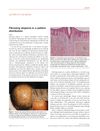 16 citations
,
February 2010 in “Journal of the European Academy of Dermatology and Venereology”
16 citations
,
February 2010 in “Journal of the European Academy of Dermatology and Venereology” This article is a letter to the editor about fibrosing alopecia in a pattern distribution and reports no new research findings.
29 citations
,
January 2020 in “Frontiers in endocrinology” This paper considers fibrodysplasia ossificans progressiva as a segmental progeroid syndrome, which may help uncover mechanisms of normal aging and suggest targets for new treatments.
19 citations
,
September 2006 in “Journal of Pediatric Gastroenterology and Nutrition” In this case study, a 12-year-old girl with severe Crohn colitis achieved impressive clinical and endoscopic remission after receiving infliximab and azathioprine as first-line treatment, suggesting potential benefits of early intensive therapy.
1 citations
,
September 2023 in “Portuguese Journal of Dermatology and Venereology” This case report describes a 50-year-old man with folliculotropic mycosis fungoides stage IB, noting trichoscopic findings like dilated follicular openings, black dots, and dystrophic hairs, which are less commonly documented in this condition, suggesting trichoscopy could aid in early diagnosis.
 July 2026 in “bioRxiv (Cold Spring Harbor Laboratory)”
 This study identified a new FAK isoform, FAKΔe4, which is regulated by ECM stiffness and affects cell migration, invasion, and mechanosensing in human-derived data and engineered models.
 40 citations
,
January 2013 in “International journal of trichology”
40 citations
,
January 2013 in “International journal of trichology” This study found that among women with frontal fibrosing alopecia, 100% showed dermoscopic elements suggestive of the condition, with perifollicular erythema often indicating disease activity.
 9 citations
,
January 2015 in “Current problems in dermatology”
9 citations
,
January 2015 in “Current problems in dermatology” This review discusses partial longitudinal-follicular unit transplantation (PL-FUT) for hair loss and notes its potential to multiply hair follicles while preserving donor areas, but reports no new clinical results.
1 citations
,
March 2012 in “Actas dermo-sifiliográficas/Actas dermo-sifiliográficas” Dermoscopy helps diagnose frontal fibrosing alopecia by identifying specific scalp features.
 November 2015 in “Hair transplant forum international”
 This article discusses the educational role of the ISHRS since its establishment in 1993, but reports no new research findings.
January 2025 in “Biochemical Pharmacology” In this study, fibroblasts treated with the small molecule peficitinib were reprogrammed into dermal papilla cell-like cells capable of inducing hair growth, offering a new strategy for hair loss treatment.
February 2025 in “Archives of Dermatological Research” This study observed that fibrosing alopecia in a pattern distribution shows varied histological features and may resemble lichen planopilaris with initial diffuse distribution, potentially leading to scarring alopecia.
11 citations
,
June 2010 in “Medical Molecular Morphology”  22 citations
,
April 1998 in “Dermatologic Clinics”
22 citations
,
April 1998 in “Dermatologic Clinics” This article reviews the therapeutic use of interferons and other cytokines in various viral, tumorous, and inflammatory diseases, discussing their biological effects and potential future applications without presenting new experimental results.
 October 2020 in “International Journal of Research in Dermatology”
 This review discusses the possible immune-mediated and environmental factors contributing to frontal fibrosing alopecia but reports no new clinical findings, emphasizing the need for standardized treatment evaluations.
 May 2024 in “International Seven Journal of Multidisciplinary”
 This review discusses fibrosing frontal alopecia, including its causes, mechanisms, and treatments, and emphasizes the need for further research to improve understanding and treatments; it reports no new clinical results.
 June 2023 in “Medical records-international medical journal”
 This study observed that IGF-1R expression significantly decreased in basal keratinocytes of sacrococcygeal pilonidal sinus tissues, suggesting a potential role in its etiology, although further data are needed to evaluate its treatment implications.
 February 2024 in “IntechOpen eBooks”
 In this study, the use of "ProFecund Ino," a myo-inositol-based treatment for women with PCOS, was associated with a 38% pregnancy rate, and when combined with reproductive techniques, it significantly increased pregnancy chances.
28 citations
,
June 1995 in “The Journal of Dermatology” This study reports that flaky skin mice exhibit skin and nail features that closely resemble human psoriasis vulgaris, suggesting they may serve as a natural model for this condition.
7 citations
,
February 2023 in “Journal of Dermatological Treatment” This study concluded that the Scalp Photographic Index is a reliable and validated tool for objectively classifying and scoring various scalp conditions.
 November 2025 in “Frontiers in Nutrition”
 This study observed that in individuals with stroke, the GNRI has a significant negative association with FI and FISI, mediated by the SII index and OBS, suggesting the importance of anti-inflammatory and antioxidant strategies to reduce FI risk.
 December 2024 in “Biological and Clinical Sciences Research Journal”
 In this study, injectable platelet-rich fibrin (I-PRF) was found to be more effective than platelet-rich plasma (PRP) at improving hair growth outcomes and patient satisfaction for androgenic alopecia.
 3 citations
,
July 2018 in “Biomedicine & pharmacotherapy”
3 citations
,
July 2018 in “Biomedicine & pharmacotherapy” This study suggests that paeoniflorin's protective effects on brain astrocytes may be mediated by TSPO and neurosteroids biosynthesis.
 7 citations
,
March 2024 in “Scientific Reports”
7 citations
,
March 2024 in “Scientific Reports” This study reports that the new neighborhood face index (NFI) demonstrates a remarkably high correlation with the physiochemical properties of benzenoid hydrocarbons, highlighting its potential as a predictive tool.