 August 2015 in “Free Radical Biology and Medicine”
 Some treatments can improve skin's defense against damage, but overuse may cause other skin problems.
 August 2015 in “Free Radical Biology and Medicine”
 This study found that Nrf2 activation protected keratinocytes from UVB damage but also caused thickening, inflammation, and cysts, limiting its therapeutic potential for skin protection.
 February 2013 in “Journal of The American Academy of Dermatology”
 A boy with a rare birthmark called verrucous hemangioma needed careful timing for surgery due to its size and depth.
September 2012 in “Turkish Journal of Dermatology” In this case report, a 17-year-old with systemic lupus erythematosus showed improvement in erythema multiforme-like lesions after treatment with methylprednisolone.
 January 2012 in “The Japanese Journal of Veterinary Dermatology”
 The dog's hair loss healed on its own without treatment.

This study observed that long-term laser hair removal in women may alter hair follicle structures and stem cell interactions, with dermal fibrosis potentially influencing hair regrowth prevention.
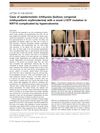 October 2011 in “Journal of dermatology”
 A man with a rare skin condition and a new gene mutation developed high calcium levels due to his treatment.
June 2008 in “The Knowledge Bank (The Ohio State University)” This study found that deleting Smad2 and Smad3 in murine skin leads to severe skin abnormalities and cancerous lesions, similar to but more severe than those seen in Smad4 mutants, indicating the critical role of TGF-β signaling in skin development.
April 2008 in “Experimental Dermatology” This article discusses the pathogenesis of hidradenitis suppurativa, highlighting follicular occlusion and inflammation as key factors in disease development, but reports no new clinical results.
January 1994 in “Toxicological Sciences” This study found that chronic high dosages of 2-(difluoromethyl)-dl-ornithine caused various toxicities in rats and dogs, with some effects potentially minimized at lower dosages.
December 1988 in “Anatomia, Histologia, Embryologia” In this study, eight healthy dogs showed hair and skin damage, including hair shaft fractures and skin irritation, after repeated application of Clairol Hair Dye Flaxen Blonde.
173 citations
,
July 2012 in “British Journal of Dermatology” This study found that the administration of the mutant BRAF inhibitor dabrafenib in patients with metastatic melanoma was associated with various skin lesions, including keratinocytic proliferation that sometimes showed low-grade malignancy features.
97 citations
,
March 2006 in “Journal of Investigative Dermatology” This study identified four novel DSG4 mutations associated with monilethrix in 12 Jewish families, suggesting a recessive inheritance pattern and broader prevalence of DSG4-related hair disorders than previously recognized.
87 citations
,
March 2017 in “Journal of Clinical Investigation” In this study, researchers identified PSENEN mutations that can lead to a form of Dowling-Degos disease, characterized by follicular hyperkeratosis and an increased susceptibility to acne inversa, especially in the presence of certain trigger factors.
82 citations
,
March 2013 in “PLoS ONE” In this study, vemurafenib was associated with a wide range of cutaneous side effects in patients with advanced melanoma, including photosensitivity and various skin and hair changes, necessitating regular dermatological management.
39 citations
,
November 2005 in “The journal of investigative dermatology/Journal of investigative dermatology” The study concluded that fatty acid transport protein 4 in epidermal keratinocytes is crucial for maintaining normal skin structure, as its deficiency led to hyperkeratosis and epidermal barrier disruption in mice.
 24 citations
,
July 1983 in “Clinical and Experimental Dermatology”
24 citations
,
July 1983 in “Clinical and Experimental Dermatology” Tigason improved hair growth in a boy with monilethrix without side effects.
11 citations
,
January 2015 in “JOURNAL OF HEALTH SCIENCE” This case report details a 12-year-old boy with Lichen Spinulosus and plantar keratoderma, who responded well to topical treatments including lactic acid, urea, and betamethasone valerate.
8 citations
,
August 2019 in “JAAD case reports” This narrative review discusses the presentation and progression of discoid lupus erythematosus in chronic cutaneous lupus erythematosus and does not report new research findings.
8 citations
,
July 2015 in “International Journal of Dermatology” This study reports that a homozygous A1103G mutation in DSG 4 is responsible for localized autosomal recessive hypotrichosis in a 2-year-old Chinese girl, resulting in reduced DSG 4 expression and hair defects.
1 citations
,
January 2022 in “Annals of Dermatology” In this case report, researchers identified a novel homozygous missense mutation in the MBTPS2 gene associated with the mild form of IFAP syndrome in a 7-year-old boy.
1 citations
,
January 2018 in “International Journal of Trichology” This report discusses the characteristics of circle hairs, a type of body hair growth disorder, and emphasizes the value of trichoscopy for diagnosis.
January 2026 in “Clinical Case Reports” This case report describes a 6-year-old girl diagnosed with the rare concurrence of monilethrix and trichorrhexis nodosa, characterized by sparse, brittle hair, who showed minimal clinical improvement with low-dose oral and topical minoxidil treatment.
 February 2023 in “Vlaams dierengeneeskundig tijdschrift”
 In this paper, regression of proliferative necrotizing otitis externa lesions in young cats was reported following systemic and topical immunomodulatory therapy.
December 2020 in “Forum Dermatologicum” In this case report, a combination treatment of intralesional triamcinolone acetonide, oral acitretin, and topical clobetasol propionate showed effectiveness in reducing symptoms of Graham-Little-Piccardi-Lasseur syndrome in one patient over two months, with no new areas of hair loss observed.
 128 citations
,
September 2011 in “British Journal of Dermatology”
128 citations
,
September 2011 in “British Journal of Dermatology” Obesity is linked to various skin problems and may increase the risk of skin cancer.
112 citations
,
January 2013 in “Experimental dermatology” This article offers a viewpoint on hidradenitis suppurativa pathogenesis, suggesting that impaired Notch signalling from γ-secretase mutations may drive inflammation and link the condition to other Th17-driven diseases.
98 citations
,
July 1968 in “Archives of Dermatology” This study found that applying scalp sebum from young men to rabbit ear canals caused follicular hyperkeratosis, suggesting sebum stimulates the formation of comedones, a key feature in acne vulgaris.
63 citations
,
April 2005 in “Mechanisms of development” This study found that heterozygous mice overexpressing Claudin-6 experienced alterations in epidermal and hair follicle differentiation, leading to distinctive coat characteristics and a disrupted epidermal permeability barrier.
 54 citations
,
January 1983 in “Archives of Dermatology”
54 citations
,
January 1983 in “Archives of Dermatology” This article presents two cases of keratosis follicularis spinulosa decalvans and reviews its features, highlighting characteristic progression from keratosis pilaris in infancy to cicatricial alopecia in childhood.