2 citations
,
January 1986 in “PubMed” This study found that spironolactone may improve acne and some ovarian functions in patients with irregular menstrual periods and androgenic symptoms, while causing few side effects.
 57 citations
,
January 1995 in “The American journal of medicine”
57 citations
,
January 1995 in “The American journal of medicine” This study discusses the use of oral contraceptives as a treatment for hyperandrogenism, showing improvement in hirsutism and acne for many women and possibly providing metabolic benefits with certain formulations.
 352 citations
,
January 2006 in “The Journal of Clinical Endocrinology and Metabolism”
352 citations
,
January 2006 in “The Journal of Clinical Endocrinology and Metabolism” This study reported that classic anovulatory PCOS was the most common androgen excess disorder, followed by mild ovulatory PCOS and idiopathic hyperandrogenism, among patients evaluated for clinical hyperandrogenism.
 1 citations
,
June 2019 in “Innovare journal of medical sciences”
1 citations
,
June 2019 in “Innovare journal of medical sciences” This review examines the use of natural remedies, including various herbs, for treating polycystic ovary syndrome, but reports no new clinical results.
 52 citations
,
June 2013 in “The Journal of Clinical Endocrinology and Metabolism”
52 citations
,
June 2013 in “The Journal of Clinical Endocrinology and Metabolism” This study defined menstrual phase-specific reference intervals for circulating androgen levels in young women, highlighting that anovulatory females showed higher androgen, LH, and FSH levels compared to ovulatory females.
 9 citations
,
March 2022 in “Frontiers in Endocrinology”
9 citations
,
March 2022 in “Frontiers in Endocrinology” This study found that PCOS is common among Iranian women, with phenotypes involving hyperandrogenism exhibiting worse lipid profiles and higher rates of metabolic syndrome compared to healthy women.
 1514 citations
,
December 2011 in “Fertility and sterility”
1514 citations
,
December 2011 in “Fertility and sterility” This consensus report reviews current knowledge and identifies knowledge gaps concerning the various health aspects of polycystic ovary syndrome, without presenting new clinical findings.
 54 citations
,
August 2017 in “Gynecological Endocrinology”
54 citations
,
August 2017 in “Gynecological Endocrinology” This review discusses treatments for polycystic ovary syndrome, including lifestyle changes, oral contraceptives, and various medications, and reports no new clinical findings; the authors highlight the potential of statins and inositol for managing symptoms.
 29 citations
,
January 2011 in “Journal of Obstetrics and Gynaecology”
29 citations
,
January 2011 in “Journal of Obstetrics and Gynaecology” This review discusses insulin resistance in women with polycystic ovary syndrome and reports no new clinical results; it highlights the potential benefits of lifestyle changes and insulin-sensitizing drugs.
 9 citations
,
January 2015 in “Springer eBooks”
9 citations
,
January 2015 in “Springer eBooks” This article reviews the diagnostic criteria and management strategies for polycystic ovary syndrome but reports no new clinical findings; it highlights associated health risks and recommended treatments.
 May 2023 in “Metabolites”
 In this study, adding α-lactalbumin to myo-inositol treatment improved ovulation rates, menstrual cycle duration, and hyperandrogenism in women with PCOS more effectively than myo-inositol alone, suggesting potential benefits for those resistant to inositol treatment.
28 citations
,
January 2017 in “Obstetrician & gynaecologist/The obstetrician & gynaecologist” This article discusses the complexities of diagnosing and managing polycystic ovary syndrome, highlighting the challenges related to fertility treatment criteria, insulin resistance, and long-term health implications, but reports no new clinical findings.
 December 2022 in “Nepal Journal of Obstetrics and Gynaecology”
 This study found that anovulatory PCOS was the most common phenotypic variant among women with menstrual irregularities seeking treatment, and no cases of obese PCOS were observed.
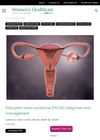 September 2022 in “Women's healthcare”
 This review discusses various aspects of polycystic ovary syndrome, including its prevalence, diagnosis, and treatment options, and reports no new empirical results.
January 2003 in “Seminars in Reproductive Medicine” This review discusses updated recommendations and recent studies on PCOS management but reports no new clinical results, questioning whether the 2018 global guideline will change practice.
 18 citations
,
December 2014 in “Obstetrics and Gynecology Clinics of North America”
18 citations
,
December 2014 in “Obstetrics and Gynecology Clinics of North America” This study suggests that weight loss can improve fertility outcomes in overweight and obese women with PCOS, and letrozole should be considered the new first-line treatment over clomiphene citrate for anovulatory infertility in this population.
 258 citations
,
July 2016 in “Reproductive Biology and Endocrinology”
258 citations
,
July 2016 in “Reproductive Biology and Endocrinology” This abstract reviews the characteristics and health risks associated with polycystic ovary syndrome and does not report new findings, highlighting the syndrome's multifactorial nature.
2 citations
,
June 2020 in “Journal of Applied Pharmaceutical Sciences and Research” This study reported an association between the rs6259 polymorphism affecting SHBG levels and PCOS in most Indian women, suggesting a potential genetic link in this population.
60 citations
,
June 1997 in “Baillière's clinical obstetrics and gynaecology” This article reviews the potential mechanisms underlying polycystic ovary syndrome, emphasizing insulin resistance and hormone dysregulation, and reports no new research findings.
 5 citations
,
October 2021 in “Meditsinskiy sovet = Medical Council”
5 citations
,
October 2021 in “Meditsinskiy sovet = Medical Council” This review discusses diagnostic criteria, phenotypes, and therapies for polycystic ovarian syndrome, emphasizing an individualized treatment approach based on the multifactorial nature of the disease; it reports no clinical results.
 April 2025 in “Journal of Neonatal Surgery”
 This review discusses the management of polycystic ovary syndrome and highlights the benefits of an integrative approach combining lifestyle, pharmacological, and herbal treatments, but reports no new research findings.
 6 citations
,
August 2023 in “Fertility and Sterility”
6 citations
,
August 2023 in “Fertility and Sterility” This review details the 2023 International Guideline update for assessing and managing polycystic ovary syndrome, which provides evidence-based recommendations to improve care and patient outcomes but notes the remaining low to moderate quality of evidence.
August 2019 in “Repozitorij Farmaceutsko-biokemijskog fakulteta (Sveučilišta u Zagrebu)” This review discusses the pathophysiological characteristics and treatment options for polycystic ovary syndrome, reporting no new clinical results; the authors emphasize combining non-pharmacological measures with pharmacological treatments for optimal patient management.
August 2019 in “Repozitorij Farmaceutsko-biokemijskog fakulteta (Sveučilišta u Zagrebu)” This review discusses the pathophysiology of polycystic ovary syndrome and its non-pharmacological and pharmacological treatment options, but reports no new clinical results.
26 citations
,
August 2008 in “Clinical endocrinology” This paper summarizes proceedings from a PCOS Special Interest Group, reporting recent advances in the understanding of PCOS follicular abnormalities, associated cardiovascular risks, and dermatological issues, but does not present new clinical findings.
 6 citations
,
April 2009 in “Fertility and Sterility”
6 citations
,
April 2009 in “Fertility and Sterility” Finasteride helps induce ovulation in nonresponder PCOS women.
 14 citations
,
January 2012 in “Endocrine development”
14 citations
,
January 2012 in “Endocrine development” This article reviews the challenges in diagnosing mild hyperandrogenism in adolescent girls, discussing potential causes like PCOS and treatment options, but reports no new clinical results.
 10 citations
,
January 2004 in “KARGER eBooks”
10 citations
,
January 2004 in “KARGER eBooks” This article reviews the differential diagnosis of mild hyperandrogenism in adolescent girls, discussing potential causes such as PCOS and nonclassic adrenal hyperplasia, but presents no new data.
 October 2023 in “ANNALS OF PAKISTAN MEDICAL & ALLIED PROFESSIONALS”
 This study found that in women with PCOS, insulin resistance is closely associated with hyperandrogenism, indicating it may independently predict increased androgen levels.
 7 citations
,
January 2025 in “Archives of Gynecology and Obstetrics”
7 citations
,
January 2025 in “Archives of Gynecology and Obstetrics” In this review, the authors aim to improve the differential diagnosis between hyperandrogenic PCOS and NCAH, which could lead to more personalized treatment strategies for patients experiencing hyperandrogenism.