 16 citations
,
May 2004 in “Hair transplant forum international”
16 citations
,
May 2004 in “Hair transplant forum international” This article describes efforts in the field of hair restoration to achieve complete results in fewer sessions, but it does not report new clinical outcomes.
1 citations
,
March 2022 in “Journal of biological chemistry/The Journal of biological chemistry” This study found that HIF-P4H-2 function in FoxD1-lineage cells is crucial for normal hair follicle development and homeostasis in mice, implicating disrupted HIF, TGF-β, and Notch signaling pathways in associated defects.
 3 citations
,
October 2021 in “Indian Journal of Plastic Surgery”
3 citations
,
October 2021 in “Indian Journal of Plastic Surgery” This review discusses the evolution of follicular unit extraction techniques for hair transplant, highlighting various devices and methods but reports no clinical results; it emphasizes advancements in tools and techniques over the years.
November 2010 in “SciVee” 5 citations
,
February 2024 in “Journal of Cosmetic Dermatology” This study found that FUE hair transplantation is effective for treating secondary scarring alopecia from burns, offering natural hair growth, quick recovery, high patient satisfaction, and few complications.
 55 citations
,
June 2007 in “Journal of Statistical Planning and Inference”
55 citations
,
June 2007 in “Journal of Statistical Planning and Inference” This study introduces an extended approach to the Bonferroni procedure that accounts for correlations among endpoints, aiming to improve test power while maintaining strong control of the family-wise type I error rate in clinical trials.
4 citations
,
March 2022 in “BioEssays” This paper reviews how studying the microbiome of the freshwater polyp Hydra can inform new, microbiome-targeting therapies for human hair follicle and skin diseases; it presents no new experimental findings.
 January 2018 in “bioRxiv (Cold Spring Harbor Laboratory)”
 This study identified a new cis-regulatory element in the mouse Hr gene that influences its expression in skin and brain cells, highlighting a complex molecular network involved in hair follicle formation.
1 citations
,
January 2020 This review outlines the evolution of hair restoration techniques, emphasizing follicular unit extraction over traditional methods due to its reduced scarring and pain, but provides no new clinical findings.
135 citations
,
December 2006 in “PLoS Medicine” This study suggests that intermediate-size hyaluronate fragments may enhance keratinocyte proliferation and improve skin thickness in atrophic conditions through a CD44-dependent mechanism.
6 citations
,
July 2009 in “Journal of Cutaneous Pathology” This review examines recent research on hair follicle stem cells, focusing on their maintenance, differentiation, and the potential for new follicle generation, but it reports no new experimental results.
 June 2024 in “Journal of Clinical Oncology”
 In this retrospective study, combining TACE with Donafenib showed promising results as a first-line treatment for Chinese patients with unresectable hepatocellular carcinoma, yielding a median progression-free survival of 12.8 months and a one-year overall survival rate of 87.5%, along with a favorable safety profile.
 4 citations
,
November 2006 in “Dermatologic Surgery”
4 citations
,
November 2006 in “Dermatologic Surgery” This study found that the survival of transplanted transected hair follicles is related to the level of transection, but their growth at the recipient site is not satisfactory, leading to a recommendation against transplanting sectioned parts.
December 2023 in “Journal of Asia Pacific Aesthetic Sciences” This study found that a novel method of isolating human follicle stem cells from hair follicles via mechanical centrifugation, without culture conditions, promises to improve hair density in patients with Androgenetic Alopecia and some cases of Alopecia Areata.
 3 citations
,
June 2005 in “Ophthalmology Clinics of North America”
3 citations
,
June 2005 in “Ophthalmology Clinics of North America” Follicular unit transplantation treats hair loss and restores eyebrows with short recovery and natural results.
 January 2021 in “Journal of Cutaneous and Aesthetic Surgery”
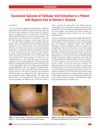
 Follicular unit extraction successfully restored hair growth in a leprosy patient without disease relapse.
1 citations
,
May 2007 in “PubMed” This case study of a subfertile couple highlighted the importance of considering haemochromatosis, particularly involving the C282Y mutation of the HFE gene, in patients with endocrine disorders linked to hypogonadism.
13 citations
,
May 2017 in “Current Protocols in Stem Cell Biology” This study outlines a method to isolate hair follicle stem cells from mouse skin using fluorescence activated cell-sorting for use in research models, but reports no experimental findings.
 April 2018 in “Journal of Investigative Dermatology”
 This study found that the absence of Hes1 in hair follicles delays secondary hair germ activation and shortens the anagen phase, impacting HFSC self-renewal and long-term hair regeneration.
 6 citations
,
May 2012 in “Archives of Dermatological Research”
6 citations
,
May 2012 in “Archives of Dermatological Research” This study reports a novel missense mutation in the HR gene in a 68-year-old Hungarian woman with alopecia universalis and limb deformities, suggesting a need for further research on its role in these conditions.
June 2026 in “Advanced Science” This study demonstrated that novel cryomicroneedles loaded with hair follicle organoids (cryoMN@HFOs) can effectively deliver and develop into functional hair follicles after intradermal transplantation in animal experiments, suggesting promising potential for human hair follicle reconstruction.
 2 citations
,
September 2002 in “Journal of Endocrinological Investigation”
2 citations
,
September 2002 in “Journal of Endocrinological Investigation” The GH-IGF-I axis is likely involved in the hormonal imbalances seen in non-obese women with functional hyperandrogenism.
 November 2024 in “BMC Surgery”
 This article notes the increasing incidence of androgenetic alopecia in males and the growing acceptance of follicular unit extraction as a treatment, but reports no new clinical results.
 2 citations
,
January 2022 in “Hair transplant forum international”
2 citations
,
January 2022 in “Hair transplant forum international” This article introduces the Follicular Unit Excision-Linear Ellipse (FUE-LE) technique, which integrates both FUE and the linear ellipse method for optimal hair restoration, but presents no new clinical results.
8 citations
,
June 2016 in “PubMed” This review discusses the use of finasteride for treating hidradenitis suppurativa and reports favorable outcomes in several cases, suggesting it could be an effective and safe option for certain patients.
10 citations
,
February 2019 in “Journal of cellular physiology” This study found that in yak hair follicles, TGF-β2 significantly contributes to the transition from growth to regression phases via inducing apoptosis, whereas HSP70 appears to inhibit follicle regression by protecting epithelial cells from apoptosis.
June 2017 in “Mechanisms of development” Hox genes control hair follicle stem cell regeneration in different body regions.
 January 2026 in “Avicenna Bulletin”
 In this study, male patients with stage III-IV androgenetic alopecia who underwent hair transplantation using a technique that considers the direction and angle of hair growth reported a 19.7% increase in satisfaction regarding the naturalness of their results.
April 2010 in “The FASEB Journal” This study found that knockout mice lacking intestinal hephaestin are smaller and anemic compared to wild-type, suggesting other mechanisms may compensate for iron absorption.
 2 citations
,
May 2018 in “PubMed”
2 citations
,
May 2018 in “PubMed” In this study, hair restoration using follicular unit extraction removed about 35% of donor area hair density, indicating a need for careful consideration of varying donor densities.