 April 2024 in “Skin health and disease”
 In this case study, a patient developed parieto-temporal pain, tissue necrosis, and alopecia after receiving a hyaluronic acid injection for temporal augmentation, which was effectively treated with hyaluronidase and aspirin.
4 citations
,
November 2024 in “Scientific Reports” This study found that bioconjugating 16-methylheptadecanoic acid to damaged human hair can mimic the protective function of the original 18-methyleicosanoic acid, effectively restoring both the hair's external structural integrity and its internal moisture balance.
 127 citations
,
June 2008 in “British Journal of Clinical Pharmacology”
127 citations
,
June 2008 in “British Journal of Clinical Pharmacology” This study supports the conclusion that the hormetic dose-response model is the most prevalent and fundamental model in biological and biomedical sciences, applicable to a wide range of clinical conditions.
 November 2023 in “Gastroenterology”
 This case study identified non-criteria antiphospholipid syndrome as a potential underlying cause of Budd-Chiari syndrome in a patient, emphasizing the need for its consideration, especially in cases with multiple thromboemboli and thrombocytopenia.
December 2025 in “Drug Testing and Analysis” This meeting underscored that hair testing is a crucial and evolving area in forensic and toxicological science, emphasizing advancements in analytical methods and its importance in public health and legal medicine.
 9 citations
,
July 2011 in “Scientific Reports”
9 citations
,
July 2011 in “Scientific Reports” This study suggests that human evolution involved accelerated changes in the HR gene, affecting its role in mediating postnatal hair cycling.
 70 citations
,
February 2012 in “Human Reproduction”
70 citations
,
February 2012 in “Human Reproduction” This study found a high prevalence of clinical signs and functional disorders of androgen excess in premenopausal women, with idiopathic hyperandrogenism and idiopathic hirsutism rates similar to PCOS.
 August 2018 in “Journal of The American Academy of Dermatology”
 Patients with multiple superficial venous thrombosis are at greater risk for serious complications like cancer and recurrent blood clots.
 October 2023 in “Dermatology practical & conceptual”
 In this study, AMD was observed more frequently in AGA patients, and a higher monocyte/HDL ratio was associated with increased AMD severity, especially in men.
January 2025 in “INTERNATIONAL JOURNAL OF CREATIVE RESEARCH THOUGHTS” This article does not present new research findings, but rather lists information about UGC-CARE approved journals and their publication standards, emphasizing qualities like peer review, cost, and impact factor.
 5 citations
,
March 2023 in “Archives of dermatological research”
5 citations
,
March 2023 in “Archives of dermatological research” This study found that hidradenitis suppurativa is associated with increased serum levels of hypoxia-inducible factor-1α, suggesting its role in the disease's pathogenesis and as a treatment target.
 January 2019 in “Annals of Dermatology”
 This study observed that in Korean HIV patients, tinea infection, folliculitis, and seborrheic dermatitis were the most common skin diseases, with HAART medications generally reducing folliculitis incidence. Skin disease prevalence differed by immune status, affecting treatment needs.
8 citations
,
March 2020 in “Colloids and surfaces. B, Biointerfaces” This study suggests that extracting hair proteins at relatively high temperatures may enhance their hemostatic properties by altering their secondary structure and increasing the precipitation of soluble fibrinogen.
 130 citations
,
August 2015 in “Experimental Dermatology”
130 citations
,
August 2015 in “Experimental Dermatology” This review provides a comprehensive guide to serum-free human hair follicle organ culture methods, highlighting research opportunities, standardization efforts, and potential applications without reporting new empirical findings.
July 2025 in “Ecotoxicology and Environmental Safety” This study found that higher levels of lead and molybdenum in hair were associated with an increased risk of dyslipidemia, while there was a significant interaction showing opposing effects of lead and cadmium on dyslipidemia risk among adults in China.
2 citations
,
July 2021 in “UNC Libraries” This study suggests that residues Val-889 and Arg-752 in the androgen receptor's steroid binding domain are crucial for NH2-/carboxyl-terminal interaction, affecting receptor stability and function.
8 citations
,
January 2024 in “Regenerative Biomaterials” This study found that a novel bioceramic/alginate hydrogel with photothermal properties and multiple ion release effectively reduces infection and inflammation, and enhances osseointegration in early-stage peri-implant lesions, potentially improving dental implant survival rates.
 1 citations
,
June 2024 in “PLoS ONE”
1 citations
,
June 2024 in “PLoS ONE” This study found that implanting hair-follicle-associated pluripotent stem cell sheets facilitated wound healing and early macrophage activity while reducing inflammation in a diabetic mouse model, suggesting clinical potential for difficult-to-heal diabetic ulcers.
 1 citations
,
February 2023 in “International journal of research - granthaalayah”
1 citations
,
February 2023 in “International journal of research - granthaalayah” This study reports that electromagnetic energy from a hydrocolloid wound dressing paste adversely affected human skin lipid droplets in vitro, but the implications, including potential cancer links, are unknown.
December 2020 in “Ambiance in Life” This study found no correlation between lipid markers and androgenetic alopecia severity, but noted a potential link between lower HDL levels and more severe alopecia in women.
 54 citations
,
June 1990 in “Journal of The American Academy of Dermatology”
54 citations
,
June 1990 in “Journal of The American Academy of Dermatology” This review discusses various skin infections and conditions that commonly occur in patients with HIV, but it does not report new research findings.
January 2025 in “Dermatologic Therapy” In this study, patients with alopecia areata were found to have higher high-sensitivity cardiac troponin T levels compared to healthy controls, indicating a potential link between the condition and cardiovascular risk.
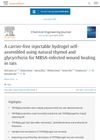 April 2024 in “Chemical engineering journal”
 In this study, a novel injectable hydrogel with antibacterial and hemostatic properties showed promise in promoting the healing of MRSA-infected skin wounds.
4 citations
,
October 2016 in “The journal of investigative dermatology/Journal of investigative dermatology” This study found that the MD-3 antibody significantly improved the survival of hair follicle allografts in nonhuman primates by reducing T-cell infiltration.
26 citations
,
March 2017 in “Aesthetic plastic surgery” Accidental injection of hyaluronic acid caused temporary hair loss and skin damage, but treatment restored hair and healed the skin.
This study found that targeting S1PR1 signaling in mouse aortic endothelial cells helps suppress inflammation-related gene expression while revealing diverse and spatially distinct endothelial cell subtypes.
September 2019 in “Encyclopedia of Life Sciences” This review presents an overview of the integrated organ systems involved in wound healing and reports no new findings; the authors emphasize the roles of blood coagulation, immune response, and cellular mechanisms in tissue repair.
June 2025 in “Advances in Clinical and Experimental Medicine” This study highlights keratin biomaterials as a promising biocompatible option for wound healing and tissue regeneration but notes that further clinical studies are necessary to confirm their effectiveness.
 April 2017 in “Journal of Investigative Dermatology”
 In this study, HPH-15, a newly synthesized compound, demonstrated potential in reducing skin fibrosis in a mouse model by targeting underlying pathogenic mechanisms and exhibited a good safety profile, warranting further clinical trials for fibrotic skin disorders like systemic sclerosis.
15 citations
,
September 2002 in “Journal of Biological Chemistry” This study observed that transgenic mice expressing keratin K10 under bovine K6beta control developed severe oral abnormalities, suggesting keratin composition changes can affect the physiology of epithelial cells, especially in the oral mucosa.