 17 citations
,
April 2004 in “Acta Clinica Belgica”
17 citations
,
April 2004 in “Acta Clinica Belgica” This study found that ultraviolet light-enhanced visualization can detect subtle skin changes linked to carotene and vitamin A deficiency, which improved with dietary correction in deficient individuals.
January 2022 in “Journal of clinical and diagnostic research” This case report describes an uncommon occurrence of trichofolliculoma in a 64-year-old male, which was easily treated through simple excision.
17 citations
,
July 1984 in “British journal of dermatology/British journal of dermatology, Supplement” This study describes a distinctive form of ichthyosis characterized by abnormal epidermal differentiation mainly within hair follicles in four patients with congenital follicular hyperkeratosis.
April 2005 in “Journal of Investigative Dermatology” This compilation reviews multiple dermatologic studies, reporting findings such as the lack of a psoriasis-susceptibility allele in cluster 17, and highlighting a mouse model for studying hair follicle formation, among others.
23 citations
,
February 2015 in “The American journal of pathology” This study found that the absence of sebaceous glands may be an early factor in the development of keratosis pilaris, leading to hair shaft and skin barrier abnormalities, independent of filaggrin mutations.
15 citations
,
July 2000 in “The journal of investigative dermatology/Journal of investigative dermatology” This study found that fluorescence excitation spectroscopy could be a promising noninvasive tool for assessing the effects of comedolytic agents like retinoids on acne-like lesions in rhino mice.
35 citations
,
April 1993 in “Clinics in dermatology” Rosacea is a common skin condition mainly causing facial redness.
June 2026 in “Journal of Clinical Microbiology” This abstract reports no new research findings; it includes an educational image of microorganisms found in a skin biopsy.
 November 2023 in “Berkala Ilmu Kesehatan Kulit dan Kelamin/Berkala ilmu kesehatan kulit dan kelamin (Periodical of dermatology and venerology)”
 This study suggests that using a dermoscope, a handheld microscope, can effectively help distinguish between Pityrosporum folliculitis and Acne vulgaris by revealing unique lesion characteristics that are not visible to the naked eye, offering a practical diagnostic alternative when KOH examinations are unavailable.
1 citations
,
January 2022 in “Clinical dermatology review” This case report describes a 26-year-old male patient with trichofolliculoma, highlighting dermoscopic features that aid its diagnosis and distinct characteristics from other similar lesions.
 2 citations
,
May 2022 in “Acta dermato-venereologica”
2 citations
,
May 2022 in “Acta dermato-venereologica” In this study, patients with frontal fibrosing alopecia showed more actinic damage than control subjects, suggesting sunscreen use by these patients may be a consequence rather than a cause of the condition.
 20 citations
,
January 2005 in “Australasian Journal of Dermatology”
20 citations
,
January 2005 in “Australasian Journal of Dermatology” This article describes a case of late-onset focal dermal elastosis in a 73-year-old woman, characterized by flat pale yellow lesions and increased normal elastic fibers, distinct from pseudoxanthoma elasticum.
30 citations
,
October 1994 in “Journal of Cutaneous Pathology” This article describes a case of multiple perifollicular fibromas and suggests that cases previously reported as such might actually be instances of Birt‐Hogg‐Dubé syndrome.
 54 citations
,
January 1983 in “Archives of Dermatology”
54 citations
,
January 1983 in “Archives of Dermatology” This article presents two cases of keratosis follicularis spinulosa decalvans and reviews its features, highlighting characteristic progression from keratosis pilaris in infancy to cicatricial alopecia in childhood.
February 2013 in “Journal of the American Academy of Dermatology”  21 citations
,
April 2019 in “Clinical, cosmetic and investigational dermatology”
21 citations
,
April 2019 in “Clinical, cosmetic and investigational dermatology” This article reviews the causes and clinical presentation of pseudofolliculitis barbae, highlighting how genetic susceptibility and hair removal practices contribute to its development, but reports no new research findings.
 July 2024 in “Iranian journal of pathology”
 This study described the clinicopathological features of patients with frontal fibrosing alopecia who underwent skin biopsies.
10 citations
,
February 2022 in “JEADV Clinical Practice” This study suggests that dermoscopy can help identify and distinguish various rosacea subtypes, improving clinical diagnosis and treatment decisions.
 October 2025 in “Pediatric Dermatology”
 In this case report, a 16-year-old boy diagnosed with lupus miliaris disseminatus faciei showed improvement in facial granulomatous lesions with scarring after treatment with doxycycline, highlighting the potential need to explore treatment options for this condition characterized by asymptomatic papules on the central face.
 7 citations
,
January 2016 in “Hair therapy & transplantation”
7 citations
,
January 2016 in “Hair therapy & transplantation” This study reported significantly lower levels of serum iron, ferritin, and calcium in young patients with premature gray hair compared to controls, implying that supplementation might prevent further graying.
 21 citations
,
October 2017 in “Journal of the European Academy of Dermatology and Venereology”
21 citations
,
October 2017 in “Journal of the European Academy of Dermatology and Venereology” This study reports that variable environmental factors, including dietary habits, may contribute to the increasing incidence and diverse clinical presentations of frontal fibrosing alopecia.
8 citations
,
January 2014 in “Indian Dermatology Online Journal” This article presents a case of trichostasis spinulosa, a common but often unrecognized disorder, diagnosed through dermoscopic examination of black macules revealing bundled vellus hairs, with the patient declining treatment.
 January 2016 in “Journal of The American Academy of Dermatology”
 This case report describes a 59-year-old woman diagnosed with frontal fibrosing alopecia, presenting with scarring alopecia and perifollicular erythematous papules.
 1 citations
,
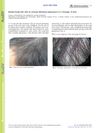
January 2018 in “Acta dermato-venereologica”
1 citations
,
January 2018 in “Acta dermato-venereologica” A teenager's hair with alternating white and dark bands, known as Pili annulati, is a genetic condition that is usually harmless and often considered attractive.
 November 2022 in “Research Square (Research Square)”
 This meta-analysis suggests a significant association between the use of facial sunscreen and moisturizer and frontal fibrosing alopecia, while finding no significant relationship with hair products or treatments.
 April 2023 in “International journal of dermatology and venereology”
 This study observed distinct dermoscopic features in pityriasis versicolor that could aid in its differentiation from similar skin disorders.
2 citations
,
February 2021 in “Developmental Cell” This study reports that aging in human skin involves early photo- and inflammation-related cellular changes, and suggests restoring KLF6 and HES1 expression might reverse some of these age-associated changes.
2 citations
,
January 2017 in “Elsevier eBooks”  9 citations
,
July 2010 in “British Journal of Dermatology”
9 citations
,
July 2010 in “British Journal of Dermatology” This article reports on lentiginosis observed within plaques of linear atrophoderma of Moulin and discusses its potential classification as a twin-spotting phenomenon but provides no new clinical research results.
2 citations
,
July 2018 in “Chinese Journal of Dermatology” This study reported that imaging characteristics of sebaceous nevus vary significantly by age group, revealing dynamic developmental changes that can be effectively identified through dermoscopy and reflectance confocal microscopy, offering noninvasive diagnostic potential.