 18 citations
,
January 2020 in “Journal of Clinical Research in Pediatric Endocrinology”
18 citations
,
January 2020 in “Journal of Clinical Research in Pediatric Endocrinology” This review discusses the pathophysiology, diagnosis, and management of functional hypothalamic amenorrhea in adolescent girls and reports no new clinical results.
 8 citations
,
October 2018 in “Journal of The American Academy of Dermatology”
8 citations
,
October 2018 in “Journal of The American Academy of Dermatology” This study evaluated treatments for frontal fibrosing alopecia and found hydroxychloroquine and 5a-reductase inhibitors to be most effective, with 70-72% of patients experiencing stabilization or improvement, but limitations in treatment consistency and assessment methods remain.
19 citations
,
February 2001 in “Journal of paediatrics and child health” This report documents a 14-year-old Chinese boy with mitochondrial encephalopathy, lactic acidosis, stroke-like episodes, and a de novo A3243G mitochondrial DNA mutation, highlighting the condition's multisystem involvement without ragged red fibers in muscle biopsy.
 14 citations
,
January 2001 in “Primary Care Update for Ob/gyns”
14 citations
,
January 2001 in “Primary Care Update for Ob/gyns” This review discusses the challenges in addressing female sexual dysfunction, focusing on the complexities of female sexual response, levels of dysfunction, clinical identification, and existing treatments, but presents no new clinical findings.
 January 2023 in “Fundamental toxicological sciences”
 In this study, mozuku-derived ultra-high-molecular-weight fucoidan was found to inhibit the growth of skin bacteria like Staphylococcus aureus but not other tested bacteria such as Cutibacterium acnes.
4 citations
,
November 2017 in “PubMed” This study found that Synsepalum dulcificum seed oil hair treatment significantly reduced hair breakage and improved hair health indices in women, outperforming both placebo and argan oil treatments.
2 citations
,
June 2018 in “International Journal of Pharmacological Research” This article reviews treatments for progeria, including aspirin, hydrotherapy, and farnesyl transferase inhibitors, but reports no new clinical results.
 1 citations
,
May 2015 in “Journal of The American Academy of Dermatology”
1 citations
,
May 2015 in “Journal of The American Academy of Dermatology” Finasteride for hair loss in young men may significantly increase the risk of sexual dysfunction.
2 citations
,
September 2021 in “Anais Brasileiros de Dermatologia” Increased sunscreen use may be linked to frontal fibrosing alopecia in Hispanic females.
 36 citations
,
November 2000 in “Journal of the American Academy of Dermatology”
36 citations
,
November 2000 in “Journal of the American Academy of Dermatology” This case study describes a unique patient with dermatomyositis who exhibited features of pityriasis rubra pilaris and porokeratosis, suggesting markers for malignancy warranting thorough investigation and monitoring.
5 citations
,
September 2020 in “Proceedings - Baylor University. Medical Center” In this case report, a 39-year-old woman's symptoms from dermatomyositis–systemic lupus erythematosus overlap syndrome improved only after she was treated with tofacitinib.
 11 citations
,
January 1993 in “Dermatology”
11 citations
,
January 1993 in “Dermatology” In this study, researchers found histopathological similarities between L-tryptophan eosinophilic myalgia syndrome and idiopathic eosinophilic fasciitis, with certain unique inflammatory features present in the former.
September 2024 in “Journal of the American Academy of Dermatology” This study found that MF patients with darker skin types show slower initial improvement with NB-UVB phototherapy, highlighting disparities in treatment efficacy that warrant further investigation.
 26 citations
,
June 2018 in “Australasian Journal of Dermatology”
26 citations
,
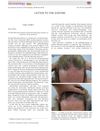
June 2018 in “Australasian Journal of Dermatology” Stopping sunscreen use on the forehead led to hair regrowth in a woman with frontal fibrosing alopecia.
2 citations
,
March 2019 in “PubMed” This case report describes successful treatment of folliculitis decalvans in a 41-year-old woman using oral fusidic acid, leading to clinical improvement and no recurrences after six months.

This article discusses the features and increasing prevalence of frontal fibrosing alopecia, a type of scarring hair loss, and reports no new clinical results.

A 72-year-old man was diagnosed with a rare skin form of Rosai-Dorfman disease after years of misdiagnosis.
May 2026 in “Cell Reports Medicine” This study develops FR-1, a topical small molecule, which reduces scarring and avoids skin atrophy in a murine wound model, showing potential for treating fibrosis without the side effects of current therapies.
 March 2025 in “Pakistan journal of physiology.”
 This hospital-based cross-sectional study found that a substantial proportion of women with female pattern hair loss also had metabolic syndrome, with no significant differences in frequency across age, disease duration, or hair loss pattern subgroups.
1 citations
,
July 2015 in “Microscopy Research and Technique” In this study, researchers found that patients with Friedreich's ataxia exhibited more pronounced ultra-structural hair alterations compared to carriers, likely due to oxidative stress related to deficient frataxin expression.
1 citations
,
March 2006 in “Journal of Cosmetic Dermatology” This case report describes a 79-year-old woman whose skin lesions were attributed to a cosmetic product, with complete resolution following mechanical removal of material and metronidazole treatment.
October 2025 in “Dermatology Practical & Conceptual” In this study, UVFD and sUVRD techniques revealed distinctive characteristics of GD lesions, suggesting that GD might be more common in younger individuals and females than previously thought, possibly due to underdiagnosis. Incorporating dermatoscopy in exams may help improve GD detection and management.
25 citations
,
May 1995 in “Journal of the American Academy of Dermatology” This article reports two new cases of erythromelanosis follicularis faciei in women and includes a literature review on this rarely diagnosed condition.
November 2025 in “Acta Dermato Venereologica” In this study, researchers reported that while systemic antibiotics are often chosen first for treating severe folliculitis decalvans, they have a high discontinuation rate, suggesting an urgent need for more effective immunomodulatory treatments.
 April 2018 in “Journal of Investigative Dermatology”
 This study found that Fgf20 signaling facilitates fibroblast migration and influences dermal condensate cell development during hair follicle morphogenesis by supporting cellular activities such as cell cycle exit and specific cell shape adoption.
1 citations
,
March 2011 in “Hospital Pharmacy” This article highlights the importance of recognizing, preventing, and reporting adverse drug reactions to the FDA's MedWatch program, but it presents no new research findings.
 15 citations
,
August 2019 in “Dermatologic Therapy”
15 citations
,
August 2019 in “Dermatologic Therapy” This letter details a case report on platelet-rich plasma treatment for a patient with treatment-resistant frontal fibrosing alopecia, but it does not provide new clinical results.
58 citations
,
April 1993 in “Developmental Biology” This study found that subcutaneous injections of basic fibroblast growth factor in neonatal mice delayed the development and hair growth cycles of hair follicles compared to controls.
 1 citations
,
June 2022 in “Chinese medical journal/Chinese Medical Journal”
1 citations
,
June 2022 in “Chinese medical journal/Chinese Medical Journal” This study identified two novel mutations in the CDH3 gene causing HJMD in a Chinese patient, expanding the genetic and phenotypic understanding of the disorder.
 24 citations
,
January 2015 in “Evidence-based Complementary and Alternative Medicine”
24 citations
,
January 2015 in “Evidence-based Complementary and Alternative Medicine” In this study, Polygonum multiflorum Radix promoted hair growth in mice, with oral administration being more effective, likely through FGF-7, while topical application favored SHH-related mechanisms.